PATH, Mumbai, India.
The Humsafar Trust, Mumbai, India.
J Int AIDS Soc. 2024 Aug;27(8):e26348. doi: 10.1002/jia2.26348.
HIV self-testing (HIVST) has been shown to increase the uptake of HIV testing and help achieve the UNAIDS 95-95-95 targets. This study assessed the acceptability, usability (ease of use and result interpretation) and the willingness to pay for HIVST kits distributed through three distribution models, namely the community-based, PLHIV network-led and private practitioners models, in India.
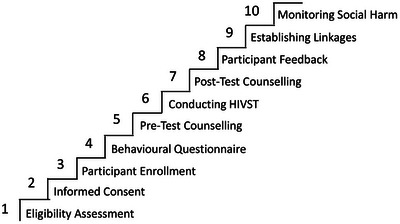
This cross-sectional study was implemented across 14 states in India between September 2021 and June 2022. All participants could choose between blood-based or oral-fluid-based test kits. Participants were shown a test-kit usage demonstration video, and pre- and post-test counselling was provided for all. Participants were followed-up after testing, and if reported reactive, were further supported for linkage to confirmatory testing and antiretroviral therapy (ART) initiation.
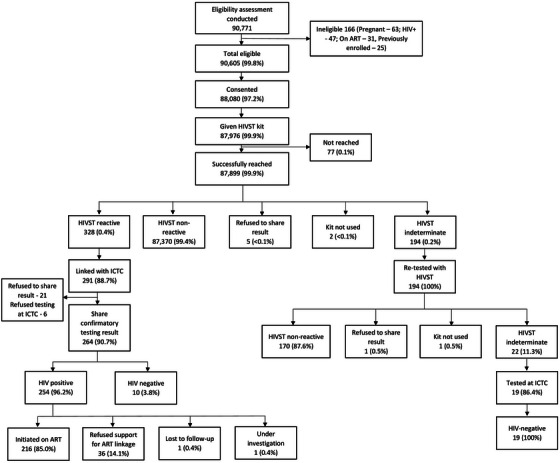
Among the 90,605 participants found eligible, 88,080 (97%) accepted an HIVST kit. Among the 87,976 who reported using an HIVST kit, 45,207 (51%) preferred a blood-based kit, and 42,120 (48%) reported testing for the first time. For future testing, 77,064 (88%) reported preferring HIVST over other HIV testing methods. Among those who used the kit, 83,308 (95%) found the kit easy to use, and 83,237 (95%) reported that the test results were easy to interpret. Among those who preferred HIVST for future use, 52,136 (69%) were willing to pay for the kit, with 35,854 (69%) of those willing to pay less than US$ 1.20. Only one instance of social harm was reported, with a participant reporting suicidal tendencies due to discord with their partner. Out of 328 participants (0.4%) who tested reactive with HIVST, 291 (89%) were linked to confirmatory testing; of these, 254 were confirmed HIV positive, and 216 (85%) successfully initiated ART.
Overall, we report that nearly all participants were willing to accept HIVST, found the test kits easy to use and interpret, and about two-thirds were willing to pay for HIVST. Given the high levels of acceptance and the ability to reach a large proportion of first-time testers, HIVST in India could contribute to achieving the UNAIDS first 95 and ending the HIV epidemic.
艾滋病毒自检(HIVST)已被证明可以增加艾滋病毒检测的采用率,并有助于实现艾滋病署 95-95-95 目标。本研究评估了在印度通过三种分发模式(社区、PLHIV 网络主导和私人从业者)分发的 HIVST 试剂盒的可接受性、可用性(易用性和结果解释)以及支付意愿。
本横断面研究于 2021 年 9 月至 2022 年 6 月在印度 14 个邦进行。所有参与者都可以选择血液或口腔液基检测试剂盒。参与者观看了一个检测试剂盒使用演示视频,并在检测前和检测后都提供了咨询。对所有参与者进行了随访,如果报告呈阳性,将进一步支持他们进行确证检测和开始抗逆转录病毒治疗(ART)。
在发现的 90605 名符合条件的参与者中,88080 名(97%)接受了 HIVST 试剂盒。在报告使用 HIVST 试剂盒的 87976 名参与者中,45207 名(51%)更喜欢血液基试剂盒,42120 名(48%)报告首次进行了检测。对于未来的检测,77064 名(88%)报告更喜欢 HIVST 而不是其他 HIV 检测方法。在使用试剂盒的参与者中,83308 名(95%)认为试剂盒易于使用,83237 名(95%)报告检测结果易于解释。在那些更喜欢未来使用 HIVST 的参与者中,52136 名(69%)愿意支付试剂盒费用,其中 35854 名(69%)愿意支付低于 1.20 美元。仅报告了一例社会危害,一名参与者因与伴侣意见不合而报告有自杀倾向。在 328 名(0.4%)HIVST 检测呈阳性的参与者中,291 名(89%)被转介进行确证检测;其中 254 人被确诊为艾滋病毒阳性,216 人(85%)成功开始接受抗逆转录病毒治疗。
总体而言,我们报告说,几乎所有参与者都愿意接受 HIVST,他们认为检测试剂盒易于使用和解释,大约三分之二的人愿意支付 HIVST 费用。鉴于接受程度高,并且能够接触到很大一部分首次检测者,HIVST 在印度可能有助于实现艾滋病署的前 95 目标和终结艾滋病疫情。