Department of Community Health and Epidemiology, University of Saskatchewan, Room 3242, Health Science Building 107 Wiggins Road, Saskatoon, SK, S7N 5E5, Canada.
BMC Health Serv Res. 2021 Aug 21;21(1):848. doi: 10.1186/s12913-021-06821-6.
In Saskatchewan, Canada, Indigenous cancer care services at the municipal, provincial, and federal levels are intended to improve quality care but can result in a complex, fragmented, and multi-jurisdictional health care system. A multi-phase needs assessment project was initiated to document Indigenous cancer care needs. Guided by Indigenous patient partners, clinicians, academics, and policy makers, the present study reflects a needs assessment of Indigenous cancer supports from the perspectives of cancer care service providers.
Qualitative data were collected through three focus groups with 20 service providers for cancer patients and their families at three Saskatchewan cities. Participants included chemotherapy and radiation nurses, social workers, a patient navigator, dieticians, and practicum students. A semi-structured interview guide was used to conduct the sessions to allow for freedom of responses. Data were recorded, transcribed verbatim, and analyzed using thematic analysis.
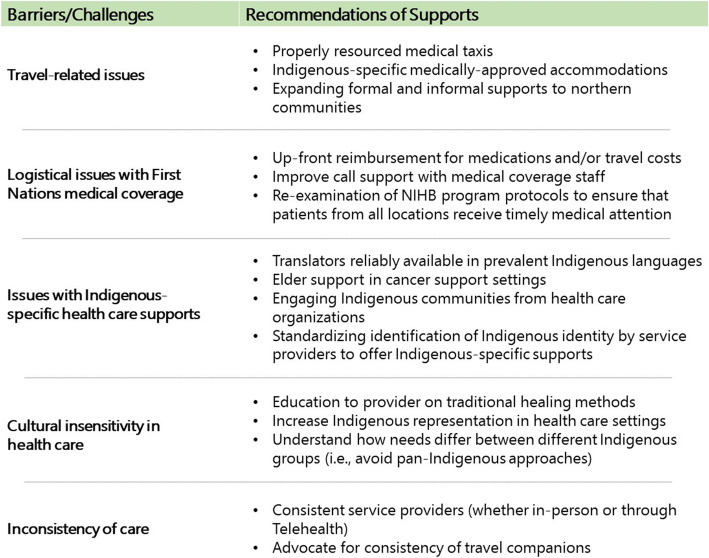
Service providers' perspectives were categorized into five themes: 1) addressing travel-related issues, 2) logistical challenges, 3) improvements to Indigenous-specific health care supports, 4) cultural sensitivity in health care, and 5) consistency in care. Supports provided differed for the two Indigenous groups, First Nations and Métis. Service providers made recommendations regarding how needs could be met. They saw language translation providers and Elder supports as important. Recommendations for improving travel were for medical taxis to include breaks so that passengers may alleviate any uncomfortable side effects of their cancer treatment. Further, Indigenous-specific accommodations were recommended for those requiring medical travel. These recommendations aligned with supports that are available in four other Canadian provinces.
These results identified gaps in supports and outlined recommendations to address barriers to cancer care from the perspectives of service providers. These recommendations may inform evidence-based health system interventions for Indigenous cancer patients and ultimately aim to improve cancer care services, quality of life, and health outcomes of Indigenous patients throughout their cancer journey.
在加拿大萨斯喀彻温省,市级、省级和联邦级的原住民癌症护理服务旨在改善优质护理,但可能导致复杂、分散和多司法管辖区的医疗保健系统。启动了一个多阶段需求评估项目来记录原住民癌症护理需求。在原住民患者伙伴、临床医生、学者和政策制定者的指导下,本研究反映了从癌症护理服务提供者的角度对原住民癌症支持的需求评估。
通过在萨斯喀彻温省三个城市的三个焦点小组,对 20 名癌症患者及其家属的服务提供者进行了定性数据收集。参与者包括化疗和放疗护士、社会工作者、患者导航员、营养师和实习学生。使用半结构化访谈指南进行会议,以允许自由回答。记录数据、逐字转录,并使用主题分析进行分析。
服务提供者的观点分为五个主题:1)解决与旅行相关的问题,2)后勤挑战,3)改善针对原住民的医疗保健支持,4)医疗保健中的文化敏感性,5)护理的一致性。为两个原住民群体,第一民族和梅蒂斯人提供了不同的支持。服务提供者就如何满足需求提出了建议。他们认为语言翻译提供者和长者支持很重要。改善旅行的建议是为医疗出租车提供休息时间,以便乘客可以缓解癌症治疗的任何不适副作用。此外,还建议为需要医疗旅行的人提供原住民专用住宿。这些建议与其他四个加拿大省份提供的支持一致。
这些结果确定了支持方面的差距,并从服务提供者的角度概述了为解决癌症护理障碍的建议。这些建议可以为原住民癌症患者提供循证卫生系统干预措施,并最终旨在改善癌症护理服务、生活质量和原住民患者的健康结果,贯穿他们的癌症之旅。