Letendre Angeline, Garvey Gail, King Alexandra, King Malcolm, Crowshoe Reg, Bill Lea, Caron Nadine R, Elias Brenda
Alberta Health Services, Edmonton, Alberta, Canada.
Menzies School of Health Research, Brisbane, Queensland, Australia.
JCO Glob Oncol. 2020 Feb;6:92-98. doi: 10.1200/JGO.19.00049.
In Canada, indigenous peoples' cancer rates have increased, but cancer screening rates tend to be lower. When coupled with poor cancer prognosis, treatment barriers, and inaccessible health care, indigenous patients with cancer experience many unmet needs. Further complicating their journey is a multijurisdictional system that complicates cancer control services, treatments, patient supports, and cancer surveillance. To address these issues, the Canadian Indigenous Research Network Against Cancer (CIRNAC) was developed. This article describes the forerunners and consultative process that created the network and the consensus model developed to ground this network with, by, and for indigenous peoples.
A consultative workshop was held to (1) establish and increase network membership, (2) enhance partnerships with indigenous communities and other researchers, and (3) develop an indigenous-led research program, new funding, and related initiatives.
Participants viewed the CIRNAC as a reflective parallel network led by indigenous peoples that would identify research priorities within Canada, assess how these priorities align with indigenous patients' cancer care and research needs, and cross-check to see if these priorities align with each other. The network would also advocate for indigenous elders/knowledge holders and community grassroot processes to drive research and training, thus demonstrating the power of the community voice and lived experience in research. In addition, the network would foster research partnerships to investigate alternative indigenous models for cancer prevention, care, treatment, and support.
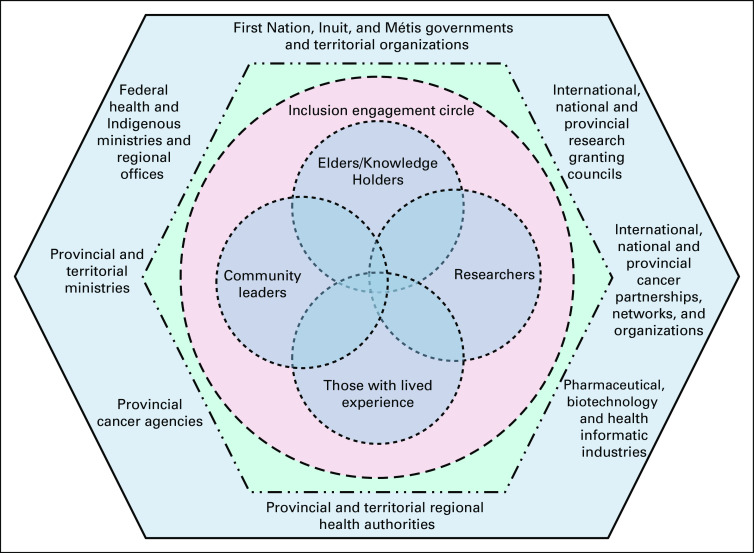
The CIRNAC evolved as a viable vehicle to address cancer with, for, and by indigenous peoples. The network is guided by a preamble, a set of aims, and an inclusion engagement circle model. It is evolving through major world initiatives, with the aim of formally becoming an internationally linked national network.
在加拿大,原住民的癌症发病率有所上升,但癌症筛查率往往较低。再加上癌症预后不佳、治疗障碍以及难以获得医疗保健服务,患有癌症的原住民患者有许多未得到满足的需求。使他们的就医过程更加复杂的是一个多辖区系统,该系统使癌症控制服务、治疗、患者支持和癌症监测变得复杂。为了解决这些问题,加拿大原住民抗癌研究网络(CIRNAC)应运而生。本文描述了创建该网络的先驱者和协商过程,以及为使该网络以原住民为基础、由原住民主导并为原住民服务而制定的共识模型。
举办了一次协商研讨会,以(1)建立并增加网络成员,(2)加强与原住民社区及其他研究人员的伙伴关系,以及(3)制定一个由原住民主导的研究计划、新的资金及相关举措。
参与者将CIRNAC视为一个由原住民主导的反思性平行网络,该网络将确定加拿大境内的研究重点,评估这些重点如何与原住民患者的癌症护理和研究需求相匹配,并进行交叉核对,以查看这些重点是否相互一致。该网络还将倡导原住民长者/知识持有者以及社区基层程序推动研究和培训,从而展示社区声音和实际经验在研究中的力量。此外,该网络将促进研究伙伴关系,以调查替代的原住民癌症预防、护理、治疗和支持模式。
CIRNAC已发展成为一个由原住民参与、为原住民服务并由原住民主导来应对癌症的可行工具。该网络以前言、一系列目标以及一个包容性参与圈模型为指导。它正在通过一些重大的全球倡议不断发展,目标是正式成为一个与国际相连的国家网络。