P Sathyamurthy, Madhavan Sudha, Pandurangan Viswanathan
Internal Medicine, Sri Ramachandra Institute of Higher Education and Research, Chennai, IND.
Cureus. 2021 Aug 15;13(8):e17189. doi: 10.7759/cureus.17189. eCollection 2021 Aug.
Introduction COVID-19 pandemic has been shown to produce high infection rates, significant morbidity and mortality among older adults. A significant proportion of people who have recovered from acute COVID-19 illness seem to suffer from post COVID-19 syndrome. Post COVID-19 syndrome is thought to be a multisystem disease involving physical, functional, mental and psychological domains. This analysis tries to estimate the prevalence, pattern and functional outcomes of post COVID-19 syndrome in hospitalized older adults. Methods A prospective cohort study was done on 279 older adults who were discharged from our centre between August 1st, 2020 and November 30th 2020. Information was collected through a telephonic interview after 90 days of discharge from the hospital using a standard questionnaire by a trained physician. Collected data were analyzed with IBM SPSS Statistics for Windows, Version 23.0 (IBM Corp., Armonk, NY). Results After 90 days of recovery, the most common symptoms prevalent in the study population were fatigue (8.9%) followed by cough (4.3%), breathlessness (1.8%), dizziness (1.4%), myalgia (1.1%), loss of smell and taste (0.8%) and chest discomfort (0.7%). The prevalence of risk of anxiety in the study population after 90 days of recovery was 7.5% while that of risk of depression was 12.2%. After 90 days of recovery, 66 (23.6%) patients reported the presence of at least one clinical feature while 9.3% had two or more clinical features. On comparing the mean activities of daily living (ADL) 5.58 (.795) and mean instrumental activities of daily living (IADL) 5.84 (1.49) before the illness and 90 days following recovery there was no statistical difference for the study population. Conclusion The prevalence of post COVID-19 syndrome in older adults is about 9.3%. The most common symptoms reported by older adults after 90 days following recovery were fatigue followed by cough and breathlessness. Most older adults retained their baseline functional status after 90 days of recovery from acute COVID-19.
新型冠状病毒肺炎(COVID-19)大流行已显示在老年人中产生高感染率、显著的发病率和死亡率。相当一部分从急性COVID-19疾病中康复的人似乎患有COVID-19后综合征。COVID-19后综合征被认为是一种涉及身体、功能、精神和心理领域的多系统疾病。本分析试图估计住院老年人中COVID-19后综合征的患病率、模式和功能结局。
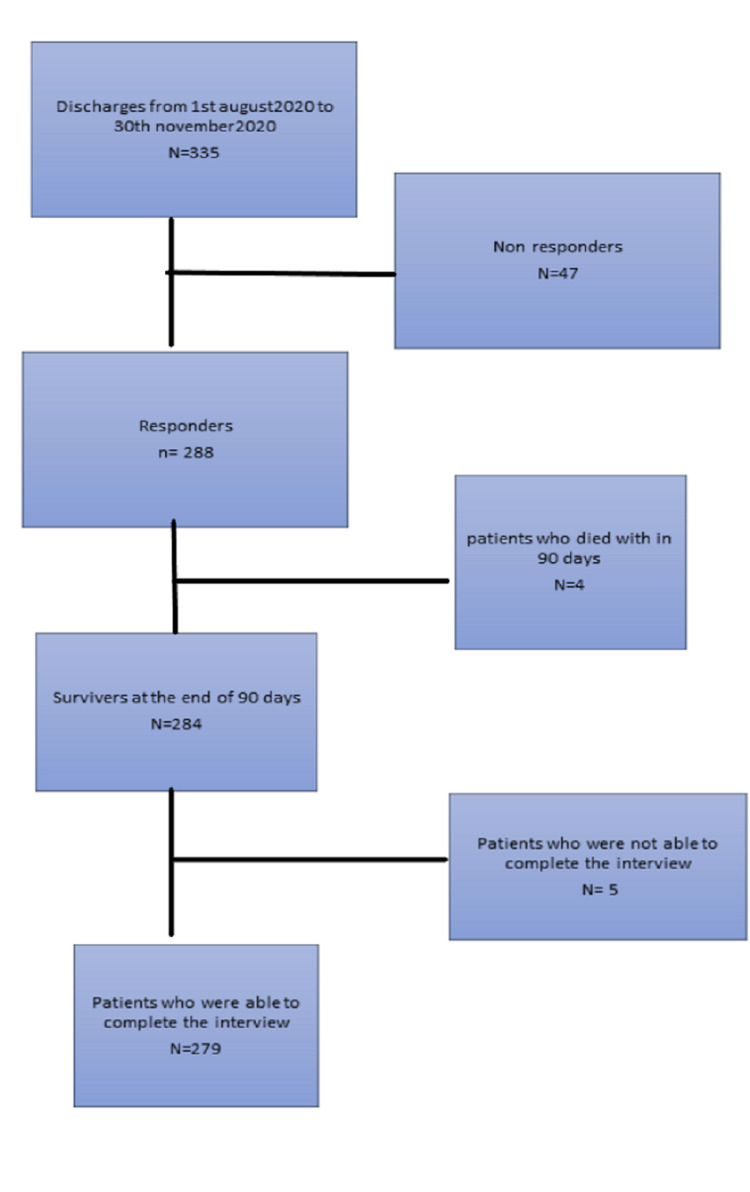
对2020年8月1日至2020年11月30日期间从我们中心出院的279名老年人进行了一项前瞻性队列研究。在出院90天后,由一名经过培训的医生使用标准问卷通过电话访谈收集信息。使用IBM SPSS Statistics for Windows,版本23.0(IBM公司,纽约州阿蒙克)对收集的数据进行分析。
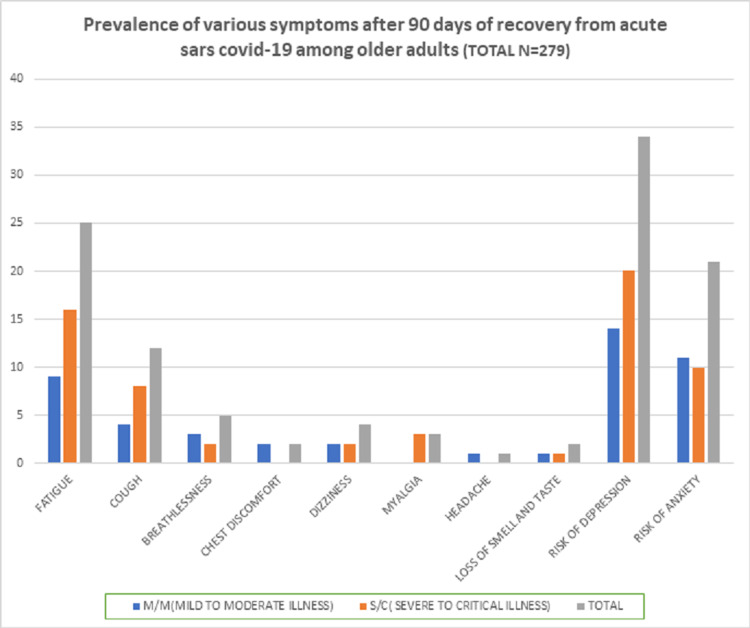
康复90天后,研究人群中最常见的症状是疲劳(8.9%),其次是咳嗽(4.3%)、呼吸急促(1.8%)、头晕(1.4%)、肌痛(1.1%)、嗅觉和味觉丧失(0.8%)以及胸部不适(0.7%)。康复90天后,研究人群中焦虑风险的患病率为7.5%,而抑郁风险的患病率为12.2%。康复90天后,66名(23.6%)患者报告至少存在一种临床特征,而9.3%的患者有两种或更多临床特征。在比较患病前和康复后90天的平均日常生活活动能力(ADL)5.58(.795)和平均工具性日常生活活动能力(IADL)5.84(1.49)时,研究人群没有统计学差异。
老年人中COVID-19后综合征的患病率约为9.3%。老年人康复90天后报告的最常见症状是疲劳,其次是咳嗽和呼吸急促。大多数老年人从急性COVID-19康复90天后保留了其基线功能状态。