Cancer Institute, Fudan University Shanghai Cancer Center, Shanghai, 200032, China.
Department of Oncology, Shanghai Medical College, Fudan University, Shanghai, 200032, China.
Stem Cell Res Ther. 2021 Aug 23;12(1):474. doi: 10.1186/s13287-021-02526-z.
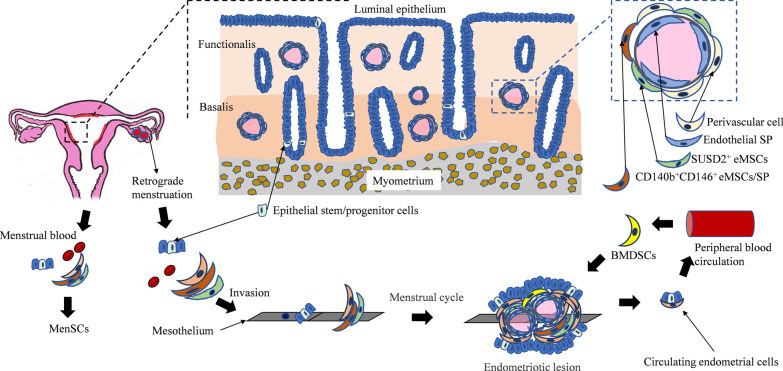
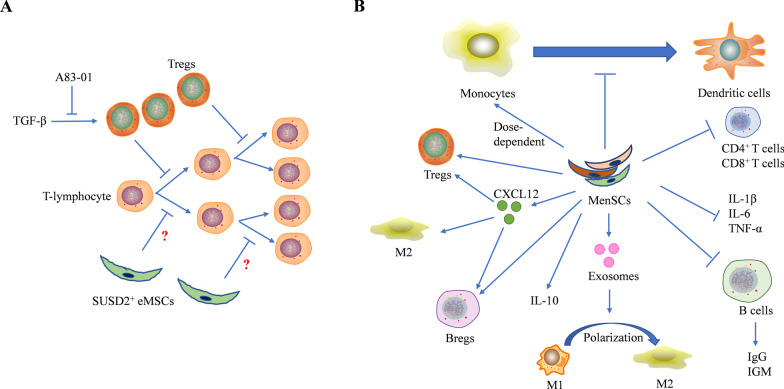
Endometrial stem/progenitor cells have been proved to exist in periodically regenerated female endometrium and can be divided into three categories: endometrial epithelial stem/progenitor cells, CD140bCD146 or SUSD2 endometrial mesenchymal stem cells (eMSCs), and side population cells (SPs). Endometrial stem/progenitor cells in the menstruation blood are defined as menstrual stem cells (MenSCs). Due to their abundant sources, excellent proliferation, and autotransplantation capabilities, MenSCs are ideal candidates for cell-based therapy in regenerative medicine, inflammation, and immune-related diseases. Endometrial stem/progenitor cells also participate in the occurrence and development of endometriosis by entering the pelvic cavity from retrograde menstruation and becoming overreactive under certain conditions to form new glands and stroma through clonal expansion. Additionally, the limited bone marrow mesenchymal stem cells (BMDSCs) in blood circulation can be recruited and infiltrated into the lesion sites, leading to the establishment of deep invasive endometriosis. On the other hand, cell derived from endometriosis may also enter the blood circulation to form circulating endometrial cells (CECs) with stem cell-like properties, and to migrate and implant into distant tissues. In this manuscript, by reviewing the available literature, we outlined the characteristics of endometrial stem/progenitor cells and summarized their roles in immunoregulation, regenerative medicine, and endometriosis, through which to provide some novel therapeutic strategies for reproductive and cancerous diseases.
子宫内膜干细胞/祖细胞已被证明存在于周期性再生的女性子宫内膜中,并可分为三类:子宫内膜上皮干细胞/祖细胞、CD140bCD146 或 SUSD2 子宫内膜间充质干细胞(eMSCs)和侧群细胞(SPs)。经血中的子宫内膜干细胞被定义为月经干细胞(MenSCs)。由于其丰富的来源、良好的增殖能力和自体移植能力,MenSCs 是再生医学、炎症和免疫相关疾病中细胞治疗的理想候选者。子宫内膜干细胞/祖细胞也通过逆行月经进入盆腔,并在某些条件下过度反应,通过克隆扩张形成新的腺体和基质,从而参与子宫内膜异位症的发生和发展。此外,循环中的有限骨髓间充质干细胞(BMDSCs)可被招募并浸润到病变部位,导致深部浸润性子宫内膜异位症的建立。另一方面,源自子宫内膜异位症的细胞也可能进入血液循环,形成具有干细胞样特性的循环子宫内膜细胞(CECs),并迁移和植入到远处组织。在本文中,我们通过回顾现有文献,概述了子宫内膜干细胞/祖细胞的特征,并总结了它们在免疫调节、再生医学和子宫内膜异位症中的作用,为生殖和癌症疾病提供了一些新的治疗策略。