Servicio de Parasitología y Enfermedad de Chagas, Hospital de Niños "Dr. Ricardo Gutiérrez", CP 1425 Gallo 1330, Buenos Aires, Argentina.
Instituto Multidisciplinario de Investigaciones en Patologías Pediátricas, Consejo Nacional de Investigaciones Científicas y Técnicas (CONICET-GCBA), Buenos Aires, Argentina.
Mol Diagn Ther. 2021 Nov;25(6):791-801. doi: 10.1007/s40291-021-00553-3. Epub 2021 Aug 23.
The real prevalence of congenital Chagas disease is undefined because of difficulties in the detection of Trypanosoma cruzi by microscopic examination. The aim of this study was to determine the diagnostic accuracy of two molecular diagnostic tools, qPCR and LAMP, in the diagnosis of congenital Chagas disease in a clinical setting.
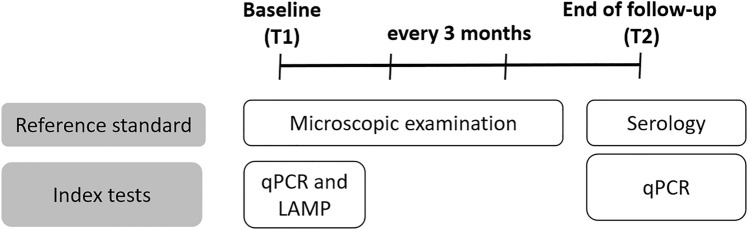
To this end, we conducted a prospective cohort study in a tertiary care center, of infants under 9 months of age, born in Buenos Aires to women with Chagas disease. Blood samples were collected for microscopic examination and molecular diagnosis at baseline. If negative, infants were followed up until 9 months of age to determine a final diagnosis by serology. In-house qPCR and LAMP previously validated were challenged as index tests.
A total of 154 participants were potentially eligible, 120 of whom were enrolled. Finally, 102 (66.2%) of them fulfilled the follow-up. The diagnosis of congenital Chagas disease was confirmed in 13 infants and excluded in 89. Both the sensitivity and specificity of the qPCR were 100.0% (95% confidence interval 75.3-100.0 and 95% confidence interval 95.9-100.0, respectively), whereas the sensitivity and specificity of LAMP were 69.2% (95% confidence interval 38.6-90.9) and 100% (95% confidence interval 95.9-100.0), respectively.
The qPCR agreed with the current diagnostic algorithm, and was a reliable and sensitive tool to detect congenital Chagas disease earlier, providing an appropriate and timely identification of infected infants requiring treatment. LAMP was able to detect congenital Chagas disease in infected infants by naked-eye visualization in accordance with a microscopic examination. The advantages of molecular diagnostic tools should be taken into account by the health system to improve congenital Chagas disease diagnosis.
由于在显微镜检查中难以检测到克氏锥虫,因此先天性克氏锥虫病的真实流行情况尚未确定。本研究的目的是确定两种分子诊断工具(qPCR 和 LAMP)在临床环境中诊断先天性克氏锥虫病的诊断准确性。
为此,我们在一家三级保健中心进行了一项前瞻性队列研究,研究对象为 9 个月以下、出生于布宜诺斯艾利斯且母亲患有克氏锥虫病的婴儿。在基线时采集血液样本进行显微镜检查和分子诊断。如果为阴性,则对婴儿进行随访,直到 9 个月大,以通过血清学确定最终诊断。经过验证的内部 qPCR 和 LAMP 被用作参考测试。
共有 154 名潜在合格的参与者,其中 120 名被纳入研究。最终,其中 102 名(66.2%)完成了随访。确诊先天性克氏锥虫病的婴儿有 13 例,排除的有 89 例。qPCR 的灵敏度和特异性均为 100.0%(95%置信区间 75.3-100.0 和 95%置信区间 95.9-100.0),而 LAMP 的灵敏度和特异性分别为 69.2%(95%置信区间 38.6-90.9)和 100.0%(95%置信区间 95.9-100.0)。
qPCR 符合当前的诊断算法,是一种可靠且敏感的工具,可更早地检测先天性克氏锥虫病,从而为需要治疗的感染婴儿提供适当和及时的识别。LAMP 通过肉眼观察即可在感染的婴儿中检测到先天性克氏锥虫病,符合显微镜检查的结果。卫生系统应考虑采用分子诊断工具的优势,以改善先天性克氏锥虫病的诊断。