Maltseva Arina L, Varfolomeeva Marina A, Ayanka Roman V, Gafarova Elizaveta R, Repkin Egor A, Pavlova Polina A, Shavarda Alexei L, Mikhailova Natalia A, Granovitch Andrei I
Department of Invertebrate Zoology St. Petersburg State University St. Petersburg Russia.
Department of Analytical Phytochemistry Komarov Botanical Institute St. Petersburg Russia.
Ecol Evol. 2021 Jul 22;11(16):11134-11154. doi: 10.1002/ece3.7901. eCollection 2021 Aug.
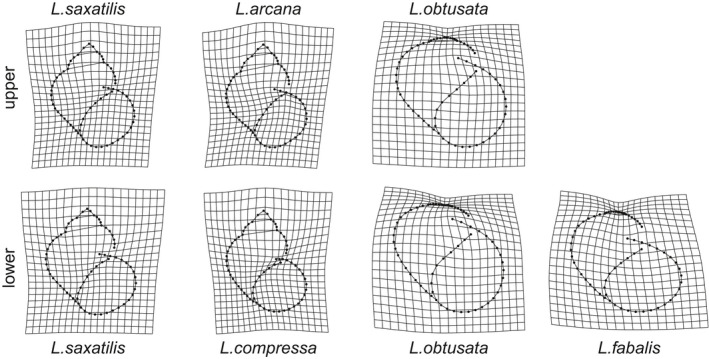
Divergence of ecological niches in phylogenetically closely related species indicates the importance of ecology in speciation, especially for sympatric species are considered. Such ecological diversification provides an advantage of alleviating interspecies competition and promotes more efficient exploitation of environmental resources, thus being a basis for ecological speciation. We analyzed a group of closely related species from the subgenus (genus , Caenogastropoda) from the gravel-bouldery shores. In two distant sites at the Barents and Norwegian Sea, we examined the patterns of snail distribution during low tide (quantitative sampling stratified by intertidal level, presence of macrophytes, macrophyte species, and position on them), shell shape and its variability (geometric morphometrics), and metabolic characteristics (metabolomic profiling). The studied species diversified microbiotopes, which imply an important role of ecological specification in the recent evolution of this group. The only exception to this trend was the species pair / , which is specifically discussed. The ecological divergence was accompanied by differences in shell shape and metabolomic characteristics. Significant differences were found between versus and / versus both in shell morphology and in metabolomes. demonstrated a clear variability depending on intertidal level which corresponds to a shift in conditions within the occupied microhabitat. Interestingly, the differences between (inhabiting the upper intertidal level) and (inhabiting the lower one) were analogous to those between the upper and lower fractions of . No significant level-dependent changes were found between the upper and lower fractions of , most probably due to habitat amelioration by fucoid macroalgae. All these results are discussed in the contexts of the role of ecology in speciation, ecological niche dynamics and conservatism, and evolutionary history of the species.
系统发育关系密切的物种间生态位的分化表明了生态在物种形成中的重要性,尤其是考虑到同域物种时。这种生态多样化提供了缓解种间竞争的优势,并促进了对环境资源更有效的利用,从而成为生态物种形成的基础。我们分析了来自砾石 - 巨石海岸的(属,新腹足目)亚属的一组关系密切的物种。在巴伦支海和挪威海的两个遥远地点,我们研究了退潮时蜗牛的分布模式(按潮间带水平、大型植物的存在、大型植物种类及其上的位置进行分层定量采样)、壳形及其变异性(几何形态计量学)和代谢特征(代谢组学分析)。所研究的物种在微生物栖息地方面呈现多样化,这意味着生态特化在该类群近期进化中发挥了重要作用。这一趋势的唯一例外是物种对 / ,对此将进行专门讨论。生态分化伴随着壳形和代谢组特征的差异。在壳形态和代谢组方面,与 以及 / 与 之间均发现了显著差异。 根据潮间带水平表现出明显的变异性,这与所占据微生境条件的变化相对应。有趣的是,(栖息在潮间带上部)和(栖息在下部)之间的差异类似于 的上部和下部部分之间的差异。在 的上部和下部部分之间未发现显著的水平依赖性变化,很可能是由于岩藻状大型藻类对栖息地的改善作用。所有这些结果都在生态在物种形成中的作用、生态位动态和保守性以及 物种的进化历史背景下进行了讨论。