Khalsa Noah S, Gatt Kyle P, Sutton Trent M, Kelley Amanda L
School of Marine and Atmospheric Sciences Stony Brook University Stony Brook NY USA.
College of Fisheries and Ocean Sciences University of Alaska Fairbanks Fairbanks Alaska USA.
Ecol Evol. 2021 Jul 22;11(16):11491-11506. doi: 10.1002/ece3.7940. eCollection 2021 Aug.
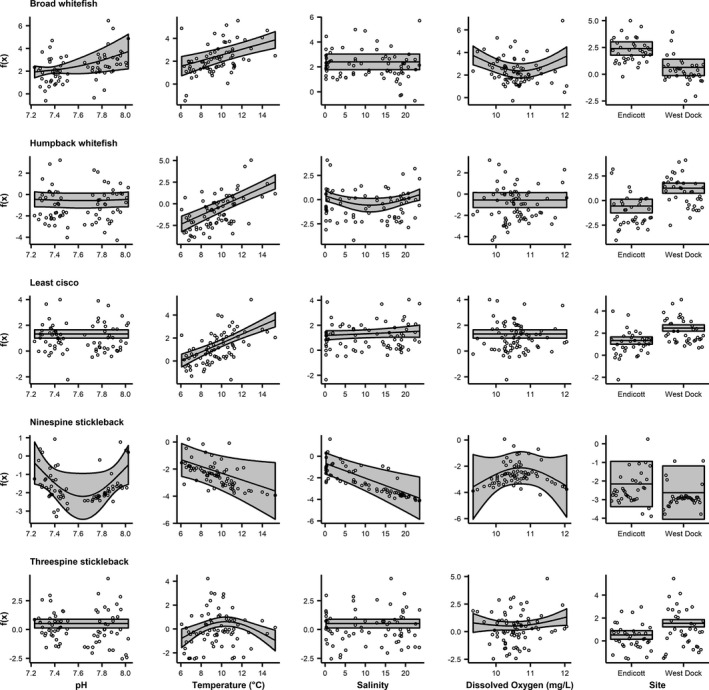
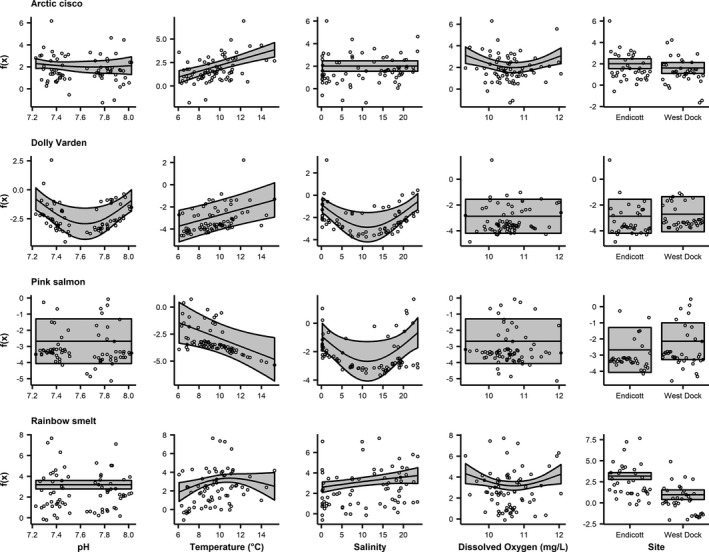
Fish are critical ecologically and socioeconomically for subsistence economies in the Arctic, an ecosystem undergoing unprecedented environmental change. Our understanding of the responses of nearshore Arctic fishes to environmental change is inadequate because of limited research on the physicochemical drivers of abundance occurring at a fine scale. Here, high-frequency in situ measurements of pH, temperature, salinity, and dissolved oxygen were paired with daily fish catches in nearshore Alaskan waters of the Beaufort Sea. Due to the threat that climate change poses to high-latitude marine ecosystems, our main objective was to characterize the abiotic drivers of abundance and elucidate how nearshore fish communities may change in the future. We used generalized additive models (GAMs) to describe responses to the nearshore environment for 18 fish species. Relationships between abundance and the physicochemical environment were variable between species and reflected life history. Each abiotic covariate was significant in at least one GAM, exhibiting both nonlinear and linear associations with abundance. Temperature was the most important predictor of abundance and was significant in GAMs for 11 species. Notably, pH was a significant predictor of abundance for six species: Arctic cod (), broad whitefish (), Dolly Varden (), ninespine stickleback (), saffron cod (), and whitespotted greenling (). Broad whitefish and whitespotted greenling abundance was positively associated with pH, while Arctic cod and saffron cod abundance was negatively associated with pH. These results may be a bellwether for future nearshore Arctic fish community change by providing a foundational characterization of the relationships between abundance and the abiotic environment, particularly in regard to pH, and demonstrate the importance of including a wider range of physicochemical habitat covariates in future research.
在北极地区,鱼类在生态和社会经济方面对维持生计的经济至关重要,而北极地区的生态系统正经历着前所未有的环境变化。由于对精细尺度上鱼类数量的物理化学驱动因素的研究有限,我们对北极近岸鱼类对环境变化的反应的了解并不充分。在这里,对pH值、温度、盐度和溶解氧进行高频原位测量,并与波弗特海阿拉斯加近岸水域的每日捕鱼量进行配对。由于气候变化对高纬度海洋生态系统构成威胁,我们的主要目标是确定鱼类数量的非生物驱动因素,并阐明近岸鱼类群落未来可能如何变化。我们使用广义相加模型(GAM)来描述18种鱼类对近岸环境的反应。物种之间数量与物理化学环境之间的关系各不相同,反映了生活史。每个非生物协变量在至少一个GAM中具有显著性,与数量呈现出非线性和线性关联。温度是数量最重要的预测因子,在11种鱼类的GAM中具有显著性。值得注意的是,pH值是6种鱼类数量的显著预测因子:北极鳕鱼()、宽鼻白鲑()、花羔红点鲑()、九刺鱼()、红大麻哈鱼()和白斑六线鱼()。宽鼻白鲑和白斑六线鱼的数量与pH值呈正相关,而北极鳕鱼和红大麻哈鱼的数量与pH值呈负相关。这些结果可能是北极近岸鱼类群落未来变化的一个先兆,因为它提供了数量与非生物环境之间关系的基础特征,特别是关于pH值的关系,并证明了在未来研究中纳入更广泛的物理化学栖息地协变量的重要性。