Costello Varea H, Tribble David, Eickhoff Christa, Tilley D Hamilton, Utz Gregory, Telu Kalyani, Ganesan Anuradha, Fraser Jamie, Lalani Tahaniyat
Naval Medical Center Portsmouth, Portsmouth, Virginia, USA.
Infectious Disease Clinical Research Program, Department of Preventive Medicine and Biostatistics, Uniformed Services University of the Health Sciences, Bethesda, Maryland, USA.
Open Forum Infect Dis. 2021 Jul 28;8(8):ofab395. doi: 10.1093/ofid/ofab395. eCollection 2021 Aug.
Antibiotic stewardship in the pretravel care of older adults is important to effectively treat infections while minimizing harm from side effects and unnecessary antibiotic use. The objective of this study was to compare the characteristics, risk behaviors, infectious diseases, and antibiotic use between older (≥60 years) and younger (18-59 years) travelers.
TravMil is a prospective, observational cohort of United States (US) Department of Defense beneficiaries traveling outside the continental US for ≤6.5 months. For this analysis, we included adults enrolled pretravel between January 2010 and August 2018 and excluded active duty personnel on deployment. Pre and post-travel surveys captured trip characteristics, exposures, illnesses, and antibiotic use.
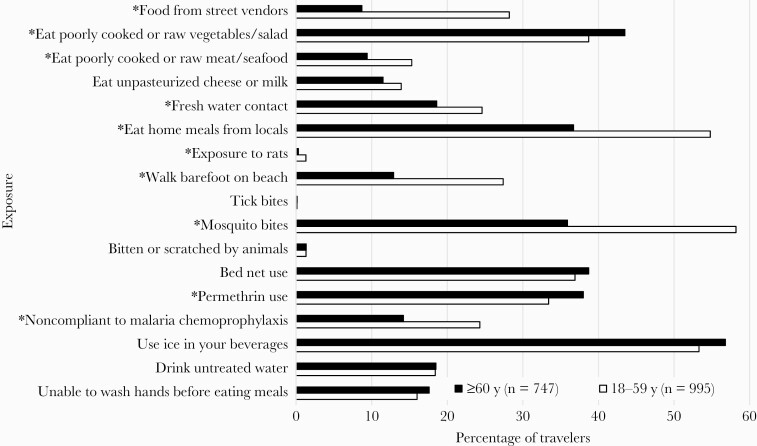
A total of 1742 travelers were analyzed: 747 (42.9%) were aged ≥60 years and 995 (57.1%) were aged 18-59 years. Older travelers were less likely to engage in high-risk dietary behaviors and experience travelers' diarrhea than younger travelers (18.2% vs 22.9%; < .05). Influenza-like illness (12.5%) and febrile illness (3.4%) occurred less frequently in the older cohort. Antibiotic use for self-treatment was common in both age groups (25.7% vs 26.7%) and often inappropriate, for example, for treatment of occasional loose stool or mild travelers' diarrhea (67.0% [67/100] in older adults vs 57.6% [83/144] in younger adults; < .05), and influenza-like illness (63.4% [64/101] vs 58.6% [68/116], respectively; < .05).
Older travelers were less likely to engage in high-risk behaviors and experience travelers' diarrhea, and both age groups experienced mild, self-limited infections. Inappropriate use of antibiotics was common, suggesting that antimicrobial stewardship should be emphasized at pretravel counseling with international travelers.
在老年人旅行前护理中进行抗生素管理对于有效治疗感染同时将副作用和不必要抗生素使用的危害降至最低非常重要。本研究的目的是比较老年(≥60岁)和年轻(18 - 59岁)旅行者的特征、风险行为、传染病及抗生素使用情况。
TravMil是一项针对美国国防部受益人前往美国本土以外地区旅行≤6.5个月的前瞻性观察队列研究。对于本分析,我们纳入了2010年1月至2018年8月旅行前登记的成年人,并排除了正在执行部署任务的现役人员。旅行前和旅行后的调查记录了旅行特征、暴露情况、疾病及抗生素使用情况。
共分析了1742名旅行者:747名(42.9%)年龄≥60岁,995名(57.1%)年龄在18 - 59岁。与年轻旅行者相比,老年旅行者从事高风险饮食行为和患旅行者腹泻的可能性较小(18.2%对22.9%;P<0.05)。老年队列中流感样疾病(12.5%)和发热性疾病(3.4%)的发生率较低。自我治疗使用抗生素在两个年龄组中都很常见(25.7%对26.7%),且通常不恰当,例如用于治疗偶尔的稀便或轻度旅行者腹泻(老年成年人中为67.0%[67/100],年轻成年人中为57.6%[83/144];P<0.05),以及流感样疾病(分别为63.4%[64/101]和58.6%[68/116];P<0.05)。
老年旅行者从事高风险行为和患旅行者腹泻的可能性较小,且两个年龄组均经历轻度、自限性感染。抗生素使用不当很常见,这表明在为国际旅行者提供旅行前咨询时应强调抗菌药物管理。