Zammitti Andrea, Russo Angela, Santisi Giuseppe, Magnano Paola
Department of Educational Sciences, University of Catania, 95124 Catania, Italy.
Faculty of Human and Social Sciences, Kore University, 94100 Enna, Italy.
Behav Sci (Basel). 2021 Jul 31;11(8):109. doi: 10.3390/bs11080109.
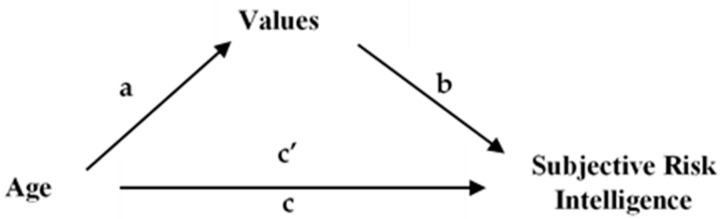
In a risk society, personal values can be important resources, useful for managing uncertainty and guiding people in the perception of risk. The goal of this article is to explore the relationship between risk intelligence and personal values. The participants were 731 Italian adults aged between 18 and 65 years (M = 30.25; DS = 10.71). The survey was composed of the following measures: Subjective Risk Intelligence Scale and Portrait Values Questionnaire. Data analyses have found significant relationships between some types of personal values and risk intelligence: subjective risk intelligence is negatively related to conservation and positively related to openness to change and self-transcendence, but it was not related to self-enhancement. Furthermore, values of openness to change and self-transcendence mediate the relationship between age and subjective risk intelligence, while conservation values and self-enhancement values did not mediate the same relationship. Implication for practice and future research will be discussed.
在风险社会中,个人价值观可能是重要资源,有助于管理不确定性并引导人们认知风险。本文旨在探讨风险智力与个人价值观之间的关系。参与者为731名年龄在18至65岁之间的意大利成年人(M = 30.25;DS = 10.71)。该调查由以下测量工具组成:主观风险智力量表和肖像价值观问卷。数据分析发现某些类型的个人价值观与风险智力之间存在显著关系:主观风险智力与保守主义呈负相关,与变革开放性和自我超越呈正相关,但与自我提升无关。此外,变革开放性和自我超越价值观在年龄与主观风险智力之间起中介作用,而保守主义价值观和自我提升价值观则不起这种中介作用。本文将讨论对实践和未来研究的启示。