Department of Nephrology, Hiroshima University Hospital, 1-2-3 Kasumi, Minami-ku, Hiroshima 734-8551, Japan.
Department of Stem Cell Biology and Medicine, Graduate School of Biomedical & Health Sciences, Hiroshima University, 1-2-3 Kasumi, Minami-ku, Hiroshima 734-8553, Japan.
Nutrients. 2021 Aug 19;13(8):2847. doi: 10.3390/nu13082847.
Although malnutrition and bone fracture are both major complications in patients undergoing hemodialysis, their association has not been clarified. The aim of our study was to clarify the association between the geriatric nutritional risk index (), an indicator of nutritional status, and the incidence of bone fractures in patients undergoing hemodialysis.
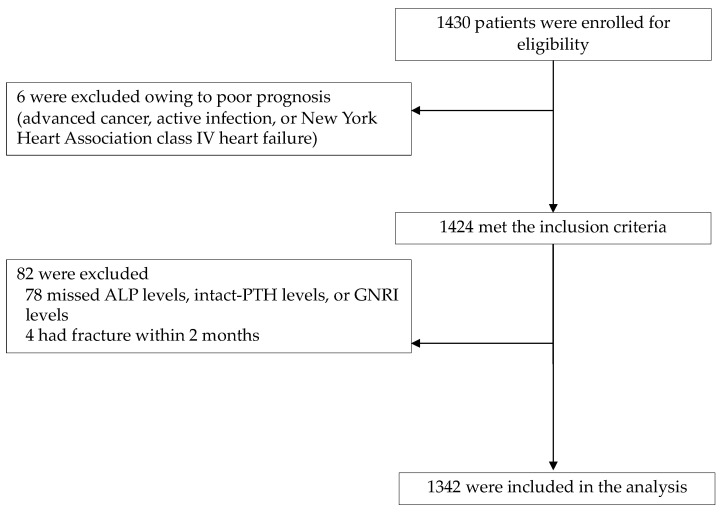
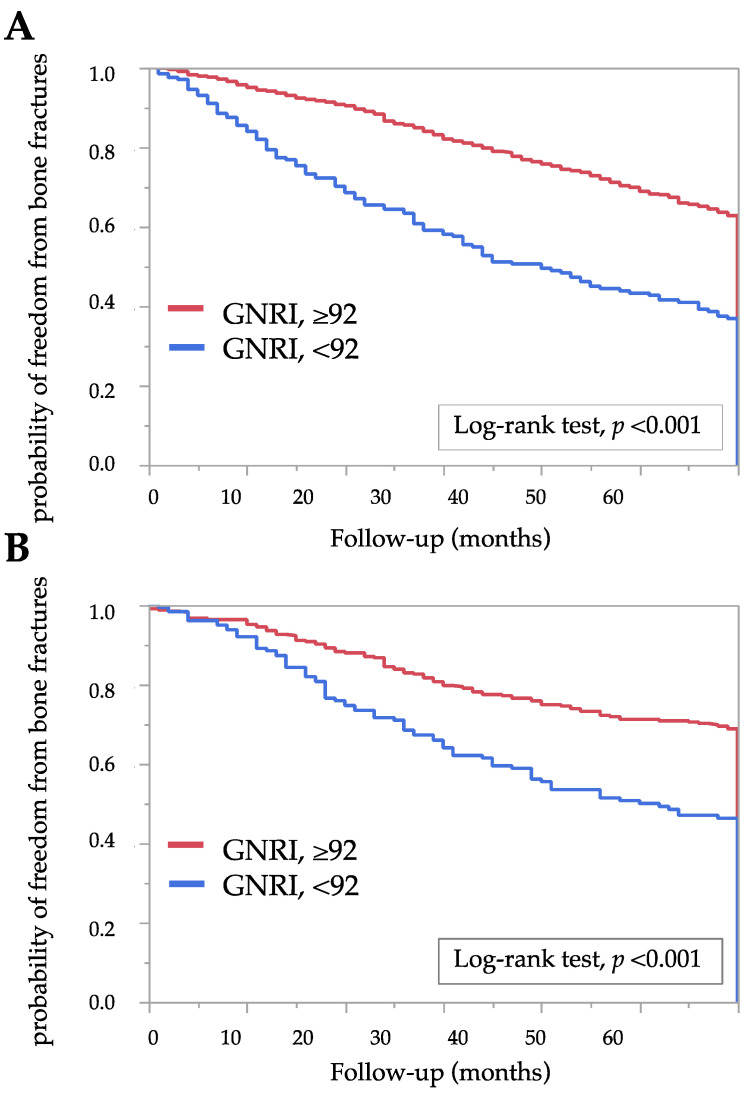
We included 1342 registered patients undergoing hemodialysis and performed a post hoc analysis. We divided patients into the high group (≥92), considered to have a low risk of malnutrition, and the low group (<92), considered to have a high risk of malnutrition. Fracture-free survival in the low and high groups was evaluated by the Kaplan-Meier method. Cox proportional hazards models were used to identify the risk factors for fractures requiring hospitalization. All results were stratified by sex.
New bone fractures developed in 108 (8.0%) patients in 5 years of follow-up. Bone fractures occurred more frequently in the low group compared with the high group (HR: 3.51, 95% CI: 1.91-6.42, < 0.01 in males; HR: 2.47, 95% CI: 1.52-4.03, < 0.01 in females). A low was significantly associated with an increased incidence of bone fractures, even after adjustment for covariates. However, the serum levels of calcium, phosphate, parathyroid hormone, and alkaline phosphatase were not associated with the incidence of bone fractures.
A low is an independent risk factor for bone fractures in patients undergoing hemodialysis. Early intervention for the low group may be important in preventing the occurrence of fractures.
尽管营养不良和骨折都是接受血液透析患者的主要并发症,但两者之间的关联尚未明确。我们的研究旨在阐明营养状况指标()与接受血液透析患者骨折发生率之间的关系。
我们纳入了 1342 名接受血液透析的登记患者,并进行了事后分析。我们将患者分为高 组(≥92),认为营养不良风险低,和低 组(<92),认为营养不良风险高。通过 Kaplan-Meier 方法评估低和高 组的无骨折生存率。使用 Cox 比例风险模型确定需要住院治疗的骨折的危险因素。所有结果均按性别分层。
在 5 年的随访中,108 名(8.0%)患者发生了新的骨折。与高 组相比,低 组的骨折发生率更高(男性 HR:3.51,95%CI:1.91-6.42,<0.01;女性 HR:2.47,95%CI:1.52-4.03,<0.01)。即使在校正了协变量后,低 仍与骨折发生率增加显著相关。然而,血清钙、磷、甲状旁腺激素和碱性磷酸酶水平与骨折发生率无关。
低 是接受血液透析患者骨折的独立危险因素。早期干预低 组可能对预防骨折的发生很重要。