Department of Cellular and Molecular Biology, Faculty of Biological Sciences, Kharazmi University, Tehran, Iran.
Applied Microbiology Research Center, Systems Biology and Poisonings Institute, Baqiyatallah University of Medical Sciences, Tehran, Iran.
Front Immunol. 2021 Aug 10;12:705772. doi: 10.3389/fimmu.2021.705772. eCollection 2021.
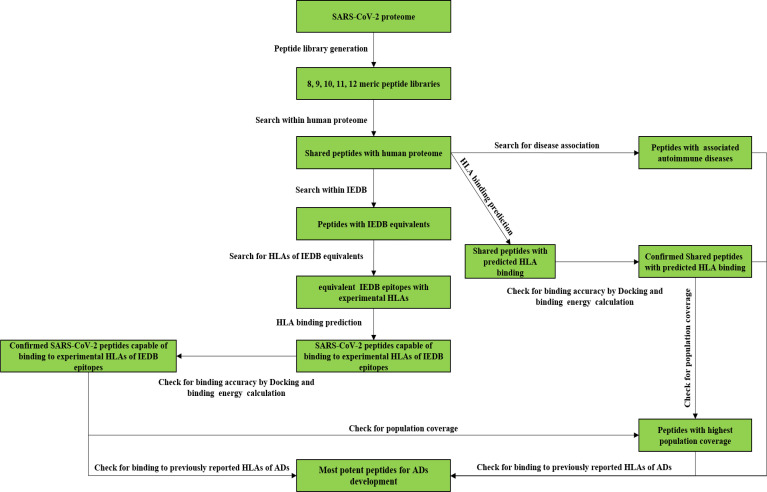
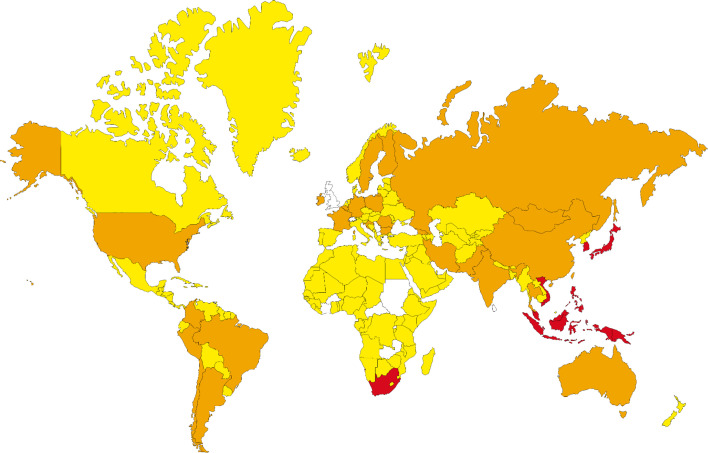
Autoimmune diseases (ADs) could occur due to infectious diseases and vaccination programs. Since millions of people are expected to be infected with SARS-CoV-2 and vaccinated against it, autoimmune consequences seem inevitable. Therefore, we have investigated the whole proteome of the SARS-CoV-2 for its ability to trigger ADs. In this regard, the entire proteome of the SARS-CoV-2 was chopped into more than 48000 peptides. The produced peptides were searched against the entire human proteome to find shared peptides with similar experimentally confirmed T-cell and B-cell epitopes. The obtained peptides were checked for their ability to bind to HLA molecules. The possible population coverage was calculated for the most potent peptides. The obtained results indicated that the SARS-CoV-2 and human proteomes share 23 peptides originated from ORF1ab polyprotein, nonstructural protein NS7a, Surface glycoprotein, and Envelope protein of SARS-CoV-2. Among these peptides, 21 peptides had experimentally confirmed equivalent epitopes. Amongst, only nine peptides were predicted to bind to HLAs with known global allele frequency data, and three peptides were able to bind to experimentally confirmed HLAs of equivalent epitopes. Given the HLAs which have already been reported to be associated with ADs, the ESGLKTIL, RYPANSIV, NVAITRAK, and RRARSVAS were determined to be the most harmful peptides of the SARS-CoV-2 proteome. It would be expected that the COVID-19 pandemic and the vaccination against this pathogen could significantly increase the ADs incidences, especially in populations harboring HLA-B08:01, HLA-A024:02, HLA-A11:01 and HLA-B27:05. The Southeast Asia, East Asia, and Oceania are at higher risk of AD development.
自身免疫性疾病(ADs)可能由于传染病和疫苗接种计划而发生。由于预计将有数百万感染 SARS-CoV-2 并接种该病毒的疫苗,因此,自身免疫性后果似乎是不可避免的。因此,我们已经研究了 SARS-CoV-2 的整个蛋白质组,以研究其引发 AD 的能力。在这方面,将 SARS-CoV-2 的整个蛋白质组切成了 48000 多个肽段。将产生的肽段与整个人类蛋白质组进行搜索,以找到具有相似的实验证实的 T 细胞和 B 细胞表位的共享肽段。检查获得的肽段与 HLA 分子结合的能力。针对最有效的肽段计算了可能的人群覆盖率。获得的结果表明,SARS-CoV-2 和人类蛋白质组共享来自 ORF1ab 多蛋白、非结构蛋白 NS7a、表面糖蛋白和 SARS-CoV-2 包膜蛋白的 23 个肽段。在这些肽段中,有 21 个肽段具有实验证实的等效表位。其中,只有 9 个肽段被预测与具有已知全球等位基因频率数据的 HLA 结合,并且 3 个肽段能够与实验证实的等效表位的 HLA 结合。鉴于已经报道与 AD 相关的 HLA,确定 ESGLKTIL、RYPANSIV、NVAITRAK 和 RRARSVAS 为 SARS-CoV-2 蛋白质组中最有害的肽段。预计 COVID-19 大流行和针对该病原体的疫苗接种将显著增加 AD 的发病率,尤其是在携带 HLA-B08:01、HLA-A024:02、HLA-A11:01 和 HLA-B27:05 的人群中。东南亚、东亚和大洋洲发生 AD 的风险更高。