El-Khuffash Afif, Lewandowski Adam J, Jain Amish, Hamvas Aaron, Singh Gautam K, Levy Philip T
Department of Neonatology, The Rotunda Hospital and School of Medicine (Pediatrics), Royal College of Surgeons in Ireland, Dublin, Ireland.
Oxford Cardiovascular Clinical Research Facility, Division of Cardiovascular Medicine, Radcliffe, Department of Medicine, University of Oxford, Oxford, United Kingdom.
JAMA Netw Open. 2021 Aug 2;4(8):e2121206. doi: 10.1001/jamanetworkopen.2021.21206.
There is a beneficial association between human breast milk exposure in the neonatal period and cardiac mechanics in adults who were born preterm. It is unknown whether this benefit is apparent in infants in the first year of age.
To test the hypothesis that higher consumption of mother's own milk in preterm infants is associated with enhanced cardiac performance during the first year of age.
DESIGN, SETTING, AND PARTICIPANTS: This cross-sectional study of cardiac and nutritional data at an academic medical center included 80 individuals born preterm and 100 individuals in the control group born full-term. All births were between 2011 and 2013. Two-dimensional echocardiograms were performed at 32 weeks' and 36 weeks' postmenstrual age and at 1 year's corrected age in individuals born preterm and at 1 month and 1 year of age in individuals born full-term. Statistical analysis was performed from January to May 2021.
Consumption of mother's own milk.
Main study outcomes included echocardiography measures of right and left ventricle longitudinal strain (function), left ventricle mass index and right ventricular areas (morphology), and pulmonary vascular resistance (pulmonary hemodynamics) at age 1 year.
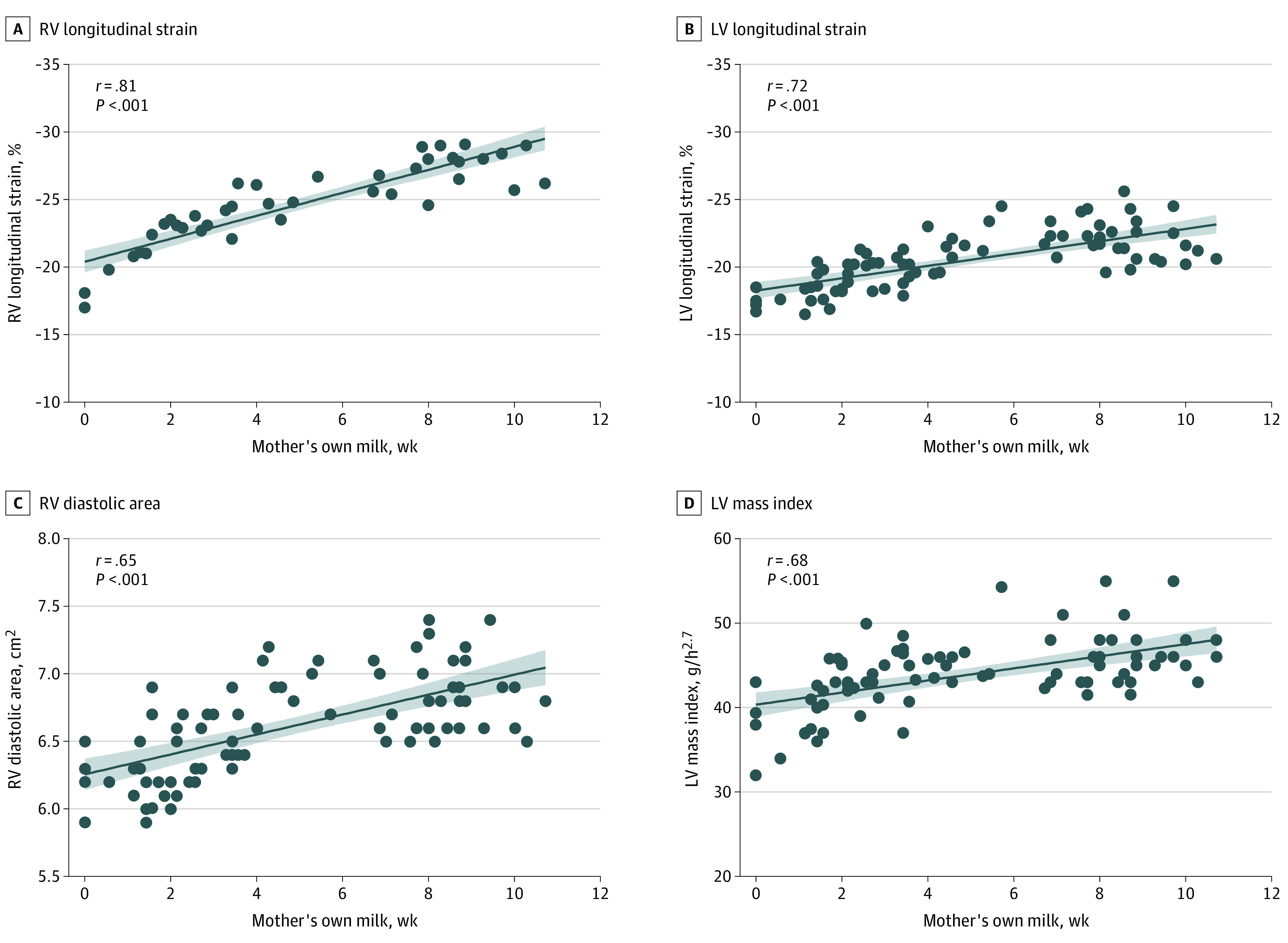
Of 180 infants included in the study, 97 (54%) were Black infants and 89 (49%) were female infants. Among the 80 infants born in the preterm cohort, 43 (54%) were female infants and 43 (54%) were Black infants. The median gestational age at birth of the preterm infants was 27.0 weeks (interquartile range, 26.0-28.0 weeks) and the median birth weight was 960 g (interquartile range, 800-1138). For each week of exposure to mother's own milk, preterm infants had greater magnitudes of right ventricular strain (eg, right longitudinal strain: β, 0.021; 95% CI, 0.002-0.041; P < .001) and left ventricular strain (eg, left longitudinal strain: β, 0.065; 95% CI, 0.049-0.080; P = .01), larger right ventricle areas (eg, systolic area: β, 0.026; 95% CI, 0.011-0.042; P = .009), larger left ventricle mass index (β, 0.045; 95% CI, 0.024-0.073; P = .003), and decreased pulmonary vascular resistance (eg, pulmonary artery acceleration time: β, 0.041; 95% CI, 0.018-0.063; P < .001) at 1 year's corrected age, even after accounting for gestational age and common neonatal morbidities. Cardiac values approached those seen in controls born full-term with increased mother's own milk exposure. There were no differences in any of the cardiac indices at 32 weeks' postmenstrual age, but with each week of exposure, right ventricle function (eg, right longitudinal strain: β, 0.016; 95% CI, 0.002-0.031; P < .001) was greater and pulmonary pressured (eg, pulmonary artery acceleration time: β, 0.0032; 95% CI, 0.0013-0.0062; P < .001).
This study found that preterm infants with higher consumption of mother's own milk had enhanced cardiac performance at age 1 year, suggesting that mother's own milk consumption may play a dynamic modulator role on cardiac mechanics in preterm-born infants and help in normalization of the preterm cardiac phenotype.

在新生儿期接触人乳与早产出生的成年人的心脏力学之间存在有益关联。目前尚不清楚这种益处对于一岁以内的婴儿是否明显。
检验以下假设,即早产婴儿更多食用母乳与一岁以内心脏功能增强有关。
设计、地点和参与者:这项在学术医疗中心对心脏和营养数据进行的横断面研究纳入了80名早产出生个体和100名足月出生的对照组个体。所有出生均发生在2011年至2013年之间。对早产出生个体在孕龄32周和36周以及矫正年龄1岁时进行二维超声心动图检查,对足月出生个体在1个月和1岁时进行二维超声心动图检查。统计分析于2021年1月至5月进行。
食用母乳。
主要研究结局包括一岁时右心室和左心室纵向应变(功能)、左心室质量指数和右心室面积(形态)的超声心动图测量指标,以及肺血管阻力(肺血流动力学)。
在纳入研究的180名婴儿中,97名(54%)为黑人婴儿,89名(49%)为女婴。在早产队列中的80名婴儿中,43名(54%)为女婴,43名(54%)为黑人婴儿。早产婴儿出生时的中位孕周为27.0周(四分位间距,26.0 - 28.0周),中位出生体重为960克(四分位间距,800 - 1138克)。即使在考虑了孕周和常见新生儿疾病之后,早产婴儿每多接触一周母乳,在矫正年龄1岁时右心室应变幅度更大(例如,右纵向应变:β,0.021;95%置信区间,0.002 - 0.041;P < 0.001)和左心室应变幅度更大(例如,左纵向应变:β,0.065;95%置信区间,0.049 - 0.080;P = 0.01),右心室面积更大(例如,收缩期面积:β,0.026;95%置信区间,0.011 - 0.042;P = 0.009),左心室质量指数更大(β,0.045;95%置信区间,0.024 - 0.073;P = 0.003),肺血管阻力降低(例如,肺动脉加速时间:β,0.041;95%置信区间,0.018 - 0.063;P < 0.001)。随着母乳接触增加,心脏指标接近足月出生对照组所见。在孕龄32周时,任何心脏指标均无差异,但每多接触一周,右心室功能(例如,右纵向应变:β,0.016;95%置信区间,0.002 - 0.031;P < 0.001)更强,肺压力(例如,肺动脉加速时间:β,0.0032;95%置信区间,0.0013 - 0.0062;P < 0.001)更低。
本研究发现,食用母乳较多的早产婴儿在1岁时心脏功能增强,这表明食用母乳可能对早产出生婴儿的心脏力学起动态调节作用,并有助于使早产心脏表型正常化。