MRC Human Immunology Unit, MRC Weatherall Institute of Molecular Medicine, University of Oxford, John Radcliffe Hospital, Oxford, UK; Haematology Theme, Oxford Biomedical Research Centre, Oxford, UK.
Population Health and Immunity Division, Walter and Eliza Hall Institute of Medical Research, Parkville, VIC, Australia; Diagnostic Haematology, The Royal Melbourne Hospital, Parkville, VIC, Australia; Clinical Haematology, The Peter MacCallum Cancer Centre and The Royal Melbourne Hospital, Parkville, VIC, Australia; Department of Medical Biology, The University of Melbourne, Parkville, VIC, Australia.
Lancet Haematol. 2021 Sep;8(9):e666-e669. doi: 10.1016/S2352-3026(21)00201-5.
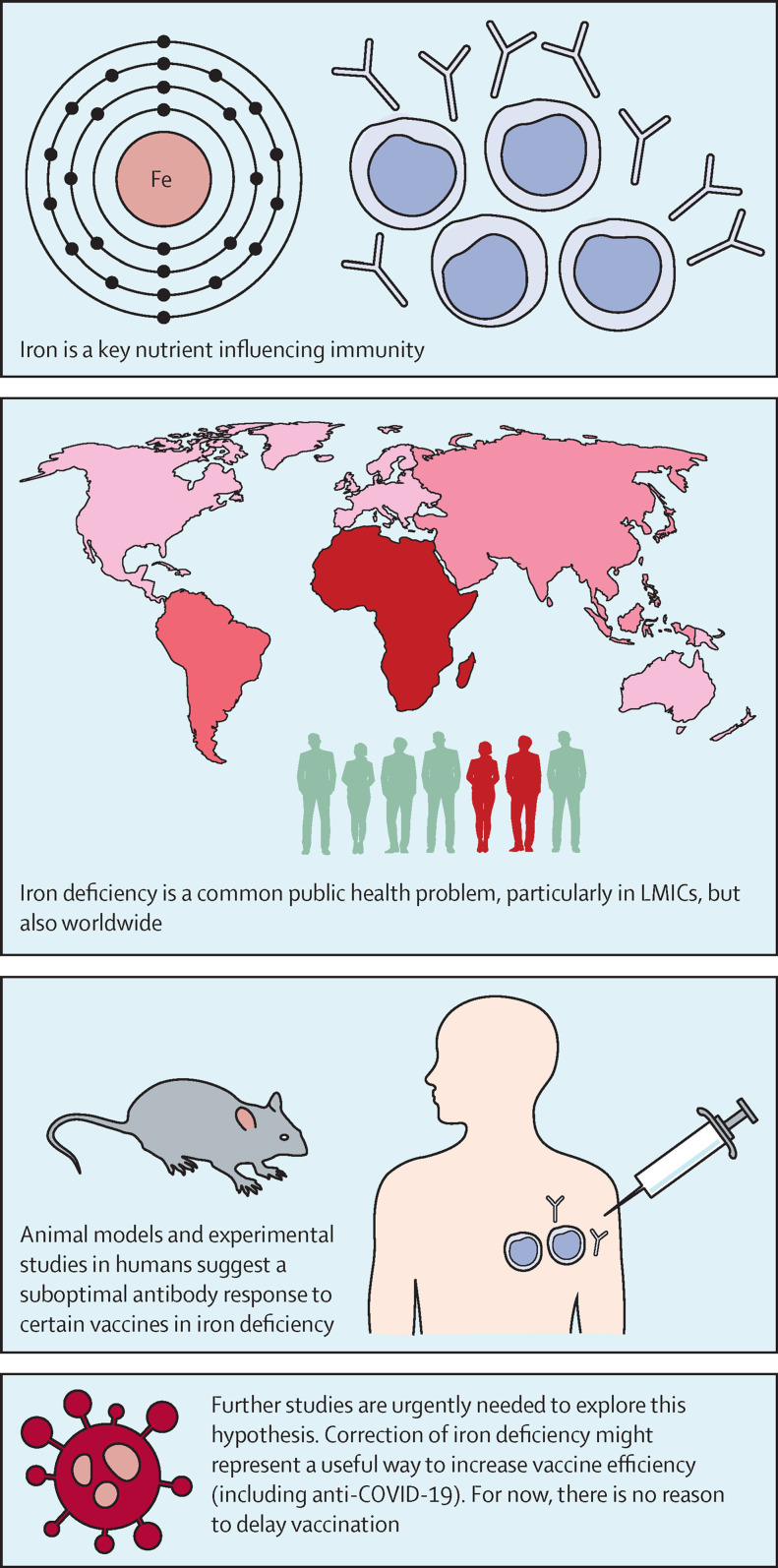
Vaccines are the most effective measure to prevent deaths and illness from infectious diseases. Nevertheless, the efficacy of several paediatric vaccines is lower in low-income and middle-income countries (LMICs), where mortality from vaccine-preventable infections remains high. Vaccine efficacy can also be decreased in adults in the context of some common comorbidities. Identifying and correcting the specific causes of impaired vaccine efficacy is of substantial value to global health. Iron deficiency is the most common micronutrient deficiency worldwide, affecting more than 2 billion people, and its prevalence in LMICs could increase as food security is threatened by the COVID-19 pandemic. In this Viewpoint, we highlight evidence showing that iron deficiency limits adaptive immunity and responses to vaccines, representing an under-appreciated additional disadvantage to iron deficient populations. We propose a framework for urgent detailed studies of iron-vaccine interactions to investigate and clarify the issue. This framework includes retrospective analysis of newly available datasets derived from trials of COVID-19 and other vaccines, and prospective testing of whether nutritional iron interventions, commonly used worldwide to combat anaemia, improve vaccine performance.
疫苗是预防传染病导致死亡和疾病的最有效措施。然而,在低收入和中等收入国家(LMICs),几种儿科疫苗的效力较低,这些国家的疫苗可预防感染导致的死亡率仍然很高。在某些常见合并症的情况下,疫苗的效力也会在成年人中降低。确定和纠正疫苗效力受损的具体原因对全球健康具有重要价值。铁缺乏是全球最常见的微量营养素缺乏症,影响着超过 20 亿人,而随着 COVID-19 大流行威胁到粮食安全,铁缺乏症在 LMICs 的患病率可能会增加。在本观点中,我们强调了有证据表明铁缺乏会限制适应性免疫和对疫苗的反应,这代表了缺铁人群的另一个未被充分认识的不利因素。我们提出了一个紧急详细研究铁-疫苗相互作用的框架,以调查和阐明这个问题。该框架包括对来自 COVID-19 和其他疫苗试验的新可用数据集的回顾性分析,以及前瞻性测试在全球广泛用于治疗贫血的营养性铁干预措施是否能提高疫苗效果。