
巴拿马的遗传多样性:中美洲消除疟疾面临的挑战。
Genetic Diversity in Panama: Challenges for Malaria Elimination in Mesoamerica.
作者信息
Santamaría Ana María, Vásquez Vanessa, Rigg Chystrie, Samudio Franklyn, Moreno Dianik, Romero Luis, Saldaña Azael, Chaves Luis Fernando, Calzada José Eduardo
机构信息
Departamento de Investigación en Parasitología, Instituto Conmemorativo Gorgas de Estudios de la Salud, Panama 0816-02593, Panama.
Facultad de Medicina y Medicina Veterinaria, Universidad de Panamá, Panama 0816-03366, Panama.
出版信息
Pathogens. 2021 Aug 5;10(8):989. doi: 10.3390/pathogens10080989.
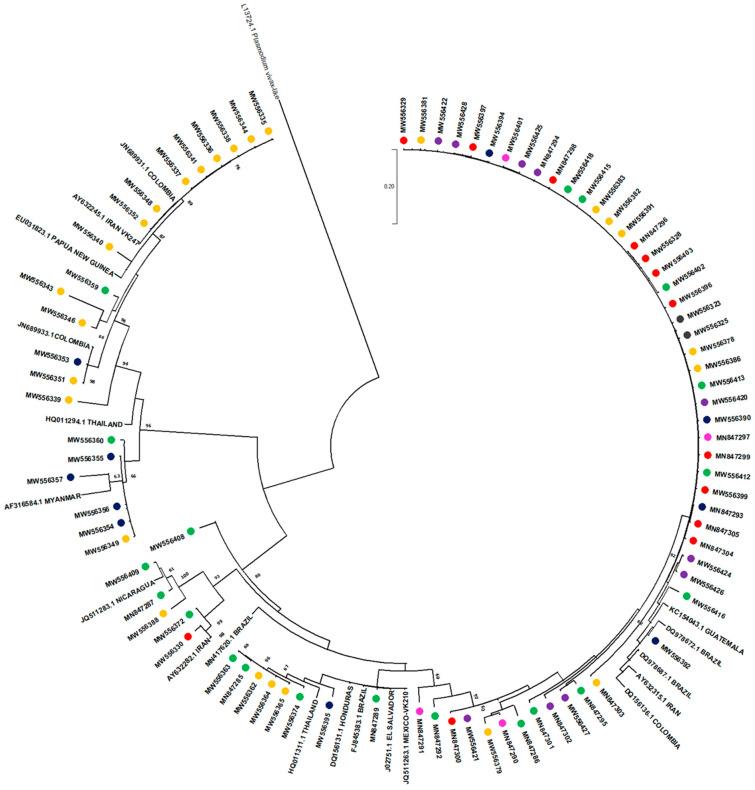
Panama and all nations within the Mesoamerican region have committed to eliminate malaria within this decade. With more than 90% of the malaria cases in this region caused by , an efficient national/regional elimination plan must include a comprehensive study of this parasite's genetic diversity. Here, we retrospectively analyzed genetic diversity in autochthonous and imported field isolates collected in different endemic regions in Panama from 2007 to 2020, using highly polymorphic markers (, -1, and -3α). We did the analysis using molecular techniques that are cost-effective for malaria molecular surveillance within Mesoamerica. Thus, we used molecular analyses that are feasible for malaria molecular surveillance within the region, and that can provide useful information for policy and decision making about malaria elimination. We also evaluated if haplotypes established by combining the genotypes found in these genes were associated with relevant epidemiological variables and showed structure across the transmission foci that have been observed in Panama. Ten different haplotypes were identified, some of them strongly associated with geographical origin, age, and collection year. Phylogenetic analysis of (central repeat domain) revealed that both major variant types (vk210 and vk247) were circulating in Panama. Variant vk247 was restricted to the eastern endemic regions, while vk210 was predominant (77.3%) and widespread, displaying higher diversity (14 alleles) and geographically biased alleles. The regional implications of these molecular findings for the control of malaria to achieve elimination across Mesoamerica are discussed.
巴拿马和中美洲地区的所有国家都致力于在本十年内消除疟疾。由于该地区90%以上的疟疾病例是由[疟原虫名称未给出]引起的,一项有效的国家/区域消除计划必须包括对这种寄生虫遗传多样性的全面研究。在这里,我们回顾性分析了2007年至2020年在巴拿马不同流行地区收集的本地和输入性野外分离株中的[疟原虫名称未给出]遗传多样性,使用了高度多态性的标记([标记名称未给出]、-1和-3α)。我们使用了对中美洲疟疾分子监测具有成本效益的分子技术进行分析。因此,我们使用的分子分析方法在该地区进行疟疾分子监测是可行的,并且可以为疟疾消除的政策和决策提供有用信息。我们还评估了通过组合这些基因中发现的基因型所建立的单倍型是否与相关的流行病学变量相关,并显示出在巴拿马观察到的传播疫源地之间的结构。我们鉴定出了10种不同的单倍型,其中一些与地理来源、年龄和采集年份密切相关。对[疟原虫名称未给出](中央重复结构域)的系统发育分析表明,两种主要变异类型(vk210和vk247)都在巴拿马传播。变异型vk247仅限于东部流行地区,而vk210占主导地位(77.3%)且分布广泛,显示出更高的多样性(14个等位基因)和地理偏向性等位基因。本文讨论了这些分子研究结果对中美洲控制[疟原虫名称未给出]疟疾以实现消除的区域意义。


 Zotero 插件