Saso Anja, Kampmann Beate, Roetynck Sophie
The Vaccine Centre, Faculty of Infectious and Tropical Diseases, London School of Hygiene & Tropical Medicine, London WC1 7HT, UK.
Vaccines and Immunity Theme, MRC Unit, The Gambia at London School of Hygiene & Tropical Medicine, Banjul P.O. Box 273, The Gambia.
Vaccines (Basel). 2021 Aug 7;9(8):877. doi: 10.3390/vaccines9080877.
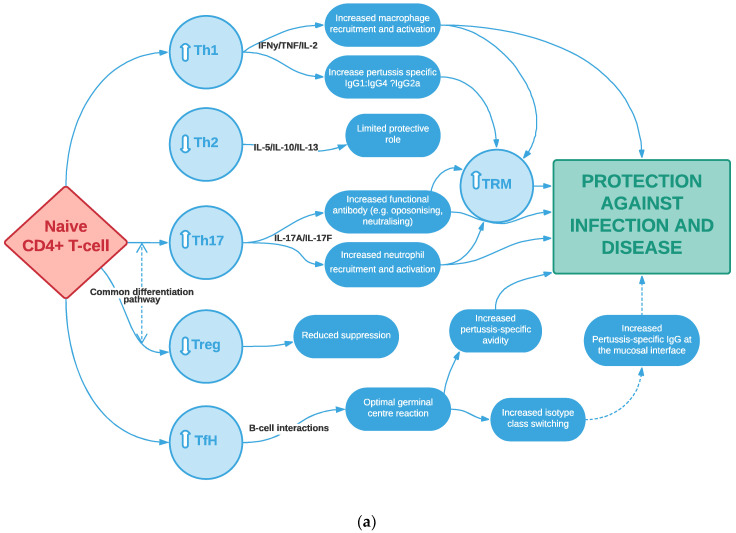
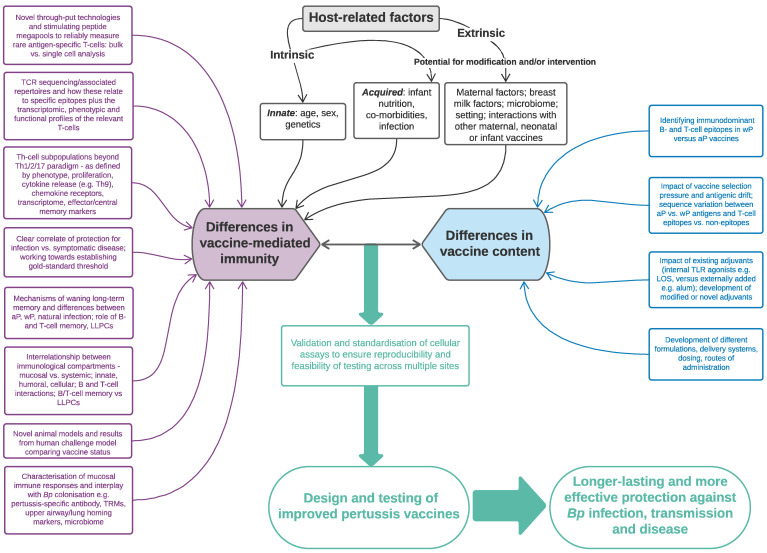
Pertussis ('whooping cough') is a severe respiratory tract infection that primarily affects young children and unimmunised infants. Despite widespread vaccine coverage, it remains one of the least well-controlled vaccine-preventable diseases, with a recent resurgence even in highly vaccinated populations. Although the exact underlying reasons are still not clear, emerging evidence suggests that a key factor is the replacement of the whole-cell (wP) by the acellular pertussis (aP) vaccine, which is less reactogenic but may induce suboptimal and waning immunity. Differences between vaccines are hypothesised to be cell-mediated, with polarisation of Th1/Th2/Th17 responses determined by the composition of the pertussis vaccine given in infancy. Moreover, aP vaccines elicit strong antibody responses but fail to protect against nasal colonisation and/or transmission, in animal models, thereby potentially leading to inadequate herd immunity. Our review summarises current knowledge on vaccine-induced cellular immune responses, based on mucosal and systemic data collected within experimental animal and human vaccine studies. In addition, we describe key factors that may influence cell-mediated immunity and how antigen-specific responses are measured quantitatively and qualitatively, at both cellular and molecular levels. Finally, we discuss how we can harness this emerging knowledge and novel tools to inform the design and testing of the next generation of improved infant pertussis vaccines.
百日咳(“小儿咳嗽”)是一种严重的呼吸道感染疾病,主要影响幼儿和未接种疫苗的婴儿。尽管疫苗接种覆盖率很高,但它仍然是控制效果最差的疫苗可预防疾病之一,甚至在疫苗接种率高的人群中近期也出现了疫情反弹。虽然确切的根本原因尚不清楚,但新出现的证据表明,一个关键因素是用无细胞百日咳(aP)疫苗取代全细胞(wP)疫苗,aP疫苗的反应原性较低,但可能诱导的免疫效果欠佳且会逐渐减弱。疫苗之间的差异被认为是由细胞介导的,婴儿期接种的百日咳疫苗的成分决定了Th1/Th2/Th17反应的极化。此外,在动物模型中,aP疫苗能引发强烈的抗体反应,但无法预防鼻腔定植和/或传播,从而可能导致群体免疫力不足。我们的综述基于在实验动物和人类疫苗研究中收集的黏膜和全身数据,总结了目前关于疫苗诱导的细胞免疫反应的知识。此外,我们描述了可能影响细胞介导免疫的关键因素,以及如何在细胞和分子水平上对抗原特异性反应进行定量和定性测量。最后,我们讨论了如何利用这些新出现的知识和新工具为下一代改进型婴儿百日咳疫苗的设计和测试提供信息。