Department of Health Science and Technology, Aalborg University, Fredrik Bajers Vej 5, 9220, Aalborg, Denmark.
Sino-Danish College (SDC), University of Chinese Academy of Sciences, Beijing, China.
Sci Rep. 2021 Aug 27;11(1):17300. doi: 10.1038/s41598-021-96675-z.
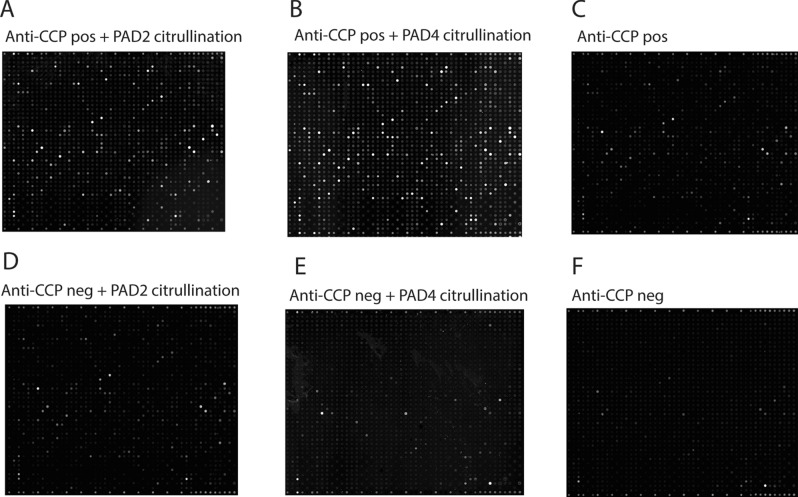
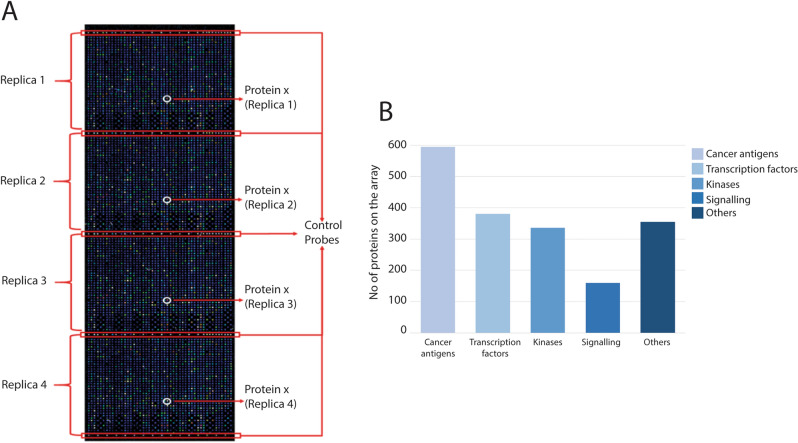
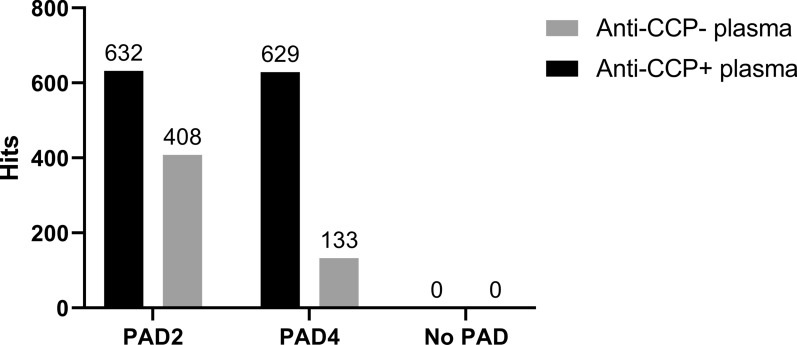
The presence or absence of autoantibodies against citrullinated proteins (ACPAs) distinguishes two main groups of rheumatoid arthritis (RA) patients with different etiologies, prognoses, disease severities, and, presumably, disease pathogenesis. The heterogeneous responses of RA patients to various biologics, even among ACPA-positive patients, emphasize the need for further stratification of the patients. We used high-density protein array technology for fingerprinting of ACPA reactivity. Identification of the proteome recognized by ACPAs may be a step to stratify RA patients according to immune reactivity. Pooled plasma samples from 10 anti-CCP-negative and 15 anti-CCP-positive RA patients were assessed for ACPA content using a modified protein microarray containing 1631 different natively folded proteins citrullinated in situ by protein arginine deiminases (PADs) 2 and PAD4. IgG antibodies from anti-CCP-positive RA plasma showed high-intensity binding to 87 proteins citrullinated by PAD2 and 99 proteins citrullinated by PAD4 without binding significantly to the corresponding native proteins. Curiously, the binding of IgG antibodies in anti-CCP-negative plasma was also enhanced by PAD2- and PAD4-mediated citrullination of 29 and 26 proteins, respectively. For only four proteins, significantly more ACPA binding occurred after citrullination with PAD2 compared to citrullination with PAD4, while the opposite was true for one protein. We demonstrate that PAD2 and PAD4 are equally efficient in generating citrullinated autoantigens recognized by ACPAs. Patterns of proteins recognized by ACPAs may serve as a future diagnostic tool for further subtyping of RA patients.
抗瓜氨酸化蛋白抗体(ACPAs)的存在与否将类风湿关节炎(RA)患者分为两组,两组患者的病因、预后、疾病严重程度不同,推测发病机制也不同。RA 患者对各种生物制剂的反应存在异质性,即使在 ACPA 阳性患者中也是如此,这强调了需要进一步对患者进行分层。我们使用高密度蛋白质阵列技术对 ACPA 的反应进行指纹图谱分析。识别 ACPA 所识别的蛋白质组可能是根据免疫反应对 RA 患者进行分层的一步。使用包含通过蛋白质精氨酸脱亚氨酶(PAD)2 和 PAD4 原位瓜氨酸化的 1631 种不同天然折叠蛋白的改良蛋白质微阵列,评估了 10 名抗 CCP 阴性和 15 名抗 CCP 阳性 RA 患者的血浆样本中的 ACPA 含量。来自抗 CCP 阳性 RA 血浆的 IgG 抗体强烈结合到由 PAD2 瓜氨酸化的 87 种蛋白质和由 PAD4 瓜氨酸化的 99 种蛋白质,而对相应的天然蛋白质无显著结合。奇怪的是,抗 CCP 阴性血浆中的 IgG 抗体的结合也分别被 PAD2 和 PAD4 介导的 29 种和 26 种蛋白质的瓜氨酸化增强。仅对于四种蛋白质,与 PAD4 相比,PAD2 介导的瓜氨酸化导致更多的 ACPA 结合,而对于一种蛋白质则相反。我们证明 PAD2 和 PAD4 在产生被 ACPAs 识别的瓜氨酸化自身抗原方面同样有效。ACPAs 识别的蛋白质模式可作为进一步对 RA 患者进行亚型分类的未来诊断工具。