Yan Wen, Meng Xianghong, Sun Jinglai, Yu Hui, Wang Zhi
School of Precision Instrument and Opto-Electronics Engineering, Tianjin University, Nankai District, 92 Weijin Road, Tianjin, 300072, China.
Radiology Department, Tianjin Hospital, 406 Jiefangnan Road, Hexi District, Tianjin, 300210, China.
BMC Med Imaging. 2021 Aug 28;21(1):130. doi: 10.1186/s12880-021-00660-x.
There is a high incidence of injury to the lateral ligament of the ankle in daily living and sports activities. The anterior talofibular ligament (ATFL) is the most frequent types of ankle injuries. It is of great clinical significance to achieve intelligent localization and injury evaluation of ATFL due to its vulnerability.
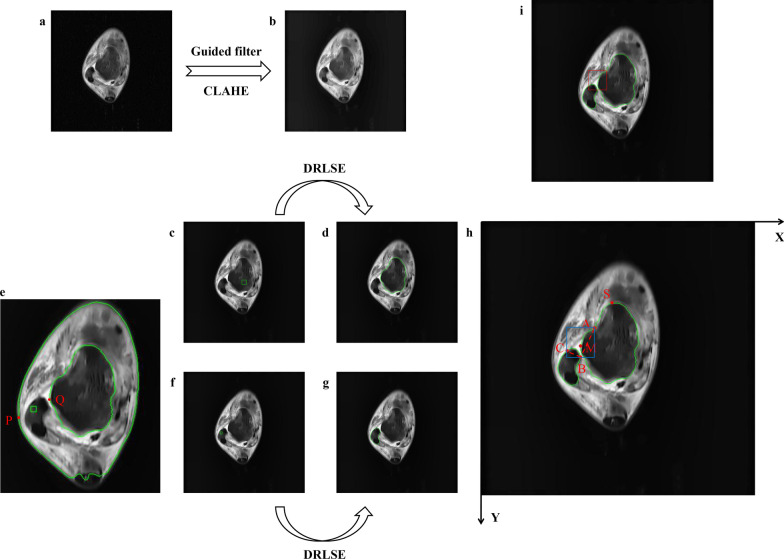
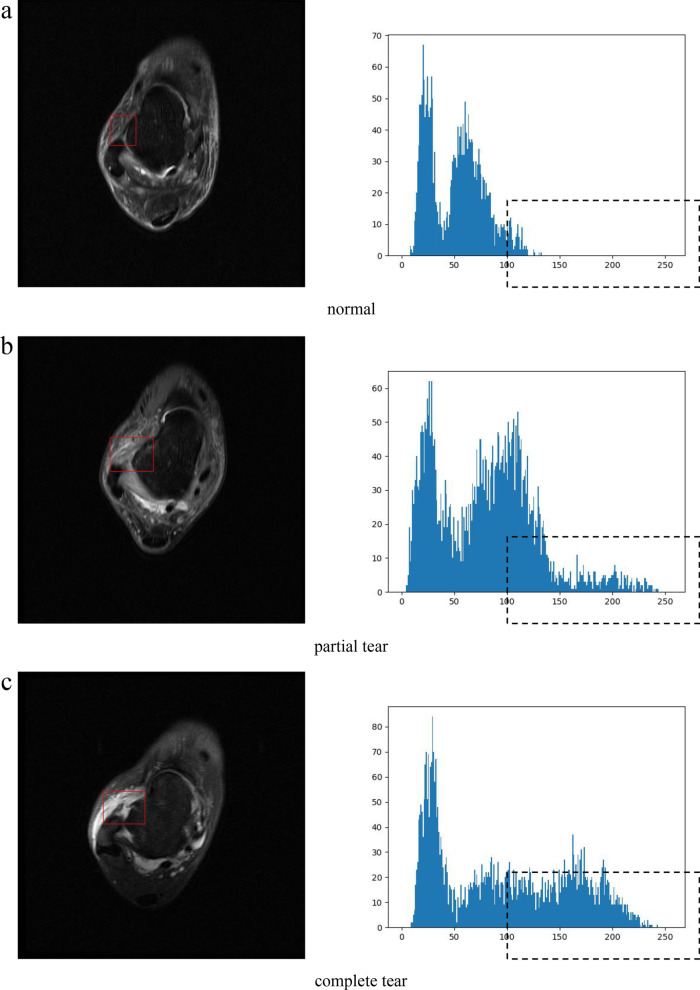
According to the specific characteristics of bones in different slices, the key slice was extracted by image segmentation and characteristic analysis. Then, the talus and fibula in the key slice were segmented by distance regularized level set evolution (DRLSE), and the curvature of their contour pixels was calculated to find useful feature points including the neck of talus, the inner edge of fibula, and the outer edge of fibula. ATFL area can be located using these feature points so as to quantify its first-order gray features and second-order texture features. Support vector machine (SVM) was performed for evaluation of ATFL injury.
Data were collected retrospectively from 158 patients who underwent MRI, and were divided into normal (68) and tear (90) group. The positioning accuracy and Dice coefficient were used to measure the performance of ATFL localization, and the mean values are 87.7% and 77.1%, respectively, which is helpful for the following feature extraction. SVM gave a good prediction ability with accuracy of 93.8%, sensitivity of 88.9%, specificity of 100%, precision of 100%, and F1 score of 94.2% in the test set.
Experimental results indicate that the proposed method is reliable in diagnosing ATFL injury. This study may provide a potentially viable method for aided clinical diagnoses of some ligament injury.
在日常生活和体育活动中,踝关节外侧韧带损伤的发生率很高。距腓前韧带(ATFL)是最常见的踝关节损伤类型。由于其易损性,实现ATFL的智能定位和损伤评估具有重要的临床意义。
根据不同切片中骨骼的具体特征,通过图像分割和特征分析提取关键切片。然后,采用距离正则化水平集演化(DRLSE)对关键切片中的距骨和腓骨进行分割,并计算其轮廓像素的曲率,以找到有用的特征点,包括距骨颈、腓骨内缘和腓骨外缘。利用这些特征点定位ATFL区域,从而量化其一阶灰度特征和二阶纹理特征。采用支持向量机(SVM)对ATFL损伤进行评估。
回顾性收集了158例接受MRI检查患者的数据,分为正常组(68例)和撕裂组(90例)。采用定位准确率和Dice系数衡量ATFL定位性能,其平均值分别为87.7%和77.1%,有助于后续特征提取。在测试集中,SVM具有良好的预测能力,准确率为93.8%,灵敏度为88.9%,特异性为100%,精确率为100%,F1分数为94.2%。
实验结果表明,所提方法在诊断ATFL损伤方面是可靠的。本研究可能为某些韧带损伤的辅助临床诊断提供一种潜在可行的方法。