Department of Population and Health, College of Humanities and Legal Studies, University of Cape Coast, Cape Coast, Ghana.
The Australian Centre for Public and Population Health Research, Faculty of Health, University of Technology Sydney, Sydney, NSW, Australia.
Reprod Health. 2021 Aug 28;18(1):177. doi: 10.1186/s12978-021-01227-3.
Women in sub-Saharan Africa (SSA) have a higher risk of unintended pregnancies that are more likely to be terminated, most of which are unsafe with associated complications. Unmet need for contraception is highest in SSA and exceeds the global average. This study investigates the association between unmet/met need for contraception and pregnancy termination SSA.
We used pooled data from Demographic and Health Surveys conducted from January 2010 to December 2018 in 32 countries in SSA. Our study involved 265,505 women with diverse contraception needs and with complete data on all variables of interest. Multilevel logistic regression at 95% CI was used to investigate the association between individual and community level factors and pregnancy termination.
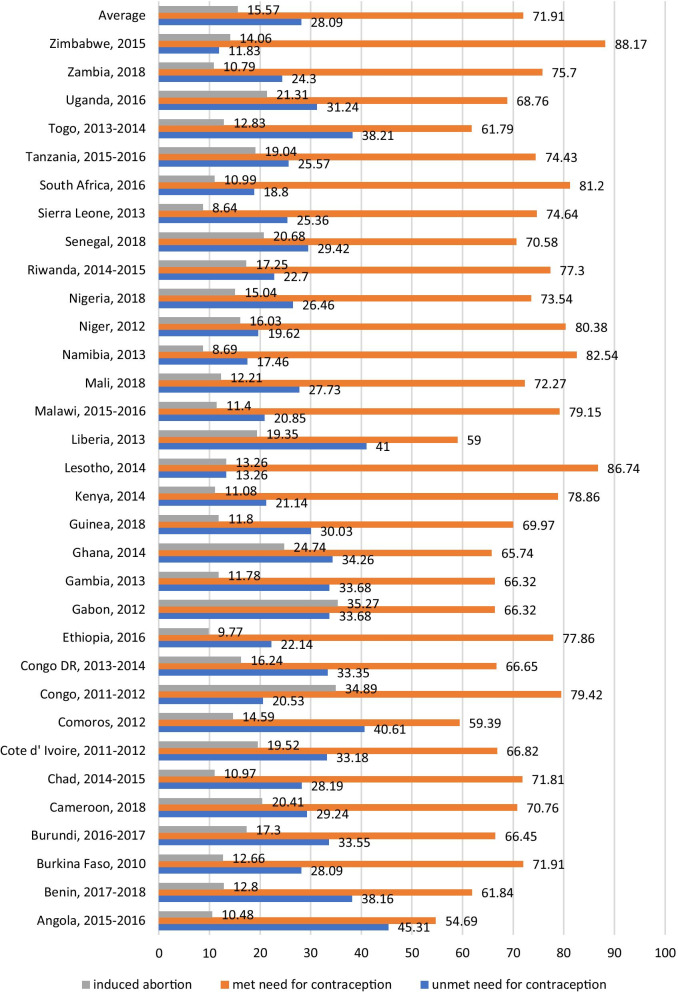
We found an overall pregnancy termination rate of 16.27% ranging from 9.13% in Namibia to 38.68% in Gabon. Intriguingly, women with a met need for contraception were more likely to terminate a pregnancy [aOR = 1.11; 95% CI 1.07-1.96] than women with unmet needs. Women with secondary education were more likely to terminate a pregnancy as compared to those without education [aOR = 1.23; 95% CI 1.19-1.27]. With regards to age, we observed that every additional age increases the likelihood of terminating a pregnancy. At the contextual level, the women with female household heads were less likely to terminate a pregnancy [aOR = 0.95; 95% CI 0.92-0.97]. The least socio-economically disadvantaged women were less likely to terminate a pregnancy compared to the moderately and most socio-economically disadvantaged women.
Our study contributes towards the discussion on unmet/met need for contraception and pregnancy termination across SSA. Women with met need for contraception have higher odds of terminating a pregnancy. The underlying cause of this we argued could be poor adherence to the protocols of contraceptives or the reluctance of women to utilise contraceptives after experiencing a failure. Governments of SSA and non-governmental organisations need to take pragmatic steps to increase met needs for contraception and also utilise mass media to encourage women to adhere to the prescription of contraceptives in order to reduce the incidence of unplanned pregnancies and unsafe abortions.
撒哈拉以南非洲(SSA)的女性意外怀孕的风险更高,且更有可能终止妊娠,其中大多数都是不安全的,伴有相关并发症。SSA 的避孕需求未得到满足的比例最高,超过全球平均水平。本研究调查了避孕需求未得到满足/得到满足与 SSA 妊娠终止之间的关联。
我们使用了 2010 年 1 月至 2018 年 12 月在 SSA 32 个国家进行的人口与健康调查中的汇总数据。我们的研究涉及 265505 名具有不同避孕需求且所有感兴趣变量均有完整数据的女性。使用 95%置信区间的多水平逻辑回归来研究个体和社区层面因素与妊娠终止之间的关系。
我们发现总体妊娠终止率为 16.27%,范围从纳米比亚的 9.13%到加蓬的 38.68%。有趣的是,避孕需求得到满足的女性比未得到满足的女性更有可能终止妊娠[aOR=1.11;95%CI 1.07-1.96]。与没有受过教育的女性相比,接受过中等教育的女性更有可能终止妊娠[aOR=1.23;95%CI 1.19-1.27]。关于年龄,我们发现每增加一岁都会增加终止妊娠的可能性。在社区层面,女性户主为女性的家庭不太可能终止妊娠[aOR=0.95;95%CI 0.92-0.97]。与中度和高度社会经济地位不利的女性相比,社会经济地位最低的女性不太可能终止妊娠。
本研究有助于讨论 SSA 避孕需求未得到满足/得到满足与妊娠终止之间的关系。避孕需求得到满足的女性终止妊娠的可能性更高。我们认为,这背后的原因可能是对避孕药具使用方案的依从性差,或者是女性在经历失败后不愿意使用避孕药具。SSA 政府和非政府组织需要采取切实措施,增加避孕需求的满足程度,并利用大众媒体鼓励女性遵守避孕药具的处方,以减少意外怀孕和不安全堕胎的发生率。