• 文献检索
  • 文档翻译
  • 深度研究
  • 学术资讯
  • Suppr Zotero 插件Zotero 插件
  • 邀请有礼
  • 套餐&价格
  • 历史记录
应用&插件
Suppr Zotero 插件Zotero 插件浏览器插件Mac 客户端Windows 客户端微信小程序
定价
高级版会员购买积分包购买API积分包
服务
文献检索文档翻译深度研究API 文档MCP 服务
关于我们
关于 Suppr公司介绍联系我们用户协议隐私条款
关注我们

Suppr 超能文献

核心技术专利:CN118964589B侵权必究
粤ICP备2023148730 号-1Suppr @ 2026

文献检索

告别复杂PubMed语法,用中文像聊天一样搜索,搜遍4000万医学文献。AI智能推荐,让科研检索更轻松。

立即免费搜索

文件翻译

保留排版,准确专业,支持PDF/Word/PPT等文件格式,支持 12+语言互译。

免费翻译文档

深度研究

AI帮你快速写综述,25分钟生成高质量综述,智能提取关键信息,辅助科研写作。

立即免费体验

撒哈拉以南非洲年轻女性避孕未满足需求的社会经济和人口预测因素:来自横断面调查的证据。

Socio-economic and demographic predictors of unmet need for contraception among young women in sub-Saharan Africa: evidence from cross-sectional surveys.

机构信息

School of Public Health, Faculty of Health, University of Technology Sydney, Sydney, NSW, Australia.

Department of Population and Health, College of Humanities and Legal Studies, University of Cape Coast, Cape Coast, Ghana.

出版信息

Reprod Health. 2020 Oct 23;17(1):163. doi: 10.1186/s12978-020-01018-2.

DOI:10.1186/s12978-020-01018-2
PMID:33097088
原文链接:https://pmc.ncbi.nlm.nih.gov/articles/PMC7585192/
Abstract

INTRODUCTION

Globally, sub-Saharan Africa (SSA) bears the highest proportion of women with unmet need for contraception as nearly 25% of women of reproductive age in the sub-region have unmet need for contraception. Unmet need for contraception is predominant among young women. We examined the association between socio-economic and demographic factors and unmet need for contraception among young women in SSA.

METHODS

Data for this study obtained from current Demographic and Health Surveys (DHS) conducted between January 1, 2010 and December 31, 2018 in 30 sub-Saharan African countries. The sample size consisted of young women (aged 15-24), who were either married or cohabiting and had complete cases on all the variables of interest (N = 59,864). Both bivariate and multivariable binary logistic regression analyses were performed using STATA version 14.0.

RESULTS

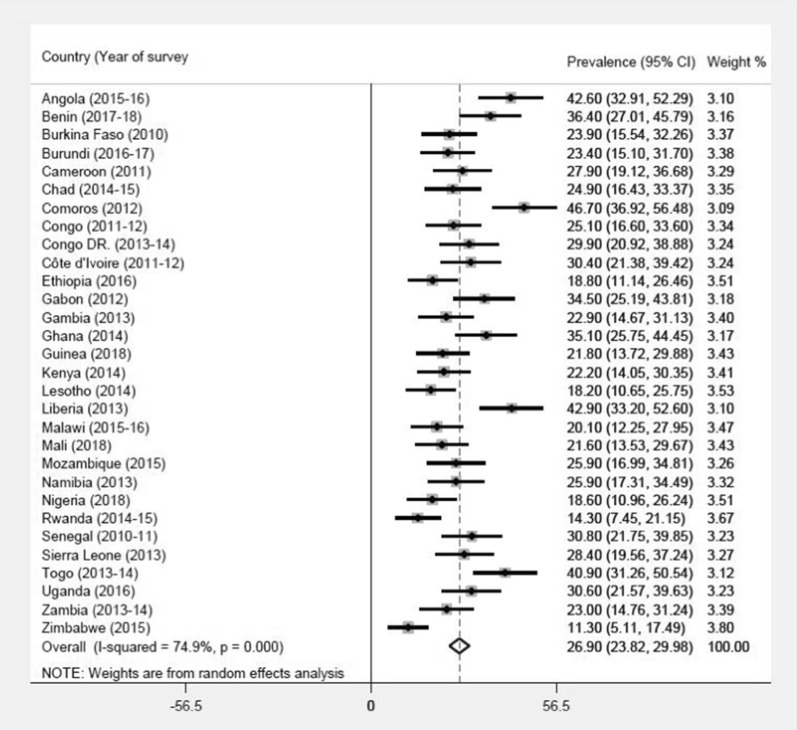
The overall prevalence of unmet need for contraception among young women was 26.90% [95% CI: 23.82-29.921], ranging from 11.30% [95% CI: 5.1-17.49] in Zimbabwe to 46.7% [95% CI: 36.92-56.48] in Comoros. Results on socio-economic status and unmet need for contraception showed that young women who had primary [aOR = 1.18; CI = 1.12-1.25, p < 0.001] and secondary/higher levels of formal education [aOR = 1.27; CI = 1.20-1.35, p < 0.001] had higher odds of unmet need for contraception compared to those with no formal education. With wealth status, young women in the richest wealth quintile had lower odds of unmet need for contraception compared with those in the poorest wealth quintile [aOR = 0.89; CI = 0.81-0.97, p < 0.01]. With the demographic factors, the odds of unmet need for contraception was lower among young women aged 20-24 [aOR = 0.74; CI = 0.70-0.77, p < 0.001], compared with 15-19 aged young women. Also, young women who were cohabiting had higher odds of unmet need for contraception compared to those who were married [aOR = 1.35; CI = 1.28-1.43, p < 0.001].

CONCLUSION

Our study has demonstrated that unmet need for contraception is relatively high among young women in SSA and this is associated with socio-economic status. Age, marital status, parity, occupation, sex of household head, and access to mass media (newspaper) are also associated with unmet need for contraception. It is therefore, prudent that organisations such as UNICEF and UNFPA and the Bill & Melinda Gates Foundation who have implemented policies and programmes on contraception meant towards reducing unmet need for contraception among women take these factors into consideration when designing interventions in sub-Saharan African countries to address the problem of high unmet need for contraception among young women.

摘要

引言

在全球范围内,撒哈拉以南非洲(SSA)的避孕需求未得到满足的女性比例最高,该地区近 25%的育龄女性避孕需求未得到满足。避孕需求未得到满足主要集中在年轻女性群体中。我们研究了社会经济和人口因素与撒哈拉以南非洲年轻女性避孕需求未得到满足之间的关联。

方法

本研究的数据来自于 2010 年 1 月 1 日至 2018 年 12 月 31 日期间在 30 个撒哈拉以南非洲国家进行的当前人口与健康调查(DHS)。样本量包括 15-24 岁的年轻女性(已婚或同居,且所有感兴趣的变量均有完整案例)(N=59864)。使用 STATA 版本 14.0 进行了单变量和多变量二元逻辑回归分析。

结果

年轻女性避孕需求未得到满足的总体流行率为 26.90%[95%CI:23.82-29.921],范围从津巴布韦的 11.30%[95%CI:5.1-17.49]到科摩罗的 46.7%[95%CI:36.92-56.48]。关于社会经济地位和避孕需求未得到满足的结果表明,与没有正规教育的女性相比,具有小学[优势比(aOR)=1.18;置信区间(CI)=1.12-1.25,p<0.001]和中学/高等正规教育[aOR=1.27;CI=1.20-1.35,p<0.001]的年轻女性更有可能避孕需求未得到满足。就财富状况而言,与最贫穷的财富五分位数相比,最富有的财富五分位数的年轻女性避孕需求未得到满足的可能性更低[aOR=0.89;CI=0.81-0.97,p<0.01]。在人口因素方面,与 15-19 岁的年轻女性相比,20-24 岁的年轻女性避孕需求未得到满足的可能性更低[aOR=0.74;CI=0.70-0.77,p<0.001]。此外,与已婚女性相比,同居的年轻女性避孕需求未得到满足的可能性更高[aOR=1.35;CI=1.28-1.43,p<0.001]。

结论

我们的研究表明,撒哈拉以南非洲年轻女性的避孕需求未得到满足的情况相对较高,这与社会经济地位有关。年龄、婚姻状况、生育子女数、职业、家庭户主性别和大众媒体(报纸)的获取情况也与避孕需求未得到满足有关。因此,联合国儿童基金会、联合国人口基金会和比尔及梅琳达·盖茨基金会等组织在实施旨在减少女性避孕需求未得到满足的政策和方案时,在设计撒哈拉以南非洲国家的干预措施以解决年轻女性避孕需求未得到满足的问题时,应考虑这些因素。
https://cdn.ncbi.nlm.nih.gov/pmc/blobs/bfc1/7585192/dda4a3a7a6d8/12978_2020_1018_Fig1_HTML.jpg

相似文献

1
Socio-economic and demographic predictors of unmet need for contraception among young women in sub-Saharan Africa: evidence from cross-sectional surveys.撒哈拉以南非洲年轻女性避孕未满足需求的社会经济和人口预测因素:来自横断面调查的证据。
Reprod Health. 2020 Oct 23;17(1):163. doi: 10.1186/s12978-020-01018-2.
2
Predictors of unmet need for contraception among adolescent girls and young women in selected high fertility countries in sub-Saharan Africa: A multilevel mixed effects analysis.撒哈拉以南非洲部分高生育率国家青少年和年轻女性避孕未满足需求的预测因素:一项多层次混合效应分析。
PLoS One. 2020 Aug 6;15(8):e0236352. doi: 10.1371/journal.pone.0236352. eCollection 2020.
3
Sexual violence and unmet need for contraception among married and cohabiting women in sub-Saharan Africa: Evidence from demographic and health surveys.撒哈拉以南非洲已婚和同居妇女中的性暴力和避孕需求未得到满足:来自人口与健康调查的证据。
PLoS One. 2020 Nov 3;15(11):e0240556. doi: 10.1371/journal.pone.0240556. eCollection 2020.
4
Female adolescents' reproductive health decision-making capacity and contraceptive use in sub-Saharan Africa: What does the future hold?撒哈拉以南非洲地区女性青少年的生殖健康决策能力与避孕措施使用情况:未来会怎样?
PLoS One. 2020 Jul 10;15(7):e0235601. doi: 10.1371/journal.pone.0235601. eCollection 2020.
5
Coverage and determinants of modern contraceptive use in sub-Saharan Africa: further analysis of demographic and health surveys.撒哈拉以南非洲地区现代避孕方法的使用情况及决定因素:人口与健康调查的进一步分析。
Reprod Health. 2022 Jan 21;19(1):18. doi: 10.1186/s12978-022-01332-x.
6
What has women's reproductive health decision-making capacity and other factors got to do with pregnancy termination in sub-Saharan Africa? evidence from 27 cross-sectional surveys.撒哈拉以南非洲地区的女性生殖健康决策能力和其他因素与妊娠终止有什么关系?来自 27 个横断面调查的证据。
PLoS One. 2020 Jul 23;15(7):e0235329. doi: 10.1371/journal.pone.0235329. eCollection 2020.
7
Socio-economic and demographic determinants of female genital mutilation in sub-Saharan Africa: analysis of data from demographic and health surveys.撒哈拉以南非洲地区女性外阴残割的社会经济和人口决定因素:来自人口与健康调查的数据分析。
Reprod Health. 2020 Oct 22;17(1):162. doi: 10.1186/s12978-020-01015-5.
8
Individual and contextual factors associated with mistimed and unwanted pregnancies among adolescent girls and young women in selected high fertility countries in sub-Saharan Africa: A multilevel mixed effects analysis.撒哈拉以南非洲部分高生育率国家青少年女孩和年轻妇女中与时机不当和非意愿妊娠相关的个体和背景因素:一项多层次混合效应分析。
PLoS One. 2020 Oct 22;15(10):e0241050. doi: 10.1371/journal.pone.0241050. eCollection 2020.
9
Use of contraceptives, high risk births and under-five mortality in Sub Saharan Africa: evidence from Kenyan (2014) and Zimbabwean (2011) demographic health surveys.撒哈拉以南非洲地区避孕药具的使用、高危分娩与五岁以下儿童死亡率:来自肯尼亚(2014年)和津巴布韦(2011年)人口与健康调查的证据
BMC Womens Health. 2018 Oct 24;18(1):173. doi: 10.1186/s12905-018-0666-1.
10
Factors associated with unmet need for family planning in sub-Saharan Africa: A multilevel multinomial logistic regression analysis.撒哈拉以南非洲地区计划生育需求未满足的相关因素:一项多层次多项逻辑回归分析。
PLoS One. 2022 Feb 10;17(2):e0263885. doi: 10.1371/journal.pone.0263885. eCollection 2022.

引用本文的文献

1
Alignment of contraceptive method attribute preferences and use among Kenyan women living with HIV.肯尼亚感染艾滋病毒女性的避孕方法属性偏好与使用情况的比对
medRxiv. 2025 Aug 26:2025.08.21.25334189. doi: 10.1101/2025.08.21.25334189.
2
Domestic violence laws and women's unmet need for family planning: Quasi-experimental evidence from Africa.家庭暴力法与妇女未满足的计划生育需求:来自非洲的准实验证据。
Reprod Health. 2025 Apr 26;22(1):60. doi: 10.1186/s12978-025-02011-3.
3
Spatial distribution and factors associated with unmet need for contraception among women in Ghana.

本文引用的文献

1
Individual and community-level factors associated with unmet need for contraception among reproductive-age women in Ethiopia; a multi-level analysis of 2016 Ethiopia Demographic and Health Survey.与埃塞俄比亚育龄期妇女避孕需求未得到满足相关的个体和社区层面因素;对 2016 年埃塞俄比亚人口与健康调查的多层次分析。
BMC Public Health. 2020 Apr 19;20(1):529. doi: 10.1186/s12889-020-08653-1.
2
Unmet Need for Contraception Among Young Married Women in Eastern Ethiopia.埃塞俄比亚东部年轻已婚女性避孕需求未得到满足的情况。
Open Access J Contracept. 2019 Dec 17;10:89-101. doi: 10.2147/OAJC.S227260. eCollection 2019.
3
Measuring unmet need for contraception as a point prevalence.
加纳女性避孕需求未满足的空间分布及相关因素
Reprod Health. 2025 Mar 5;22(1):31. doi: 10.1186/s12978-024-01935-6.
4
Attitudes toward sexual and reproductive health and rights and their associations with reproductive agency: a population-based cross-sectional study in Ethiopia, Kenya, and Zimbabwe.对性与生殖健康及权利的态度及其与生殖自主权的关联:一项在埃塞俄比亚、肯尼亚和津巴布韦开展的基于人群的横断面研究。
Sex Reprod Health Matters. 2024 Dec;32(1):2444725. doi: 10.1080/26410397.2024.2444725. Epub 2025 Feb 21.
5
Legal changes and evidence on unmet need for contraception, Philippines.菲律宾避孕需求未得到满足的法律变化和证据。
Bull World Health Organ. 2024 Nov 1;102(11):778-785. doi: 10.2471/BLT.23.290577. Epub 2024 Oct 2.
6
Training in the symptothermal method to ameliorate unmet need for family planning: knowledge, attitudes and satisfaction.开展症状体温法培训以改善未满足的计划生育需求:知识、态度与满意度。
Int Health. 2025 May 1;17(3):304-312. doi: 10.1093/inthealth/ihae063.
7
Unmet need for family planning among pastoralist community of West Omo zone, Ethiopia: A community based cross-sectional study.埃塞俄比亚西奥莫地区牧民社区计划生育需求未得到满足的情况:一项基于社区的横断面研究。
SAGE Open Med. 2024 Sep 29;12:20503121241285657. doi: 10.1177/20503121241285657. eCollection 2024.
8
Determinants of unmet need for contraceptive method among young married women in Ethiopia: Multilevel analysis of Ethiopia Demographic and Health Survey 2016.埃塞俄比亚年轻已婚女性避孕方法需求未满足的决定因素:基于 2016 年埃塞俄比亚人口与健康调查的多水平分析
PLoS One. 2024 Sep 5;19(9):e0306068. doi: 10.1371/journal.pone.0306068. eCollection 2024.
9
Effect of a digital school-based intervention on adolescent family planning and reproductive health in Rwanda: a cluster-randomized trial.基于数字化的学校干预对卢旺达青少年计划生育和生殖健康的影响:一项整群随机试验。
Nat Med. 2024 Nov;30(11):3121-3128. doi: 10.1038/s41591-024-03205-1. Epub 2024 Aug 23.
10
Exploring the drivers of unmet need for contraception among adolescents and young women in Sierra Leone. a cross-sectional study.探索塞拉利昂青少年和年轻女性避孕需求未得到满足的驱动因素。一项横断面研究。
Contracept Reprod Med. 2024 May 17;9(1):25. doi: 10.1186/s40834-024-00286-8.
将未满足的避孕需求作为时点患病率进行测量。
BMJ Glob Health. 2019 Aug 28;4(4):e001581. doi: 10.1136/bmjgh-2019-001581. eCollection 2019.
4
Maternal and community factors associated with unmet contraceptive need among childbearing women in Northern Nigeria.尼日利亚北部育龄妇女中与未满足的避孕需求相关的孕产妇和社区因素。
Contracept Reprod Med. 2019 Sep 2;4:11. doi: 10.1186/s40834-019-0093-1. eCollection 2019.
5
Socio-demographic determinants of unmet need for family planning among married women in Pakistan.巴基斯坦已婚妇女计划生育未满足需求的社会人口决定因素。
BMC Public Health. 2019 Sep 5;19(1):1226. doi: 10.1186/s12889-019-7487-5.
6
Unmet needs for contraception: A comparative study among Somali immigrant women in Oslo and their original population in Mogadishu, Somalia.避孕需求未得到满足:在奥斯陆的索马里移民妇女与她们在索马里摩加迪沙原籍人口中的比较研究。
PLoS One. 2019 Aug 15;14(8):e0220783. doi: 10.1371/journal.pone.0220783. eCollection 2019.
7
Prevalence and determinants of unintended pregnancy in sub-Saharan Africa: A multi-country analysis of demographic and health surveys.撒哈拉以南非洲意外怀孕的流行情况和决定因素:多国人口与健康调查分析。
PLoS One. 2019 Aug 9;14(8):e0220970. doi: 10.1371/journal.pone.0220970. eCollection 2019.
8
Predictors of unmet need for family planning among all women of reproductive age in Ethiopia.埃塞俄比亚所有育龄妇女计划生育需求未得到满足的预测因素。
Contracept Reprod Med. 2019 Jun 4;4:6. doi: 10.1186/s40834-019-0087-z. eCollection 2019.
9
Long-Acting Reversible Contraception Uptake and Associated Factors among Women of Reproductive Age in Rural Kenya.肯尼亚农村育龄妇女长效可逆避孕措施的采用及相关因素。
Int J Environ Res Public Health. 2019 May 1;16(9):1543. doi: 10.3390/ijerph16091543.
10
Factors influencing unmet need for family planning among Ghanaian married/union women: a multinomial mixed effects logistic regression modelling approach.影响加纳已婚/同居女性计划生育需求未满足情况的因素:一种多项混合效应逻辑回归建模方法。
Arch Public Health. 2019 Mar 12;77:11. doi: 10.1186/s13690-019-0340-6. eCollection 2019.