Departments of Gastric Surgery.
State Key Laboratory of Oncology in South China, Collaborative Innovation Center for Cancer Medicine.
J Immunother. 2021;44(9):371-375. doi: 10.1097/CJI.0000000000000389.
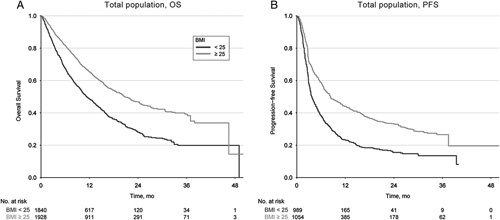
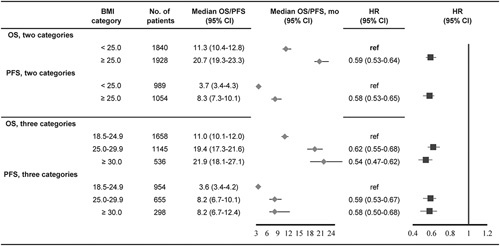
Despite that immune checkpoint inhibitors (ICIs) had tremendous improved the survival of multiple solid tumors, only a limited proportion of patients are responsive to ICIs. Therefore, effective variables are urgently needed to predict the probability of response to ICIs. Systematic searches were conducted from inception up to May, 2020. Prospective or retrospective studies of ICIs that investigated the association between body mass index (BMI) and survival outcomes, including overall survival (OS) and/or progression-free survival (PFS), were selected. The association between each BMI category and survival outcomes was calculated using Cox proportional hazard regression models and quantified as hazard ratio (HR) with corresponding 95% confidence interval. Seven clinical studies involving data from 3768 individual patients were included. The median OS was 15.5 months (95% confidence interval: 14.7-16.2 mo) and the median PFS was 5.7 months (5.2-6.3 mo). The median OS was significantly longer in overweight/obese patients than in nonoverweight patients (20.7 vs. 11.3 mo; P<0.001). The difference in OS between overweight and obese patients was not statistically significant (HR: 1.14, P=0.098). Similar results were observed for PFS outcomes. Subgroup analysis demonstrated improved OS in overweight/obese patients with nonsmall-cell lung cancer (HR: 0.81, P=0.002), melanoma (HR: 0.66, P<0.001), renal cell carcinoma (HR: 0.53, P<0.001), and multiple cancer type (HR: 0.34, P<0.001), with parallel results noted regarding PFS outcomes. Results of the present study suggested that BMI may be a satisfactory prognostic factor for patients treated with ICIs.
尽管免疫检查点抑制剂 (ICIs) 显著提高了多种实体瘤的生存率,但只有有限比例的患者对 ICI 有反应。因此,迫切需要有效的变量来预测对 ICI 反应的概率。从成立到 2020 年 5 月进行了系统搜索。选择了前瞻性或回顾性研究,研究了体重指数 (BMI) 与生存结果之间的关系,包括总生存期 (OS) 和/或无进展生存期 (PFS)。使用 Cox 比例风险回归模型计算每个 BMI 类别与生存结果之间的关联,并使用相应的 95%置信区间量化为危险比 (HR)。纳入了 7 项涉及 3768 名个体患者数据的临床研究。中位 OS 为 15.5 个月(95%置信区间:14.7-16.2 mo),中位 PFS 为 5.7 个月(5.2-6.3 mo)。超重/肥胖患者的中位 OS 明显长于非超重患者(20.7 比 11.3 mo;P<0.001)。超重和肥胖患者之间的 OS 差异无统计学意义(HR:1.14,P=0.098)。PFS 结果也观察到类似的结果。亚组分析表明,非小细胞肺癌(HR:0.81,P=0.002)、黑色素瘤(HR:0.66,P<0.001)、肾细胞癌(HR:0.53,P<0.001)和多种癌症类型(HR:0.34,P<0.001)的超重/肥胖患者 OS 改善,PFS 结果也相似。本研究结果表明,BMI 可能是接受 ICI 治疗的患者的一个满意的预后因素。