Zhu Chen, Talhelm Thomas, Li Yingxiang, Chen Gang, Zhu Jiong, Wang Jun
College of Economics and Management, China Agricultural University, Beijing 100081, People's Republic of China.
Academy of Global Food Economics and Policy (AGFEP), China Agricultural University, Beijing 100081, People's Republic of China.
R Soc Open Sci. 2021 Aug 18;8(8):210382. doi: 10.1098/rsos.210382. eCollection 2021 Aug.
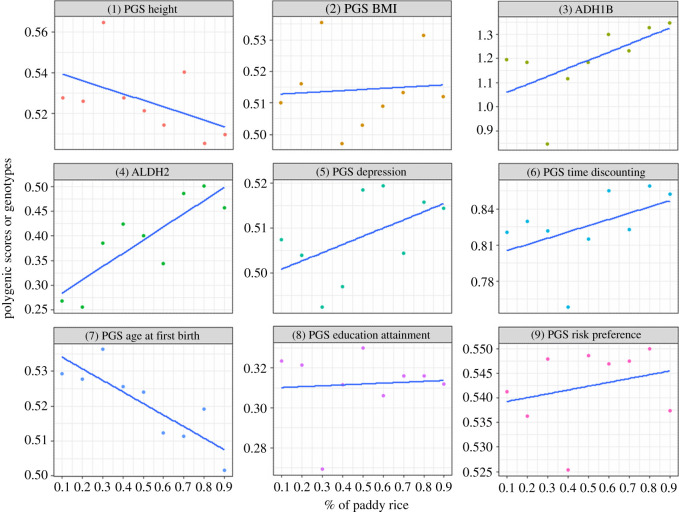
Following domestication in the lower Yangtze River valley 9400 years ago, rice farming spread throughout China and changed lifestyle patterns among Neolithic populations. Here, we report evidence that the advent of rice domestication and cultivation may have shaped humans not only culturally but also genetically. Leveraging recent findings from molecular genetics, we construct a number of polygenic scores (PGSs) of behavioural traits and examine their associations with rice cultivation based on a sample of 4101 individuals recently collected from mainland China. A total of nine polygenic traits and genotypes are investigated in this study, including PGSs of height, body mass index, depression, time discounting, reproduction, educational attainment, risk preference, rs1229984 and rs671. Two-stage least-squares estimates of the county-level percentage of cultivated land devoted to paddy rice on the PGS of age at first birth ( = -0.029, = 0.021) and rs671 ( = 0.182, < 0.001) are both statistically significant and robust to a wide range of potential confounds and alternative explanations. These findings imply that rice farming may influence human evolution in relatively recent human history.
9400年前在长江下游流域驯化之后,水稻种植传遍中国,并改变了新石器时代人群的生活方式。在此,我们报告证据表明,水稻驯化和种植的出现不仅可能在文化上而且在基因上塑造了人类。利用分子遗传学的最新发现,我们构建了一些行为特征的多基因分数(PGS),并基于最近从中国大陆收集的4101名个体的样本,研究它们与水稻种植的关联。本研究共调查了9个多基因性状和基因型,包括身高、体重指数、抑郁、时间折扣、繁殖、教育程度、风险偏好的PGS,以及rs1229984和rs671。县级水稻种植耕地百分比对初育年龄PGS(β = -0.029,P = 0.021)和rs671(β = 0.182,P < 0.001)的两阶段最小二乘估计在统计上均显著,并且对广泛的潜在混杂因素和替代解释具有稳健性。这些发现意味着水稻种植可能在相对较近的人类历史中影响人类进化。