Yu Jia-Sheng, Chen Ru-Dong, Zeng Ling-Cheng, Yang Hong-Kuan, Li Hua
Department of Neurosurgery, Tongji Hospital, Tongji Medical College, Huazhong University of Science and Technology, Wuhan, China.
Front Cardiovasc Med. 2021 Aug 12;8:686328. doi: 10.3389/fcvm.2021.686328. eCollection 2021.
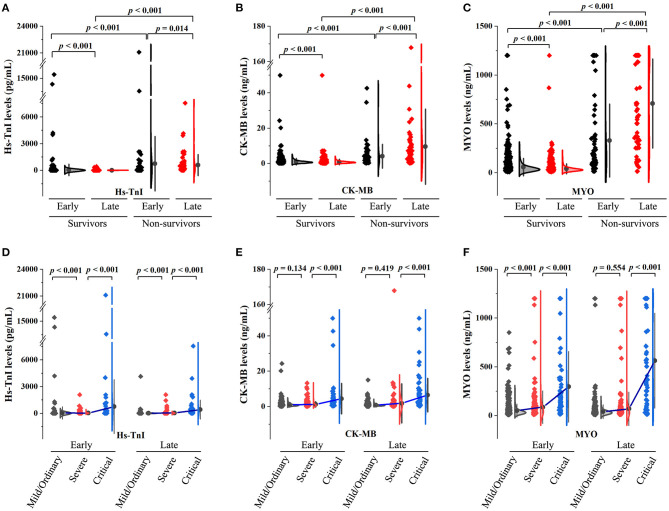
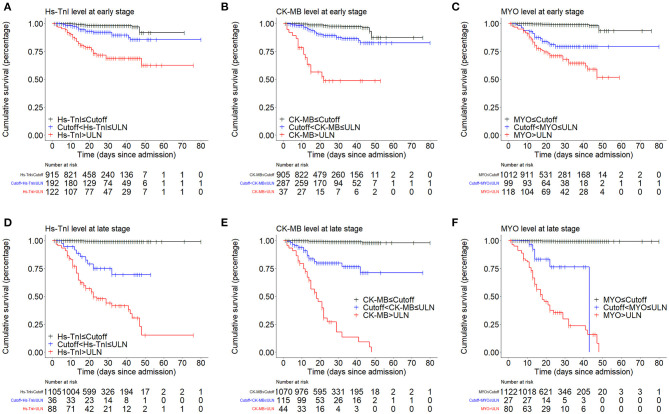
Although sporadic studies have shown that myoglobin may have better prognostic performance than other cardiac markers in COVID-19, a comprehensive comparative study is lacking. Herein, we retrospectively analyzed the clinical and laboratory data of COVID-19 patients admitted to the Guanggu Campus of Wuhan Tongji Hospital from February 9, 2020 to March 30, 2020, intending to compare the prognostic accuracy of three commonly used cardiac markers on COVID-19 mortality. Our results revealed that abnormal increases in myocardial biomarkers were associated with a significantly increased risk of in-hospital mortality with COVID-19. Interestingly, myoglobin, a non-cardiac-specific biomarker, also expressed in skeletal myocytes, had even higher prognostic accuracy than cardiac-specific biomarkers such as high-sensitivity troponin I (hs-TnI) and creatine kinase-MB (CK-MB). More importantly, multivariate Cox analysis showed that myoglobin, rather than hs-TnI or CK-MB, was independently prognostic for in-hospital mortality in COVID-19. These results were further confirmed by subgroup analyses of patients with severe and critical illnesses and those without a history of cardiovascular disease. Our findings suggest that myoglobin may be a reliable marker of illness reflecting general physiological disturbance and help to assess prognosis and treatment response in patients with COVID-19.
尽管零星研究表明,在新冠肺炎中肌红蛋白可能比其他心脏标志物具有更好的预后性能,但缺乏全面的比较研究。在此,我们回顾性分析了2020年2月9日至2020年3月30日入住武汉同济医院光谷院区的新冠肺炎患者的临床和实验室数据,旨在比较三种常用心脏标志物对新冠肺炎死亡率的预后准确性。我们的结果显示,心肌生物标志物异常升高与新冠肺炎住院死亡率显著增加相关。有趣的是,肌红蛋白这种非心脏特异性生物标志物也在骨骼肌细胞中表达,其预后准确性甚至高于心脏特异性生物标志物,如高敏肌钙蛋白I(hs-TnI)和肌酸激酶同工酶MB(CK-MB)。更重要的是,多因素Cox分析表明,对于新冠肺炎住院死亡率,肌红蛋白而非hs-TnI或CK-MB具有独立的预后价值。对重症和危重症患者以及无心血管疾病史患者的亚组分析进一步证实了这些结果。我们的研究结果表明,肌红蛋白可能是反映一般生理紊乱的可靠疾病标志物,并有助于评估新冠肺炎患者的预后和治疗反应。