Abdel-Karim Tasneem, Haris Basma, Afyouni Houda, Mohammed Shayma, Khalifa Amel, Al-Maadheed Maryam, Zyoud Mahmoud, Elawwa Ahmed, Al-Khalaf Fawziya, Petrovski Goran, Hussain Khalid
Division of Endocrinology, Department of Pediatrics, Sidra Medicine, Doha, Qatar.
J Endocr Soc. 2021 Jul 29;5(10):bvab131. doi: 10.1210/jendso/bvab131. eCollection 2021 Oct 1.
Idiopathic type 1 diabetes is characterized by the absence of autoantibodies and the underlying mechanisms are not clear.
We aimed to study the epidemiology, describe the clinical characteristics, and report results of genetic studies in pediatric patients with idiopathic type 1 diabetes.
This was a prospective study of type 1 diabetes patients attending Sidra Medicine from 2018 to 2020. Autoantibodies (GAD65, IAA, IA-2A, and ZnT8) were measured and genetic testing was undertaken in patients negative for autoantibodies to rule out monogenic diabetes. Demographic and clinical data of patients with idiopathic type 1 diabetes were compared with patients with autoimmune type 1 diabetes.
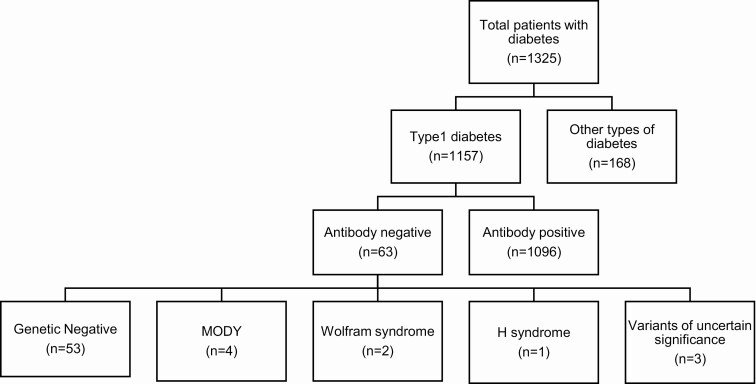
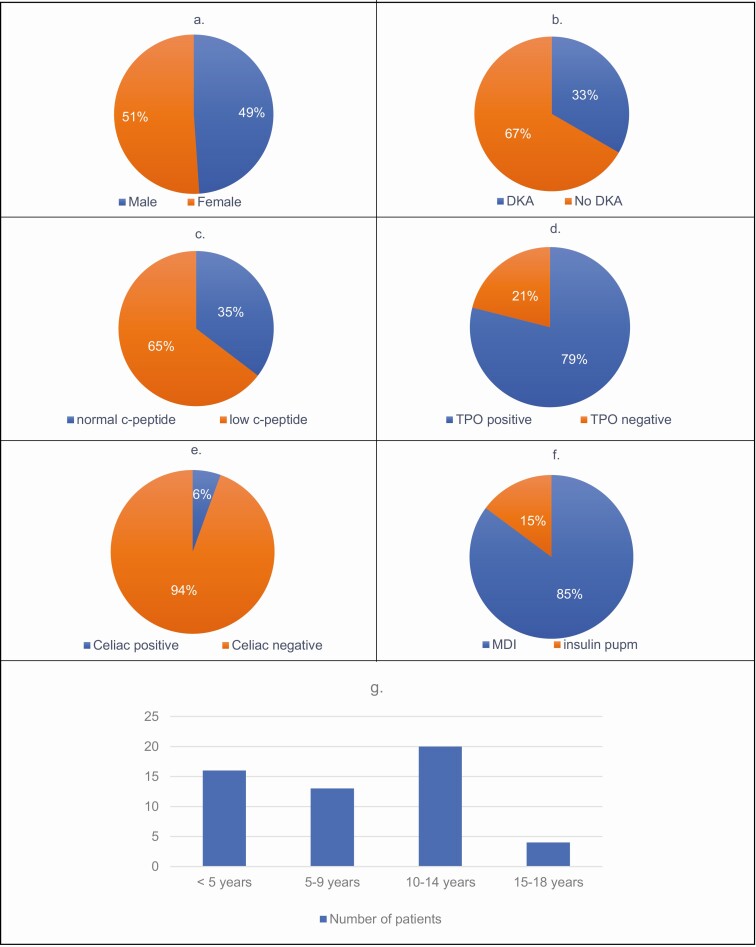
Of 1157 patients with type 1 diabetes, 63 were antibody-negative. Upon genome sequencing, 4 had maturity onset diabetes of the young (MODY), 2 had Wolfram syndrome, 1 had H syndrome, and 3 had variants of uncertain significance in MODY genes; 53 patients had idiopathic type 1 diabetes. The most common age of diagnosis was 10 to 14 years. C-peptide level was low but detectable in 30 patients (56.6%) and normal in 23 patients (43.4%) The average body mass index was in the normal range and 33% of the patients had a history of diabetic ketoacidosis (DKA).
Four percent of the children had idiopathic type 1 diabetes. There were statistically significant differences in the C-peptide level and insulin requirement between the 2 groups. DKA was less common in the idiopathic group. Mutations in MODY genes suggest the importance of autoantibody testing and genetic screening for known causes of monogenic diabetes in idiopathic type 1 diabetes. The mechanism of idiopathic type 1 diabetes is unknown but could be due to defects in antibody production or due to autoantibodies that are not yet detectable or discovered.
特发性1型糖尿病的特征是不存在自身抗体,其潜在机制尚不清楚。
我们旨在研究儿童特发性1型糖尿病患者的流行病学,描述其临床特征,并报告基因研究结果。
这是一项对2018年至2020年在西德拉医学中心就诊的1型糖尿病患者的前瞻性研究。检测自身抗体(谷氨酸脱羧酶65、胰岛素自身抗体、胰岛抗原2抗体和锌转运体8抗体),并对自身抗体阴性的患者进行基因检测,以排除单基因糖尿病。将特发性1型糖尿病患者的人口统计学和临床数据与自身免疫性1型糖尿病患者进行比较。
在1157例1型糖尿病患者中,63例抗体阴性。经基因组测序,4例为青少年成年起病型糖尿病(MODY),2例为沃夫勒姆综合征,1例为H综合征,3例在MODY基因中有意义未明的变异;53例患者为特发性1型糖尿病。最常见的诊断年龄为10至14岁。30例患者(56.6%)的C肽水平较低但可检测到,23例患者(43.4%)的C肽水平正常。平均体重指数在正常范围内,33%的患者有糖尿病酮症酸中毒(DKA)病史。
4%的儿童患有特发性1型糖尿病。两组之间的C肽水平和胰岛素需求量存在统计学显著差异。特发性组中DKA较少见。MODY基因突变表明在特发性1型糖尿病中进行自身抗体检测和已知单基因糖尿病病因的基因筛查的重要性。特发性1型糖尿病的机制尚不清楚,但可能是由于抗体产生缺陷或由于尚未检测到或发现的自身抗体所致。