Division of Cardiology Lahey Hospital and Medical CenterBeth Israel Lahey Health Burlington MA.
Department of Medicine Forrest General Hospital Hattiesburg MS.
J Am Heart Assoc. 2021 Sep 7;10(17):e021361. doi: 10.1161/JAHA.121.021361. Epub 2021 Aug 28.
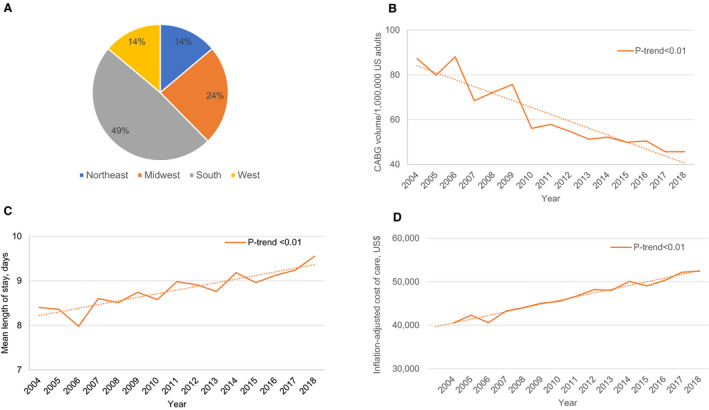
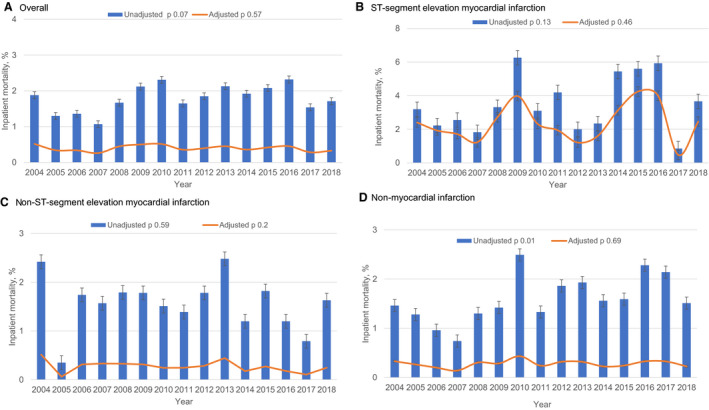
Background Data are limited about young adults' characteristics and outcomes undergoing coronary artery bypass grafting (CABG). Methods and Results We used the National Inpatient Sample database to identify adults aged 18 to 45 years who underwent CABG between 2004 and 2018. The data were weighted to generate national estimates of the entire US hospitalized population. We identified 110 463 CABG cases, equivalent to 62.2 per 1 000 000 person-years; 27.1% were women, and 70.2% were White adults. Overall, annual CABG volume per 1 000 000 significantly decreased from 87.3 in 2004 to 45.7 in 2018. The prevalence of obesity, diabetes mellitus, hypertension, drug abuse, and chronic medical conditions increased over time. Overall, inpatient mortality was 1.76%; ST-segment-elevation myocardial infarction, non-ST-segment-elevation myocardial infarction, heart failure, peripheral vascular disease, renal failure, and valvular surgery were associated with higher inpatient mortality. Women had higher inpatient mortality than men (2.29% versus 1.57%), and Black patients had higher deaths than White patients (2.86% versus 1.58%). Inpatient mortality remained stable overall, according to sex, race, or clinical indication of CABG. However, the mean length of stay (8.4 days in 2004 to 9.5 days in 2018) and inflation-adjusted cost of care ($40 522.8 in 2004 to $52 434.2 in 2018) significantly increased during the study period. Conclusions Despite the increased burden of cardiometabolic risk factors, the inpatient mortality in young adults undergoing CABG remained stable during the last 15 years. However, CABG volumes have decreased, but length of stay and inflation-adjusted costs have increased over time.
背景 关于接受冠状动脉旁路移植术 (CABG) 的年轻成年人的特征和结局的数据有限。
方法和结果 我们使用国家住院患者样本数据库,确定了 2004 年至 2018 年期间接受 CABG 的 18 至 45 岁成年人。对数据进行加权,以生成整个美国住院人群的全国估计值。我们确定了 110 463 例 CABG 病例,相当于每 100 万人中有 62.2 例;27.1%为女性,70.2%为白人成年人。总体而言,每 100 万人每年的 CABG 量从 2004 年的 87.3 例显著下降至 2018 年的 45.7 例。肥胖、糖尿病、高血压、药物滥用和慢性疾病的患病率随时间推移而增加。总体而言,住院死亡率为 1.76%;ST 段抬高型心肌梗死、非 ST 段抬高型心肌梗死、心力衰竭、外周血管疾病、肾衰竭和瓣膜手术与更高的住院死亡率相关。女性的住院死亡率高于男性(2.29%比 1.57%),黑人患者的死亡率高于白人患者(2.86%比 1.58%)。根据 CABG 的性别、种族或临床指征,住院死亡率总体保持稳定。然而,平均住院时间(2004 年为 8.4 天,2018 年为 9.5 天)和调整通胀后的护理费用(2004 年为 40522.8 美元,2018 年为 52434.2 美元)在研究期间显著增加。
结论 尽管心血管代谢危险因素的负担增加,但在过去 15 年中,接受 CABG 的年轻成年人的住院死亡率保持稳定。然而,CABG 量减少,但住院时间和调整通胀后的成本随时间增加。