Graver Technologies, Newark, NJ 07105, USA.
Department of Cardiothoracic Surgery, Stanford University, Stanford, CA 94305, USA; Stanford Cardiovascular Institute, Stanford University, Stanford, CA 94305, USA.
J Mol Cell Cardiol. 2022 Aug;169:13-27. doi: 10.1016/j.yjmcc.2022.04.017. Epub 2022 May 12.
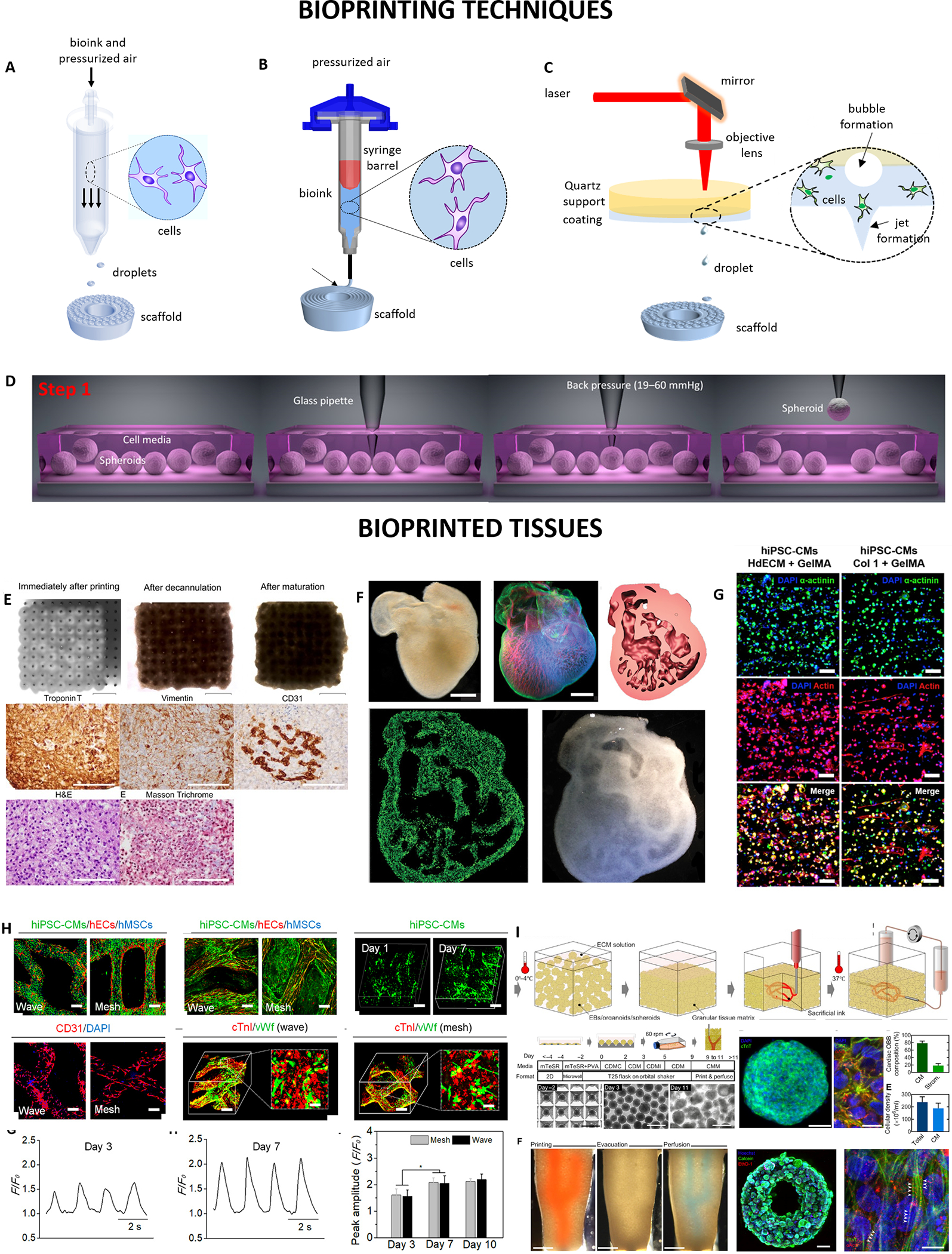
Three-dimensional (3D) bioprinting of cellular or biological components are an emerging field to develop tissue structures that mimic the spatial, mechanochemical and temporal characteristics of cardiovascular tissues. 3D multi-cellular and multi-domain organotypic biological constructs can better recapitulate in vivo physiology and can be utilized in a variety of applications. Such applications include in vitro cellular studies, high-throughput drug screening, disease modeling, biocompatibility analysis, drug testing and regenerative medicine. A major challenge of 3D bioprinting strategies is the inability of matrix molecules to reconstitute the complexity of the extracellular matrix and the intrinsic cellular morphologies and functions. An important factor is the inclusion of a vascular network to facilitate oxygen and nutrient perfusion in scalable and patterned 3D bioprinted tissues to promote cell viability and functionality. In this review, we summarize the new generation of 3D bioprinting techniques, the kinds of bioinks and printing materials employed for 3D bioprinting, along with the current state-of-the-art in engineered cardiovascular tissue models. We also highlight the translational applications of 3D bioprinting in engineering the myocardium cardiac valves, and vascular grafts. Finally, we discuss current challenges and perspectives of designing effective 3D bioprinted constructs with native vasculature, architecture and functionality for clinical translation and cardiovascular regeneration.
三维(3D)细胞或生物成分的生物打印是一个新兴领域,用于开发模拟心血管组织空间、力化学和时间特征的组织结构。3D 多细胞和多域器官型生物构建体可以更好地再现体内生理学,并且可以用于各种应用。此类应用包括体外细胞研究、高通量药物筛选、疾病建模、生物相容性分析、药物测试和再生医学。3D 生物打印策略的主要挑战是基质分子无法重建细胞外基质的复杂性以及固有细胞形态和功能。一个重要因素是包含血管网络,以促进可扩展和图案化 3D 生物打印组织中的氧气和营养灌注,从而促进细胞活力和功能。在这篇综述中,我们总结了新一代 3D 生物打印技术、用于 3D 生物打印的生物墨水和打印材料的种类,以及工程心血管组织模型的最新进展。我们还强调了 3D 生物打印在工程心肌、心脏瓣膜和血管移植物方面的转化应用。最后,我们讨论了设计具有天然血管、结构和功能的有效 3D 生物打印构建体以进行临床转化和心血管再生的当前挑战和前景。