Meegdes Marissa, Geurts Sandra M E, Erdkamp Frans L G, Dercksen Marcus Wouter, Vriens Birgit E P J, Aaldering Kirsten N A, Pepels Manon J A E, van de Winkel Linda M H, Teeuwen Nathalie J A, de Boer Maaike, Tjan-Heijnen Vivianne C G
Department of Internal Medicine, Division of Medical Oncology, GROW School for Oncology and Developmental Biology, Maastricht University Medical Center, Maastricht, The Netherlands.
Department of Internal Medicine, Zuyderland Medical Center, Sittard-Geleen, The Netherlands.
Int J Cancer. 2022 Jan 1;150(1):124-131. doi: 10.1002/ijc.33785. Epub 2021 Sep 14.
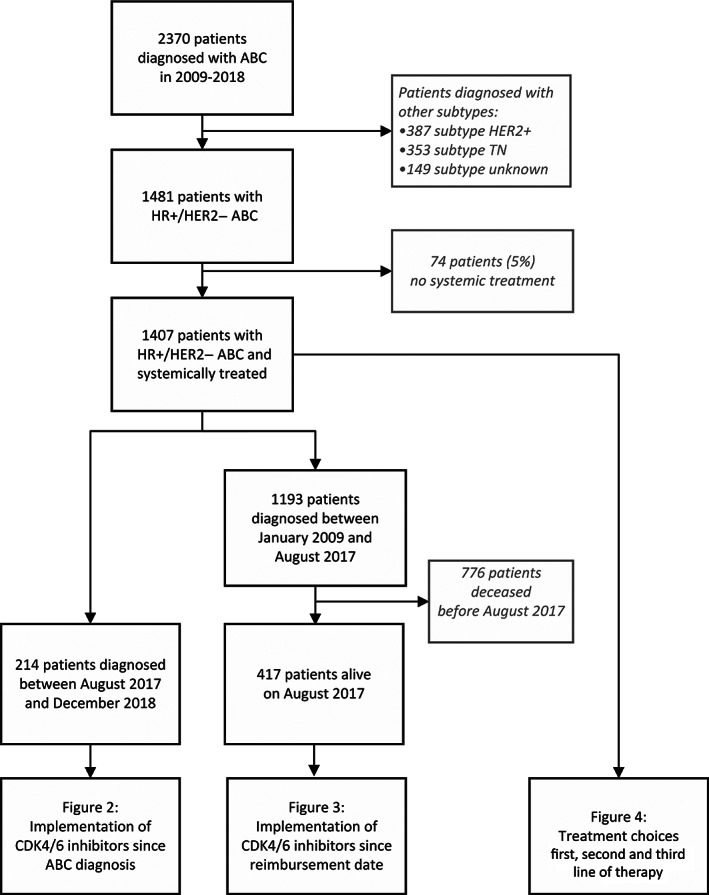
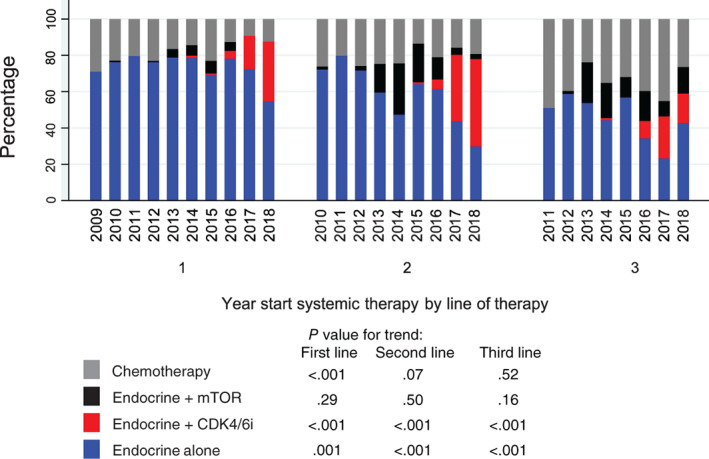
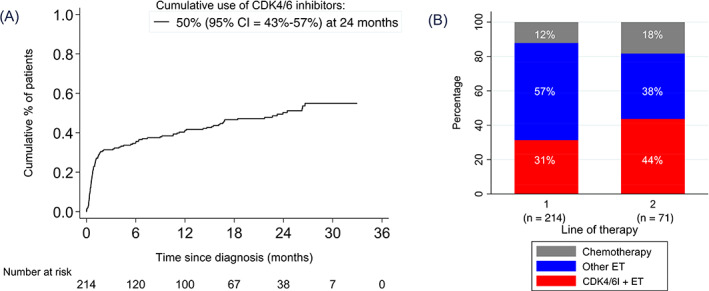
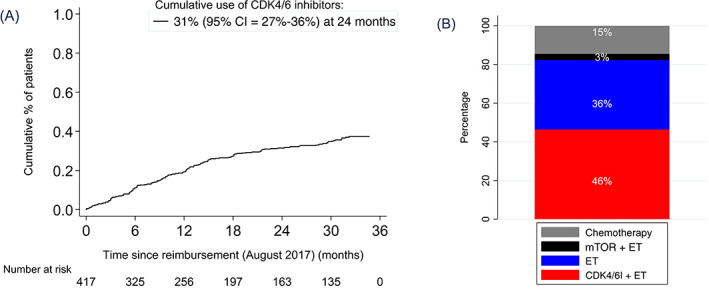
In August 2017, cyclin-dependent kinase 4/6 (CDK4/6) inhibitors combined with endocrine therapy have been reimbursed in the Netherlands for patients with hormone receptor positive (HR+), HER2 negative (HER2-) advanced breast cancer (ABC). This study evaluates the implementation of CDK4/6 inhibitors and changes in treatment choices in the Netherlands. All patients diagnosed with HR+/HER2- ABC in 2009 to 2018 in seven hospitals were selected from the Southeast Netherlands Advanced Breast cancer (SONABRE) registry. The 2-year cumulative use of CDK4/6 inhibitors since reimbursement date (August 2017) was assessed using competing-risk methodology in two cohorts. The first cohort included patients with ABC diagnosis between August 2017 and December 2018. The second cohort included patients with ABC diagnosis between 2009 and August 2017, and still alive on August 1, 2017. In addition, treatment choices in the first three lines of therapy in calendar years 2009 to 2018 were evaluated for the total study population. Among patients diagnosed since August 2017 (n = 214), 50% (95% confidence interval [CI] = 43-57) received CDK4/6 inhibitors within 2 years beyond diagnosis. Of eligible patients diagnosed before August 2017 (n = 417), 31% (95% CI = 27-36) received CDK4/6 inhibitors within 2 years following reimbursement. Another 20% of both cohorts are still CDK4/6 inhibitor naïve and on first-line therapy. The use of chemotherapy decreased in first two lines of therapy between 2009 and 2018 (first-line: 29%-13%; second-line: 26%-19%). The implementation rate of CDK4/6 inhibitors since reimbursement is currently 50% within 2 years beyond diagnosis and is expected to increase further. The implementation of targeted therapy decreased the use of chemotherapy as first-line therapy.
2017年8月起,细胞周期蛋白依赖性激酶4/6(CDK4/6)抑制剂联合内分泌治疗已在荷兰被纳入医保,用于激素受体阳性(HR+)、人表皮生长因子受体2阴性(HER2-)的晚期乳腺癌(ABC)患者。本研究评估了CDK4/6抑制剂在荷兰的实施情况以及治疗选择的变化。从荷兰东南部晚期乳腺癌(SONABRE)登记处选取了2009年至2018年在七家医院被诊断为HR+/HER2- ABC的所有患者。采用竞争风险方法对两个队列自报销日期(2017年8月)起2年的CDK4/6抑制剂累计使用情况进行评估。第一个队列包括2017年8月至2018年12月期间被诊断为ABC的患者。第二个队列包括2009年至2017年8月期间被诊断为ABC且在2017年8月1日仍存活的患者。此外,还评估了2009年至2018年整个研究人群在前三线治疗中的治疗选择。在2017年8月以后被诊断的患者中(n = 214),50%(95%置信区间[CI] = 43 - 57)在诊断后的2年内接受了CDK4/6抑制剂治疗。在2017年8月之前被诊断的符合条件的患者中(n = 417),31%(95% CI = 27 - 36)在报销后的2年内接受了CDK4/6抑制剂治疗。两个队列中另外20%的患者仍未使用CDK4/6抑制剂,正在接受一线治疗。2009年至2018年,前两线治疗中化疗的使用有所减少(一线:29% - 13%;二线:26% - 19%)。自报销以来,CDK4/6抑制剂在诊断后的2年内的实施率目前为50%,预计还会进一步提高。靶向治疗的实施减少了作为一线治疗的化疗的使用。