Meegdes Marissa, Geurts Sandra M E, Erdkamp Frans L G, Dercksen M Wouter, Vriens Birgit E P J, Aaldering Kirsten N A, Pepels Manon J A E, van de Winkel Linda M H, Peters Natascha A J B, Tol Jolien, Heijns Joan B, van de Wouw Agnes J, de Fallois Aude J O, van Kats Maartje A C E, Tjan-Heijnen Vivianne C G
Department of Medical Oncology, GROW School for Oncology and Reproduction, Maastricht University Medical Center, Maastricht, the Netherlands.
Department of Internal Medicine, Zuyderland Medical Center, Sittard-Geleen, the Netherlands.
Lancet Reg Health Eur. 2023 Jan 6;26:100573. doi: 10.1016/j.lanepe.2022.100573. eCollection 2023 Mar.
This study aims to evaluate whether changes in therapeutic strategies have improved survival of patients diagnosed with hormone receptor positive (HR+), HER2 negative (HER2-) advanced breast cancer (ABC) in real-world.
All 1950 patients systemically treated for HR+/HER2- ABC and diagnosed between 2008 and 2019 in eight hospitals were retrieved from the SONABRE Registry (NCT-03577197). Patients were categorized per three-year cohorts based on year of ABC diagnosis. Tests for trend were used to examine differences in baseline characteristics, Kaplan-Meier methods and Cox proportional hazards for survival analyses, and competing-risk methods for 3-year use of systemic therapy.
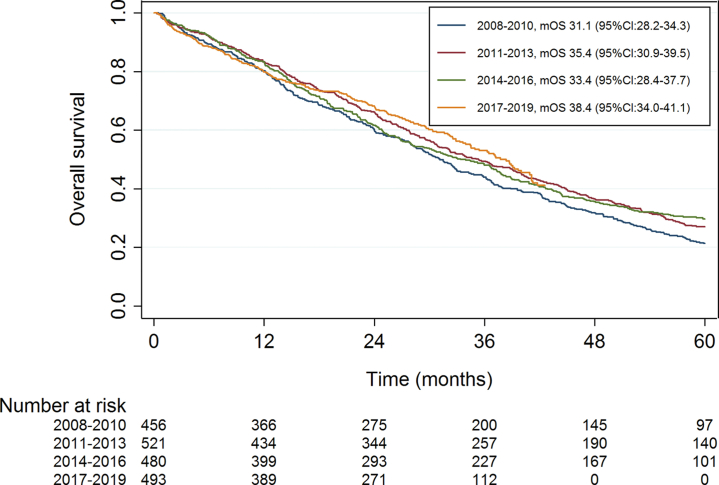
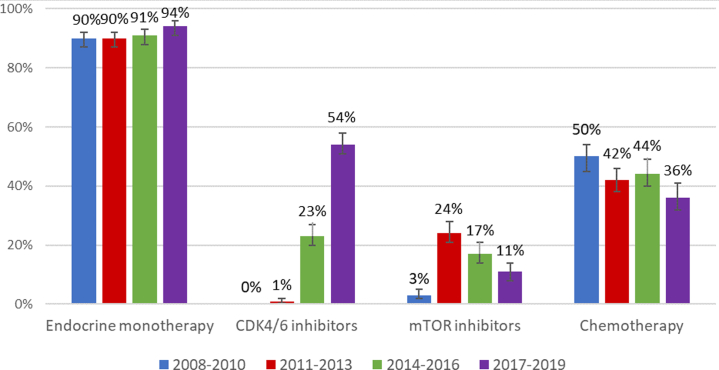
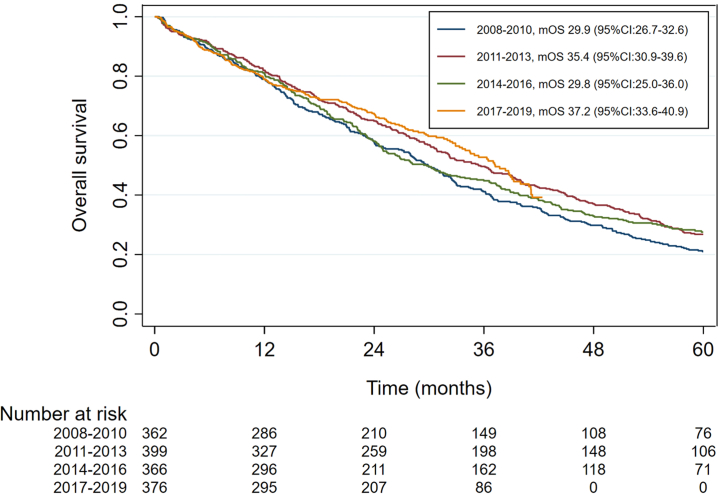
Over time, patients were older (≥70 years, 37%, n = 169/456 in 2008-2010, 47%, n = 233/493 in 2017-2019, p = 0.004) and more often had multiple metastatic sites at ABC diagnosis (48%, n = 220/456 in 2008-2010, 56%, n = 275/493 in 2017-2019, p = 0.002). Among patients with metachronous metastases the prior exposure to (neo-) adjuvant therapies increased over time (chemotherapy, 38%, n = 138/362 in 2008-2010, 48%, n = 181/376 in 2017-2019, p = <0.001; endocrine therapy, 64%, n = 231/362 in 2008-2010, 72%, n = 271/376 in 2017-2019, p = <0.001). Overall survival significantly improved from median 31.1 months (95% CI:28.2-34.3) for patients diagnosed in 2008-2010 to 38.4 months (95% CI:34.0-41.1) in 2017-2019 (adjusted hazard ratio = 0.76, 95% CI:0.64-0.90; p = 0.001). Three-year use of CDK4/6 inhibitors increased from 0% for patients diagnosed in 2008-2010 to 54% for diagnosis in 2017-2019. Conversely, three-year use of chemotherapy was 50% versus 36%, respectively.
Over time, patients diagnosed with HR+/HER2- ABC presented with less favourable patient characteristics. Nevertheless, we observed that overall survival of ABC increased between 2008 and 2019, with increased use of endocrine/targeted therapies.
The SONABRE Registry is supported by the Netherlands Organization for Health Research and Development (ZonMw: 80-82500-98-8003); Novartis BV; Roche; Pfizer; and Eli Lilly & Co. Funding sources had no role in the writing of the manuscript.
本研究旨在评估治疗策略的变化是否改善了现实世界中激素受体阳性(HR+)、人表皮生长因子受体2阴性(HER2-)的晚期乳腺癌(ABC)患者的生存率。
从SONABRE注册中心(NCT-03577197)检索了2008年至2019年期间在八家医院接受HR+/HER2-ABC系统治疗并确诊的所有1950例患者。根据ABC诊断年份,将患者按每三年一组进行分类。采用趋势检验来检查基线特征的差异,采用Kaplan-Meier方法和Cox比例风险模型进行生存分析,采用竞争风险模型分析系统治疗3年的情况。
随着时间的推移,患者年龄更大(≥70岁,2008 - 2010年为37%,n = 169/456;2017 - 2019年为47%,n = 233/493,p = 0.004),且在ABC诊断时出现多个转移部位的情况更常见(2008 - 2010年为48%,n = 220/456;2017 - 2019年为56%,n = 275/493,p = 0.002)。在异时性转移患者中,既往接受(新)辅助治疗的比例随时间增加(化疗,2008 - 2010年为38%,n = 138/362;2017 - 2019年为48%,n = 181/376,p = <0.001;内分泌治疗,2008 - 2010年为64%,n = 231/362;2017 - 2019年为72%,n = 271/376,p = <0.001)。总生存期从2008 - 2010年确诊患者的中位31.1个月(95%CI:28.2 - 34.3)显著改善至2017 - 2019年的38.4个月(95%CI:34.0 - 41.1)(调整后风险比 = 0.76,95%CI:0.64 - 0.90;p = 0.001)。CDK4/6抑制剂的3年使用比例从2008 - 2010年确诊患者的0%增加至2017 - 2019年的54%。相反,化疗的3年使用比例分别为50%和36%。
随着时间的推移,被诊断为HR+/HER2-ABC的患者呈现出不太有利的患者特征。尽管如此,我们观察到2008年至2019年间ABC的总生存期有所增加,内分泌/靶向治疗的使用也有所增加。
SONABRE注册中心由荷兰卫生研究与发展组织(ZonMw:80 - 82500 - 98 - 8003)、诺华公司、罗氏公司、辉瑞公司和礼来公司资助。资助来源在稿件撰写过程中没有发挥作用。