CAS and Shandong Province Key Laboratory of Experimental Marine Biology & Center of Deep Sea Research, Institute of Oceanology, Chinese Academy of Sciences, Qingdao, China; Laboratory for Marine Biology and Biotechnology, Qingdao National Laboratory for Marine Science and Technology, Qingdao, China; Center of Ocean Mega-Science, Chinese Academy of Sciences, Qingdao, China.
CAS and Shandong Province Key Laboratory of Experimental Marine Biology & Center of Deep Sea Research, Institute of Oceanology, Chinese Academy of Sciences, Qingdao, China; Laboratory for Marine Biology and Biotechnology, Qingdao National Laboratory for Marine Science and Technology, Qingdao, China; Center of Ocean Mega-Science, Chinese Academy of Sciences, Qingdao, China; College of Earth Science, University of Chinese Academy of Sciences, Beijing, China.
J Biol Chem. 2021 Oct;297(4):101133. doi: 10.1016/j.jbc.2021.101133. Epub 2021 Aug 28.
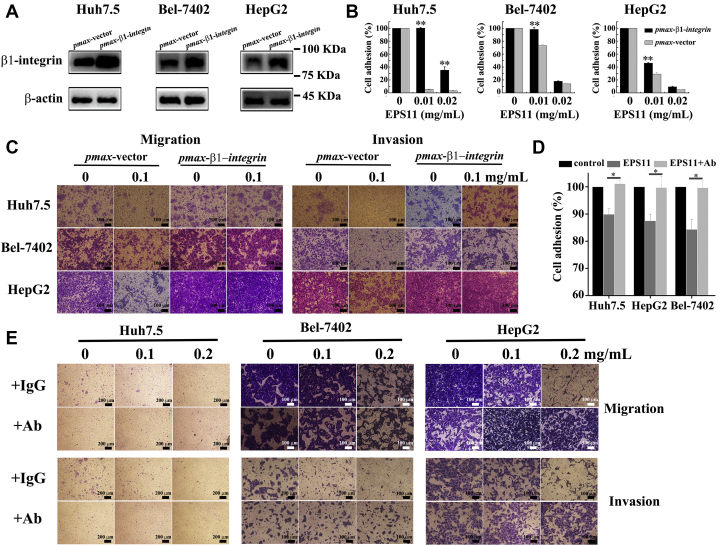
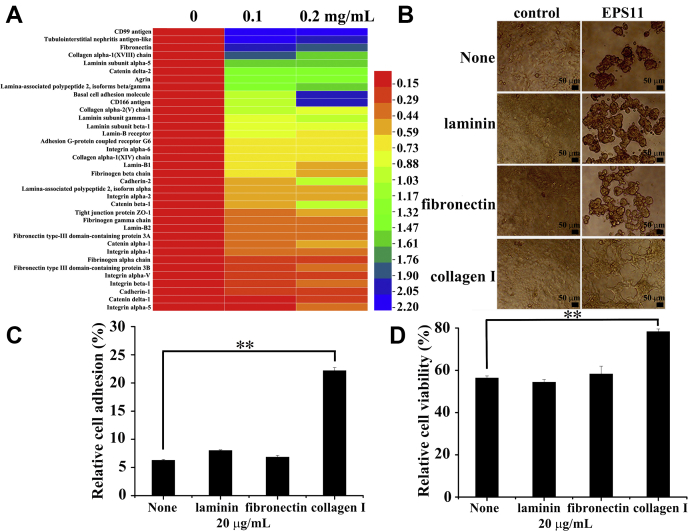
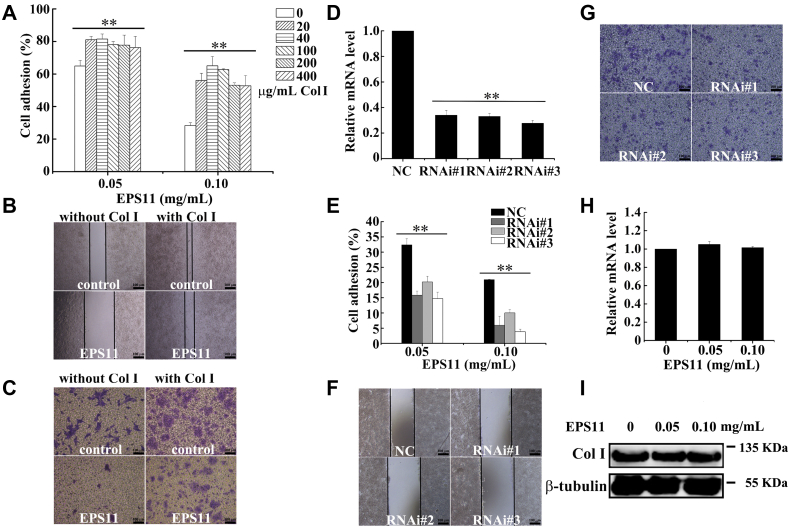
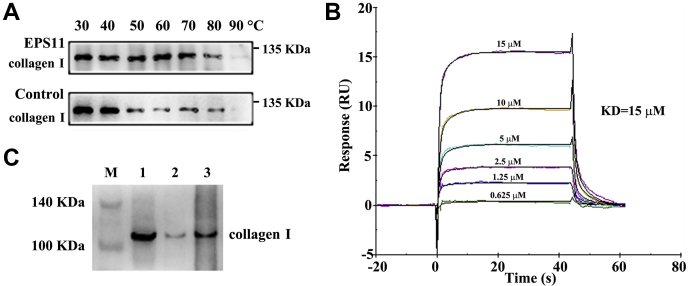
Many natural polysaccharides have significant anticancer activity with low toxicity, but the complex chemical structures make in-depth studies of the involved mechanisms extremely difficult. The purpose of this study was to investigate the effect of the marine bacterial exopolysaccharide (exopolysaccharide 11 [EPS11]) on liver cancer metastasis to explore the underlying target protein and molecular mechanism. We found that EPS11 significantly suppressed cell adhesion, migration, and invasion in liver cancer cells. Proteomic analysis showed that EPS11 induced downregulation of proteins related to the extracellular matrix-receptor interaction signaling pathway. In addition, the direct pharmacological target of EPS11 was identified as collagen I using cellular thermal shift assays. Surface plasmon resonance and pull-down assays further confirmed the specific binding of EPS11 to collagen I. Moreover, EPS11 was shown to inhibit tumor metastasis by directly modulating collagen I activity via the β1-integrin-mediated signaling pathway. Collectively, our study demonstrated for the first time that collagen I could be a direct pharmacological target of polysaccharide drugs. Moreover, directly targeting collagen I may be a promising strategy for finding novel carbohydrate-based drugs.
许多天然多糖具有显著的抗癌活性和低毒性,但复杂的化学结构使得深入研究相关机制变得极其困难。本研究旨在探讨海洋细菌胞外多糖(胞外多糖 11[EPS11])对肝癌转移的影响,以探讨潜在的靶蛋白和分子机制。我们发现 EPS11 能显著抑制肝癌细胞的黏附、迁移和侵袭。蛋白质组学分析表明,EPS11 诱导与细胞外基质-受体相互作用信号通路相关的蛋白下调。此外,细胞热转移分析鉴定出 EPS11 的直接药理靶标为胶原蛋白 I。表面等离子体共振和下拉实验进一步证实了 EPS11 与胶原蛋白 I 的特异性结合。此外,通过β1-整合素介导的信号通路,EPS11 被证明可以通过直接调节胶原蛋白 I 的活性来抑制肿瘤转移。总之,本研究首次证明胶原蛋白 I 可能是多糖药物的直接药理靶标。此外,直接靶向胶原蛋白 I 可能是寻找新型基于碳水化合物药物的有前途的策略。