Department of Medicine, New York University Langone Health, New York City, NY, USA.
Department of Medicine, Beth Israel Deaconess Medical Center, Boston, MA, USA.
Nutr Res. 2021 Sep;93:87-98. doi: 10.1016/j.nutres.2021.07.007. Epub 2021 Aug 1.
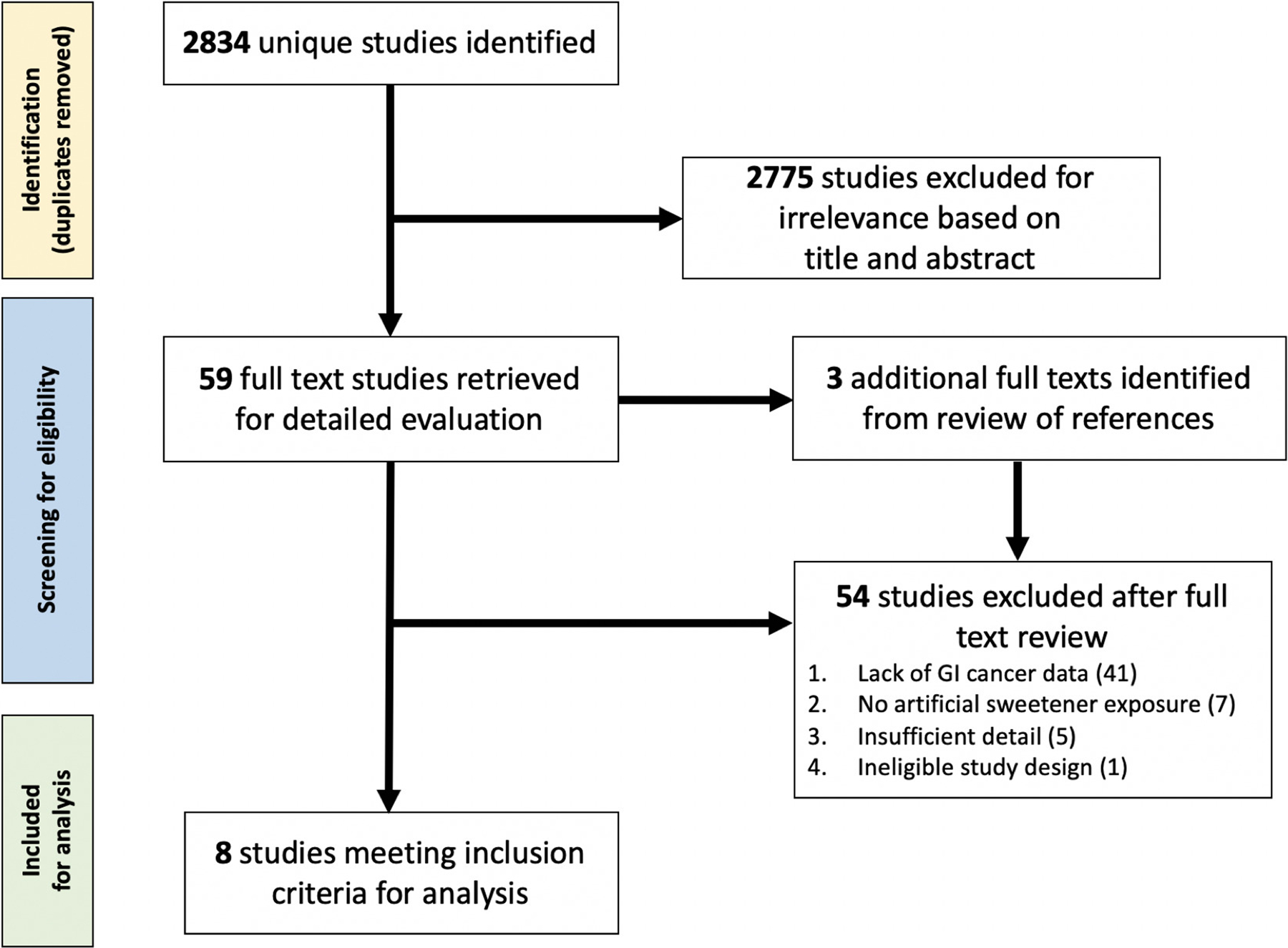
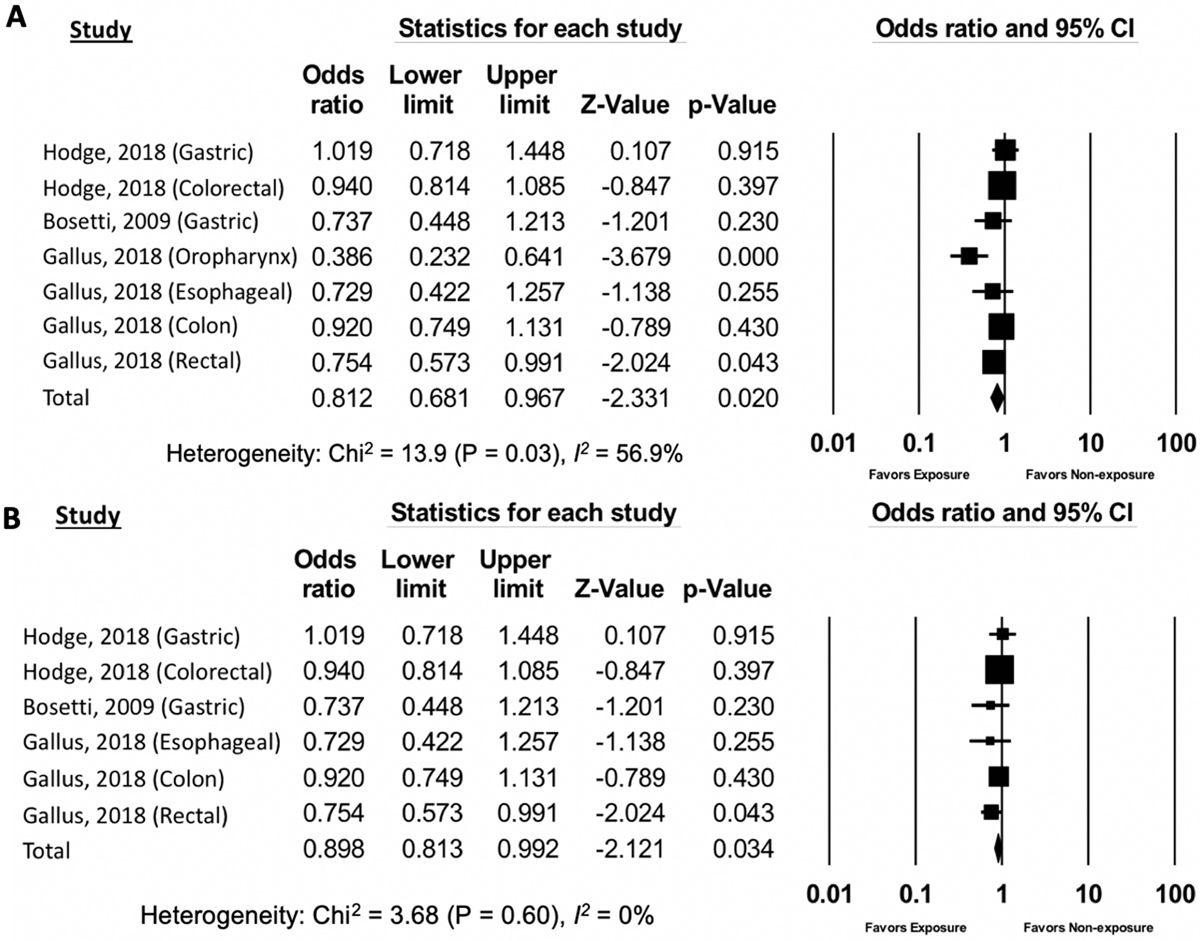
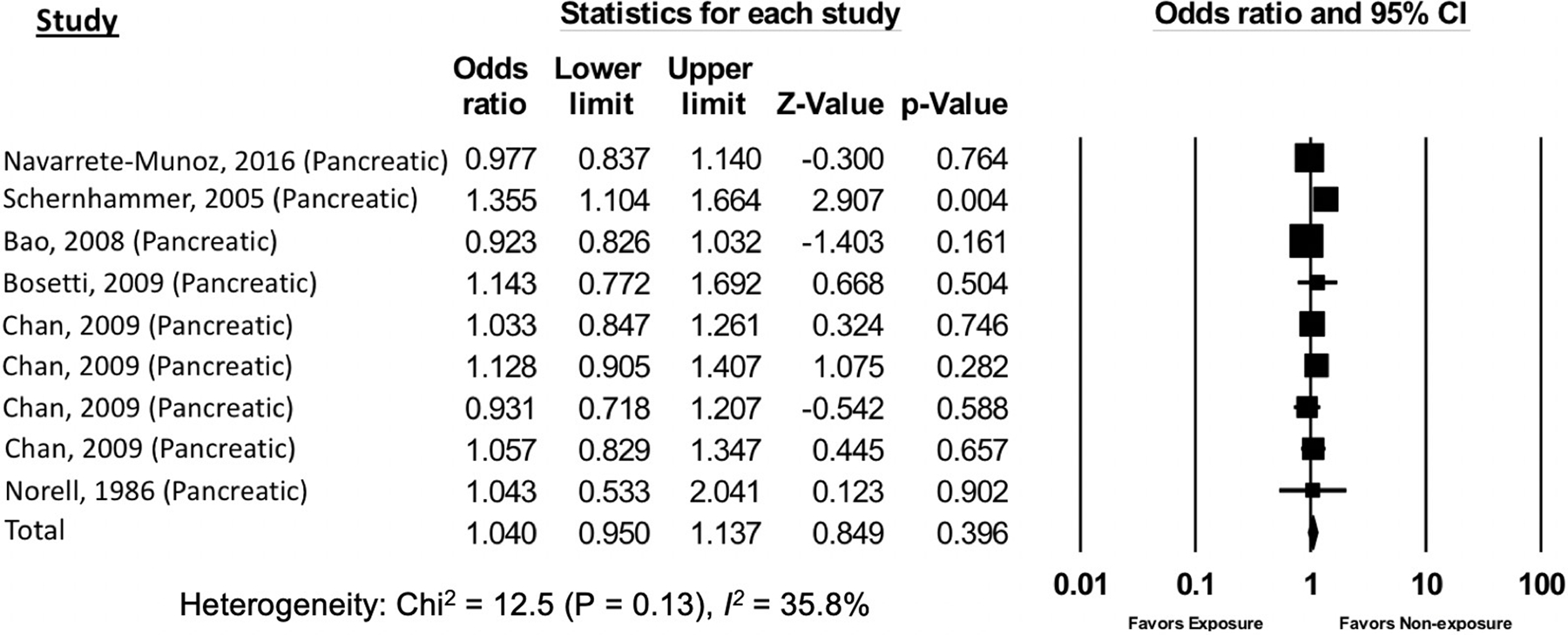
The association between artificial sweetener (AS) consumption and the risk of organ-specific cancers has been debated for decades. We hypothesized that AS consumption is associated with reduced risk of gastrointestinal (GI) cancers. We aimed to test this hypothesis by conducting a systematic review and meta-analysis of the association between AS and GI cancers. We searched 4 databases for comparative studies of AS consumption (exposed) versus no consumption (nonexposed) and the odds or risk of GI luminal or non-luminal cancer (primary outcome). Estimates were pooled using a random-effects model. Studies were evaluated for quality, bias, and heterogeneity. We analyzed 8 (4 prospective, 4 case-control) studies comprising data on 1,043,496 individuals, among whom 3271 pancreatic, 395 gastric, 304 esophageal, 3008 colorectal, and 598 oropharyngeal cancers occurred. While there was no significant association between AS consumption and odds of GI cancer overall, AS consumption was associated with 19% reduced likelihood of luminal GI cancer (OR 0.81, 95% CI:0.68-0.97). There was no association between AS consumption and non-luminal GI cancer. Meta-regression demonstrated no difference in effect estimates based on study type. Based on this first meta-analysis of AS and GI cancer, we demonstrated that AS consumption is associated with a significantly lower likelihood of luminal, but not non-luminal, GI cancer.
人工甜味剂(AS)的摄入与特定器官癌症风险之间的关联已经争论了几十年。我们假设 AS 的摄入与胃肠道(GI)癌症风险降低有关。我们旨在通过对 AS 与 GI 癌症之间的关联进行系统评价和荟萃分析来检验这一假设。我们在 4 个数据库中搜索了比较 AS 摄入(暴露)与无摄入(非暴露)以及 GI 腔道或非腔道癌症(主要结局)风险的比值比或风险的对照研究。使用随机效应模型汇总估计值。对研究进行了质量、偏倚和异质性评估。我们分析了 8 项(4 项前瞻性、4 项病例对照)研究,共纳入了 1043496 名个体的数据,其中 3271 例胰腺癌、395 例胃癌、304 例食管癌、3008 例结直肠癌和 598 例口咽癌发生。尽管 AS 摄入与 GI 癌症总体发生的比值比无显著关联,但 AS 摄入与腔道 GI 癌症的发生几率降低 19%相关(OR 0.81,95%CI:0.68-0.97)。AS 摄入与非腔道 GI 癌症无关。荟萃回归表明,研究类型对效应估计值没有差异。基于这项对 AS 和 GI 癌症的首次荟萃分析,我们表明 AS 摄入与腔道而非非腔道 GI 癌症的发生几率显著降低相关。