Kafczyk Tom, Hämel Kerstin
Department of Health Services Research and Nursing Science, School of Public Health, Bielefeld University, Universitaetsstrasse 25, 33651, Bielefeld, Germany.
Department of Health Services Research and Nursing Science, School of Public Health, Bielefeld University, Universitätsstrasse 25, 33615, Bielefeld, Germany.
Int J Ment Health Syst. 2021 Aug 30;15(1):72. doi: 10.1186/s13033-021-00494-8.
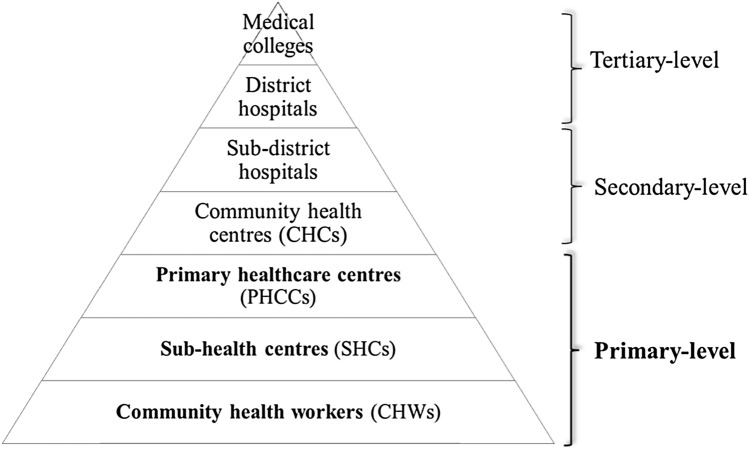
Old age mental healthcare is an issue that cuts across old age, general health, and mental healthcare policies. While strengthening the primary mental healthcare system in India is a common strategy across policy fields to improve the mental health of older persons, very little is known about the system's planned architecture. This study explores public policy strategies for and approaches to the mental health of older persons, focusing on the primary healthcare (PHC) level and the role of the family.
A document analysis of 39 key public national policy documents (2007 - 2019) from three thematically grouped policy fields (mental health, old age, and general health) was conducted.
Comprehensive community-based primary mental healthcare - focusing on vulnerable population groups including older persons - has been strengthened significantly since 2007. The promulgated approaches and strategies build on traditional community-based approaches to mental healthcare in India. They focus on (a) integrating community health workers into primary mental healthcare, (b) empowering the community to participate in healthcare planning, implementation, and monitoring, (c) supporting the family through a family-led approach to mental healthcare, and (d) integrating traditional Ayurveda, Yoga and Naturopathy, Unani, Siddha, Sowa-Rigpa and Homeopathy (AYUSH) services into primary mental healthcare.
While all policy fields address mental PHC, they do so in different ways, and approaches and strategies that promote an integrated perspective across policy fields are lacking. To realize the policies vision, strengthening PHC will be essential. Further research should evaluate strategies and approaches in light of social developments, such as eroding family norms and the poor state of the public health system in India, in order to assess their opportunities, challenges, and overall feasibility, with the benefits older people would experience taking centre stage in these inquiries.
老年心理健康护理是一个涉及老年、总体健康和心理健康护理政策的问题。虽然加强印度的初级心理健康护理系统是各个政策领域中改善老年人心理健康的共同策略,但对于该系统的规划架构却知之甚少。本研究探讨针对老年人心理健康的公共政策策略及方法,重点关注初级医疗保健(PHC)层面以及家庭的作用。
对来自三个主题分组政策领域(心理健康、老年和总体健康)的39份关键国家公共政策文件(2007 - 2019年)进行了文献分析。
自2007年以来,以社区为基础的综合初级心理健康护理——关注包括老年人在内的弱势群体——得到了显著加强。所颁布的方法和策略建立在印度传统的基于社区的心理健康护理方法之上。它们侧重于:(a)将社区卫生工作者纳入初级心理健康护理;(b)赋予社区参与医疗保健规划、实施和监测的权力;(c)通过以家庭为主导的心理健康护理方法支持家庭;(d)将传统的阿育吠陀、瑜伽与自然疗法、尤那尼、悉达、索瓦日巴和顺势疗法(AYUSH)服务纳入初级心理健康护理。
虽然所有政策领域都涉及初级心理健康护理,但方式各异,且缺乏促进跨政策领域综合视角的方法和策略。为实现政策愿景,加强初级医疗保健至关重要。进一步的研究应根据社会发展情况评估策略和方法,如印度家庭规范的侵蚀和公共卫生系统的糟糕状况,以评估其机遇、挑战和总体可行性,同时将老年人将获得的益处作为这些调查的核心关注点。