Fasihi Sanaz, Fazelian Siavash, Farahbod Farinaz, Moradi Fateme, Dehghan Morteza
Department of Orthopedic, School of Medicine, Shahrekord University of Medical Sciences, Shahrekord, Iran.
Clinical Research Development Unit, Ayatollah Kashani Hospital, Shahrekord University of Medical Sciences, Shahrekord, Iran.
J Menopausal Med. 2021 Aug;27(2):94-101. doi: 10.6118/jmm.20036.
Postmenopausal women are predisposed to osteoporosis, and those on acidic diets are at a higher risk, because it has been demonstrated that such diets have adverse effects on bone health. In this study, the effect of alkaline drinking water on bone mineral density was evaluated in postmenopausal women with osteoporosis.
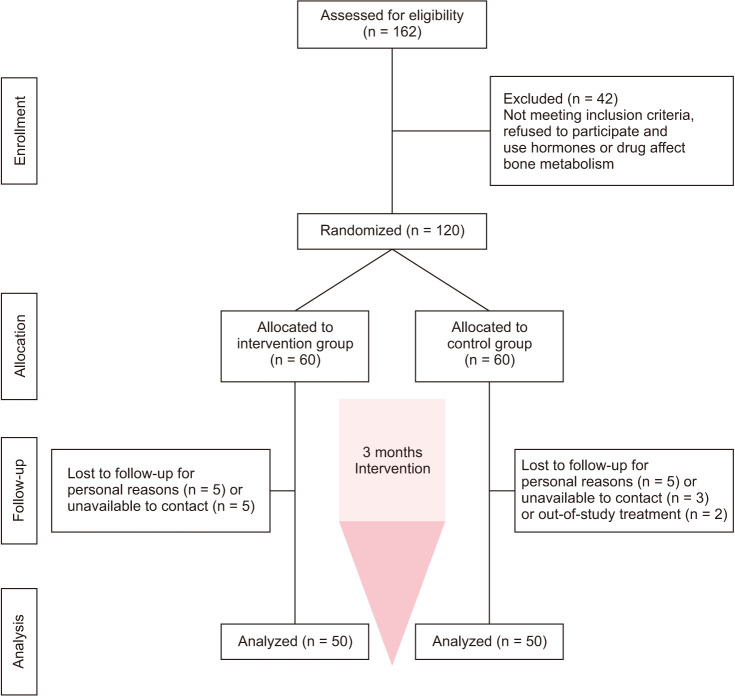
One hundred postmenopausal women with osteoporosis (T-score ≤ -2.5) were equally divided into an intervention group and a control group (n = 50 each). The intervention group received calcium D (daily), alkaline drinking water (1.5 L daily with pH 8.6 ± 0.3), and Osteofos tablet (70 mg weekly), whereas the control group received only calcium D and Osteofos tablet for 3 months. T-scores of the femur and spine bones were obtained using bone densitometry before and 3 months after the intervention.
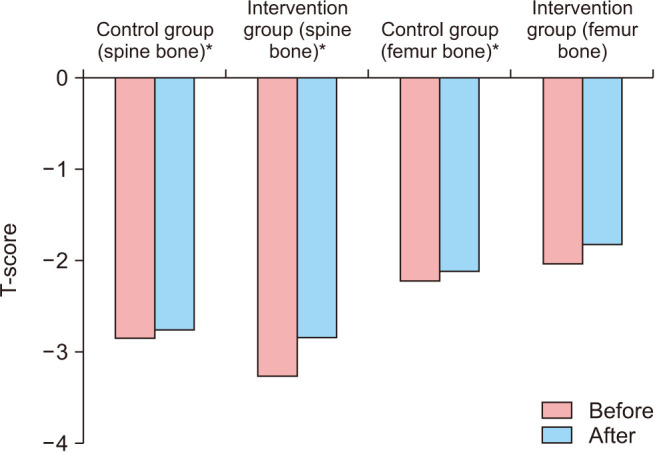
After the intervention, the mean T-scores of the femur and spine bones significantly increased in both the control and intervention groups ( < 0.05). However, the mean changes in the spine T-score were significantly higher in the intervention group (0.39 ± 0.07) than in the control group (0.08 ± 0.01) ( < 0.05). No significant differences were observed in the mean changes in the femur T-score between the two groups.
Our findings demonstrate that drinking alkaline water improves spine T-scores in postmenopausal women with osteoporosis. Hence, alkaline water can be used to treat osteoporosis due to increased bone density in postmenopausal women. Long-term interventions are necessary to confirm the effects of alkaline water on femur density.
绝经后女性易患骨质疏松症,而食用酸性饮食的女性风险更高,因为已证明此类饮食会对骨骼健康产生不利影响。在本研究中,评估了碱性饮用水对绝经后骨质疏松症女性骨密度的影响。
100名绝经后骨质疏松症女性(T值≤ -2.5)被平均分为干预组和对照组(每组n = 50)。干预组每日服用钙D、饮用碱性饮用水(每日1.5升,pH值为8.6±0.3)并每周服用一次骨磷片(70毫克),而对照组仅服用钙D和骨磷片,为期3个月。在干预前及干预3个月后,使用骨密度测定法获取股骨和脊柱骨的T值。
干预后,对照组和干预组的股骨和脊柱骨平均T值均显著增加(<0.05)。然而,干预组脊柱T值的平均变化(0.39±0.07)显著高于对照组(0.08±0.01)(<0.05)。两组之间股骨T值的平均变化未观察到显著差异。
我们的研究结果表明,饮用碱性水可提高绝经后骨质疏松症女性的脊柱T值。因此,由于绝经后女性骨密度增加,碱性水可用于治疗骨质疏松症。需要长期干预以确认碱性水对股骨密度的影响。