Costanzo Gabriele, Curatolo Salvatore, Busà Barbara, Belfiore Antonino, Gullo Damiano
Endocrine Unit, Department of Clinical and Experimental Medicine, University of Catania, Garibaldi-Nesima Hospital, Catania, Italy.
Dermatology Unit, Garibaldi Hospital, Catania, Italy.
Endocrinol Diabetes Metab Case Rep. 2021 Aug 1;2021. doi: 10.1530/EDM-21-0007.
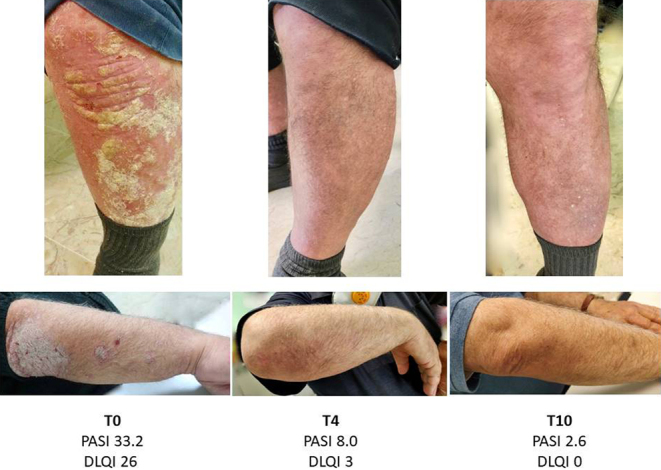
Semaglutide is a glucagon-like peptide 1 (GLP-1) receptor agonist, approved for the treatment of type 2 diabetes mellitus (T2DM). GLP-1 analogs exert several biological activities connected not only with an insulinotropic effect but also with immunoregulation and reduction of inflammation. A 73-year-old male patient with class III obesity was referred to us for T2DM, which was not controlled with metformin therapy. He had suffered from plaque psoriasis for some years and was treated with topical therapy and adalimumab, without success. The psoriasis area and severity index (PASI) was 33.2 (indicating severe psoriasis), and the dermatology life quality index (DLQI) was 26.0 (indicating an extremely negative effect on the patient's life). Semaglutide (starting with 0.25 mg/week for 4 weeks, increased to 0.50 mg/week for 12 weeks, and then to 1 mg/week) was added to metformin. After 4 months, glycemic parameters had improved, and his body weight decreased. Unexpectedly, skin lesions of plaque psoriasis improved. PASI decreased by 19% compared with baseline and quality of life, assessed with the DLQI, markedly ameliorated. After 10 months, glycemic and obesity parameters, as well as psoriasis, improved further. HbA1c, BMI, and PASI were reduced by 32, 16.3, and 92%, respectively, compared with the baseline. DLQI declined to 0, meaning there was no effect of plaque psoriasis on the patient's life.
Psoriasis in patients with type 2 diabetes is often resistant to therapy. We observed an obese patient with type 2 diabetes mellitus who achieved glycemic control and weight loss with the addition of semaglutide to metformin and had a relevant and long-lasting improvement of plaque psoriasis, which was previously resistant to biologic therapy. Therapy with semaglutide may be attempted in eligible patients with difficult to treat plaque psoriasis.
司美格鲁肽是一种胰高血糖素样肽1(GLP-1)受体激动剂,已被批准用于治疗2型糖尿病(T2DM)。GLP-1类似物具有多种生物学活性,不仅与促胰岛素分泌作用有关,还与免疫调节和炎症减轻有关。一名73岁的III级肥胖男性患者因T2DM前来就诊,二甲双胍治疗未能控制其病情。他患有斑块状银屑病数年,接受过局部治疗和阿达木单抗治疗,但均未成功。银屑病面积和严重程度指数(PASI)为33.2(表明为重度银屑病),皮肤病生活质量指数(DLQI)为26.0(表明对患者生活有极其负面的影响)。在二甲双胍基础上加用司美格鲁肽(起始剂量为0.25毫克/周,持续4周,然后增加至0.50毫克/周,持续12周,之后增至1毫克/周)。4个月后,血糖参数得到改善,体重减轻。出乎意料的是,斑块状银屑病的皮肤病变有所改善。与基线相比,PASI下降了19%,用DLQI评估的生活质量明显改善。10个月后,血糖和肥胖参数以及银屑病进一步改善。与基线相比,糖化血红蛋白、体重指数和PASI分别降低了32%、16.3%和92%。DLQI降至0,这意味着斑块状银屑病对患者生活没有影响。
2型糖尿病患者的银屑病通常对治疗有抵抗性。我们观察到一名2型糖尿病肥胖患者,在二甲双胍基础上加用司美格鲁肽后实现了血糖控制和体重减轻,并且斑块状银屑病有显著且持久的改善,该银屑病此前对生物治疗有抵抗性。对于符合条件的难治性斑块状银屑病患者,可尝试使用司美格鲁肽进行治疗。