Castle Philip E, Kinney Walter K, Chen Lu, Kim Jane J, Jenison Steven, Rossi Giovanna, Kang Huining, Cuzick Jack, Wheeler Cosette M
Albert Einstein College of Medicine, Bronx, NY, USA.
National Institutes of Health, National Cancer Institute, Division of Cancer Prevention and Division of Cancer Epidemiology and Genetics, Rockville, MD, USA.
J Natl Cancer Inst. 2021 Aug 31;114(4):626-30. doi: 10.1093/jnci/djab173.
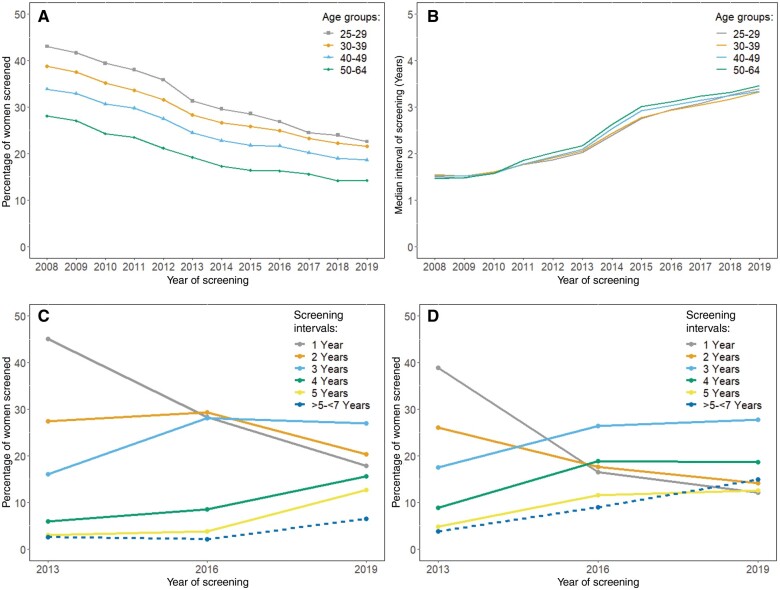
In 2012, national recommendations for cervical-cancer screening of women aged 30-64 years were quinquennial human papillomavirus and cytology co-testing or triennial cytology. Data from a state-wide surveillance program in New Mexico demonstrated 65.2% (95% confidence interval [95%CI]= 64.6%% to 65.7%) of women screened in 2019 had negative co-test within the last 3 years. Percentages of women screened in 2013, 2016, and 2019 with a prior negative co-test more than 5 and up to 7 years ago were 2.6% (95% CI = 2.2% to 2.9%), 2.1% (95% CI = 1.9% to 2.2%), and 6.5% (95% CI = 6.2% to 6.8%), respectively (2-sided P trend<.001). Percentages of women screened in 2013, 2016, and 2019 with a prior negative cytology more than 5 and up to 7 years ago were 3.8% (95% CI = 3.7% to 3.9%), 9.0% (95% CI = 8.7% to 9.3%), and 14.9% (95% CI = 14.4% to 15.4%), respectively (2-sided P trend<.001). Thus, in 2019, only 12.7% (95% CI = 12.4% to 13.1%) of the 30,215 women aged 30-64 years underwent co-testing and 27.7% (95% CI = 27.1% to 28.3%) of the 18,733 underwent cytology at the recommended interval. The observed under- and over-screening could result in increases in cervical-cancer incidence and harms and costs, respectively.
2012年,针对30 - 64岁女性的宫颈癌筛查全国性建议是每五年进行一次人乳头瘤病毒和细胞学联合检测,或每三年进行一次细胞学检测。新墨西哥州一项全州范围监测项目的数据显示,2019年接受筛查的女性中,65.2%(95%置信区间[95%CI]=64.6%至65.7%)在过去3年内联合检测结果为阴性。2013年、2016年和2019年接受筛查且5年以上至7年前联合检测结果曾为阴性的女性比例分别为2.6%(95%CI=2.2%至2.9%)、2.1%(95%CI=1.9%至2.2%)和6.5%(95%CI=6.2%至6.8%)(双侧P趋势<.001)。2013年、2016年和2019年接受筛查且5年以上至7年前细胞学检测结果曾为阴性的女性比例分别为3.8%(95%CI=3.7%至3.9%)、9.0%(95%CI=8.7%至9.3%)和14.9%(95%CI=14.4%至15.4%)(双侧P趋势<.001)。因此,在2019年,30215名30 - 64岁女性中只有12.7%(95%CI=12.4%至13.1%)进行了联合检测,18733名女性中有27.7%(95%CI=27.1%至28.3%)按照推荐间隔进行了细胞学检测。观察到的筛查不足和过度筛查可能分别导致宫颈癌发病率上升以及危害和成本增加。