Criner Gerard J, Cole Therese, Hahn Kristen A, Kastango Kari, Eudicone James M, Gilbert Ileen
Temple University Hospital, Philadelphia, PA, USA.
Department of Thoracic Medicine and Surgery, Lewis Katz School of Medicine At Temple University, 3500 North Broad Street, Philadelphia, PA, 19140, USA.
Pulm Ther. 2021 Dec;7(2):533-547. doi: 10.1007/s41030-021-00168-3. Epub 2021 Aug 31.
Telemonitoring is a promising self-management strategy to improve health care outcomes. This study evaluated real-world adoption of the chronic obstructive pulmonary disease (COPD) Co-Pilot daily symptom monitoring tool by patients and primary care providers (PCPs).
An open-label, 6-month, single-arm, multicenter, noninterventional feasibility study enrolled 97 patients aged ≥ 40 years with symptomatic or poorly controlled COPD and ≥ 10 pack-year smoking history. Patients received smartphones and training to use the COPD Co-Pilot application. During the study, patients tracked symptoms daily; an increase in symptom score of ≥ 1.0 point from baseline (symptom alert) prompted patients to contact their PCP via toll-free number. The primary endpoint was time to clinical recommendation (TTCR) from a symptom alert; adherence to completing daily symptom reports through the COPD Co-Pilot application and patient satisfaction were also measured.
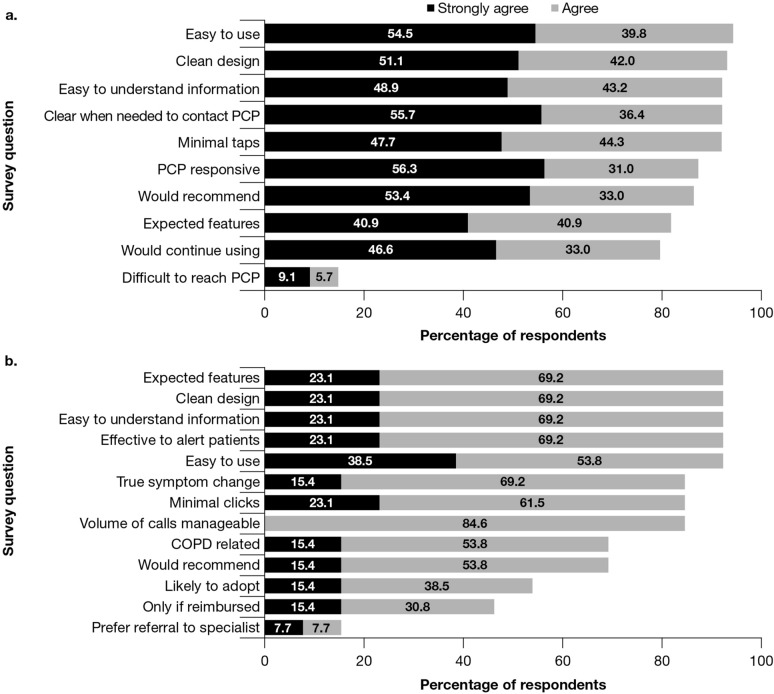
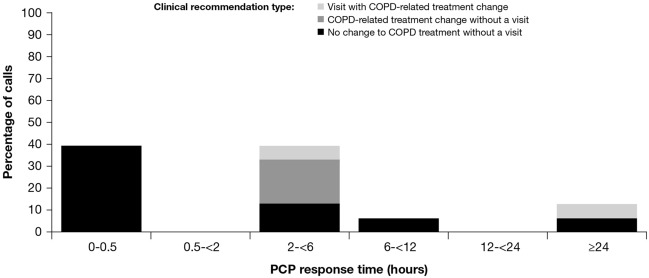
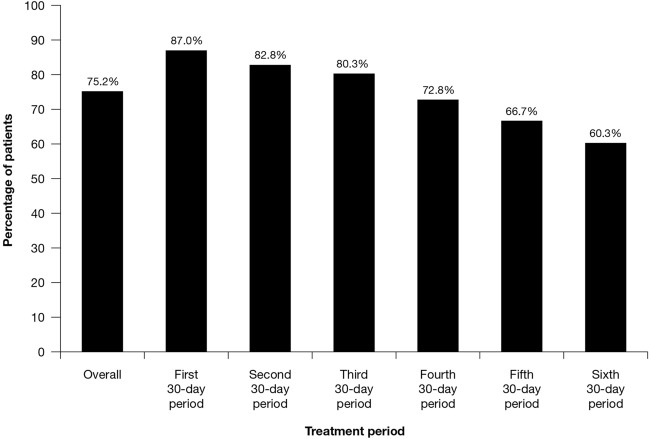
Overall, 87 of 96 patients (90.6%) received 2142 symptom alerts; 42 alerts (equivalent to 2% of all symptom alerts) resulted in 23 patients contacting their PCP. Median TTCR was 7.1 h (interquartile range [IQR]: 4.0-29.9). Among 15 patients using the toll-free number, median TTCR was 2.1 h (IQR 0.0-7.2) versus 19.6 h (IQR 4.5-45.2) for eight patients using other contact methods. Average COPD Co-Pilot adherence overall was 75.2% (95% CI 74.6-75.9). Patients responded favorably regarding the application's ease of use, functionality, and information provided.
The COPD Co-Pilot tool was associated with relatively high levels of adherence, suggesting patients' willingness to monitor symptoms daily. Although a limited number of patients initiated PCP contact, patients who used the study-provided toll-free number had substantially shorter median TTCR, suggesting that this tool could help empower patients to better manage their COPD.
远程监测是一种很有前景的自我管理策略,有助于改善医疗保健效果。本研究评估了慢性阻塞性肺疾病(COPD)联合辅助每日症状监测工具在患者和初级保健提供者(PCP)中的实际应用情况。
一项开放标签、为期6个月、单臂、多中心、非干预性的可行性研究纳入了97例年龄≥40岁、有症状或控制不佳的COPD且吸烟史≥10包年的患者。患者收到智能手机并接受使用COPD联合辅助应用程序的培训。在研究期间,患者每天跟踪症状;症状评分较基线增加≥1.0分(症状警报)促使患者通过免费电话联系其初级保健提供者。主要终点是症状警报后至临床建议的时间(TTCR);还测量了通过COPD联合辅助应用程序完成每日症状报告的依从性和患者满意度。
总体而言,96例患者中的87例(90.6%)收到了2142次症状警报;42次警报(相当于所有症状警报的2%)导致23例患者联系了他们的初级保健提供者。TTCR的中位数为7.1小时(四分位间距[IQR]:4.0 - 29.9)。在15例使用免费电话的患者中,TTCR的中位数为2.1小时(IQR 0.0 - 7.2),而8例使用其他联系方式的患者为19.6小时(IQR 4.5 - 45.2)。总体上COPD联合辅助应用程序的平均依从率为75.2%(95%CI 74.6 - 75.9)。患者对该应用程序的易用性、功能和提供的信息给予了积极评价。
COPD联合辅助工具具有较高的依从性,表明患者愿意每日监测症状。尽管只有少数患者联系了初级保健提供者,但使用研究提供的免费电话的患者TTCR中位数明显更短,这表明该工具可以帮助患者更好地管理他们的COPD。