Respiratory Medicine, Institute for Clinical and Applied Health Research, Hull York Medical School, Hull, UK.
Respiratory Medicine, Hull University Teaching Hospitals NHS Trust, Cottingham, HU16 5JQ, UK.
Lung. 2021 Apr;199(2):131-137. doi: 10.1007/s00408-021-00435-9. Epub 2021 Apr 7.
Acute exacerbations of COPD (AE-COPD) are a leading cause of health service utilisation and are associated with morbidity and mortality. Identifying the prodrome of AE-COPD by monitoring symptoms and physiological parameters (telemonitoring) has proven disappointing and false alerts limit clinical utility. We report objective monitoring of cough counts around AE-COPD and the performance of a novel alert system identifying meaningful change in cough frequency.
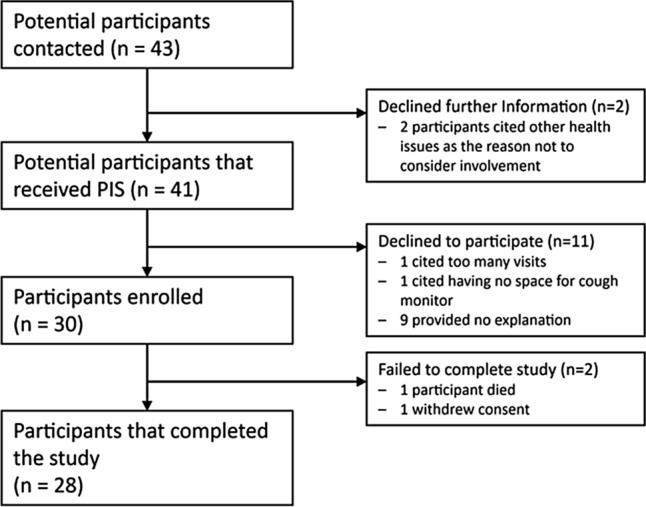
This prospective longitudinal study of cough monitoring included chronic obstructive pulmonary disease (COPD) patients experienced in telemonitoring that had two or more AE-COPD in the past year. Participants underwent cough monitoring and completed a daily questionnaire for 90 days. The automated system identified deteriorating trends in cough and this was compared with alerts generated by an established telemonitoring questionnaire.
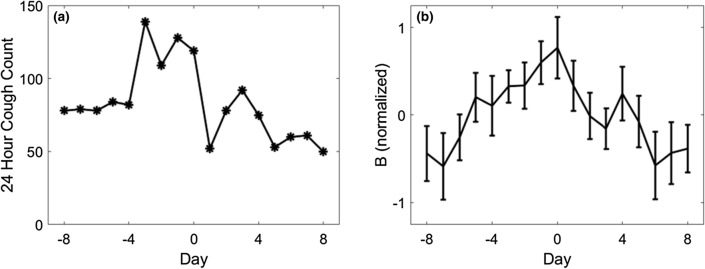
28 patients [median age 66 (range 46-86), mean FEV-1% predicted 36% (SD 18%)] completed the study and had a total of 58 exacerbations (43 moderate and 15 severe). Alerts based on cough monitoring were generated mean 3.4 days before 45% of AE-COPD with one false alert every 100 days. In contrast, questionnaire-based alerts occurred in the prodrome of 88% of AE-COPD with one false alert every 10 days.
An alert system based on cough frequency alone predicted 45% AE-COPD; the low false alert rate with cough monitoring suggests it is a practical and clinically relevant tool. In contrast, the utility of questionnaire-based symptom monitoring is limited by frequent false alerts.
慢性阻塞性肺疾病(COPD)急性加重(AE-COPD)是医疗服务利用的主要原因,并与发病率和死亡率相关。通过监测症状和生理参数(远程监测)来识别 AE-COPD 的前驱期已被证明效果不佳,且虚假警报限制了其临床实用性。我们报告了对 AE-COPD 周围咳嗽次数的客观监测,以及一种识别咳嗽频率有意义变化的新型警报系统的性能。
本前瞻性纵向咳嗽监测研究纳入了在过去一年中有两次或两次以上 AE-COPD 病史且有远程监测经验的 COPD 患者。参与者接受了咳嗽监测并完成了 90 天的日常问卷。自动化系统识别了咳嗽恶化趋势,并将其与既定远程监测问卷生成的警报进行了比较。
28 名患者[中位年龄 66 岁(范围 46-86 岁),平均 FEV-1%预计值 36%(标准差 18%)]完成了研究,共有 58 次加重(43 次中度和 15 次重度)。基于咳嗽监测的警报平均在 45%的 AE-COPD 前 3.4 天发出,每 100 天有一次假警报。相比之下,基于问卷的警报发生在 88%的 AE-COPD 前驱期,每 10 天有一次假警报。
基于咳嗽频率的警报系统预测了 45%的 AE-COPD;咳嗽监测的低假警报率表明其是一种实用且具有临床相关性的工具。相比之下,基于问卷的症状监测的实用性受到频繁假警报的限制。