National Cancer Institute, National Institutes of Health, Bethesda, Maryland, USA.
Clinical Research Division, Fred Hutchinson Cancer Research Center, Seattle, Washington, USA.
J Immunother Cancer. 2021 Aug;9(8). doi: 10.1136/jitc-2021-002812.
Dedifferentiated liposarcoma (DDLPS) is one of the most common soft tissue sarcoma subtypes and is devastating in the advanced/metastatic stage. Despite the observation of clinical responses to inhibitors, little is known about the immune microenvironment in relation to patient prognosis.
We performed a retrospective study of 61 patients with DDLPS. We completed deep sequencing of the T-cell receptor (TCR) β-chain and RNA sequencing for predictive modeling, evaluating both immune markers and tumor escape genes. Hierarchical clustering and recursive partitioning were employed to elucidate relationships of cellular infiltrates within the tumor microenvironment, while an immune score for single markers was created as a predictive tool.
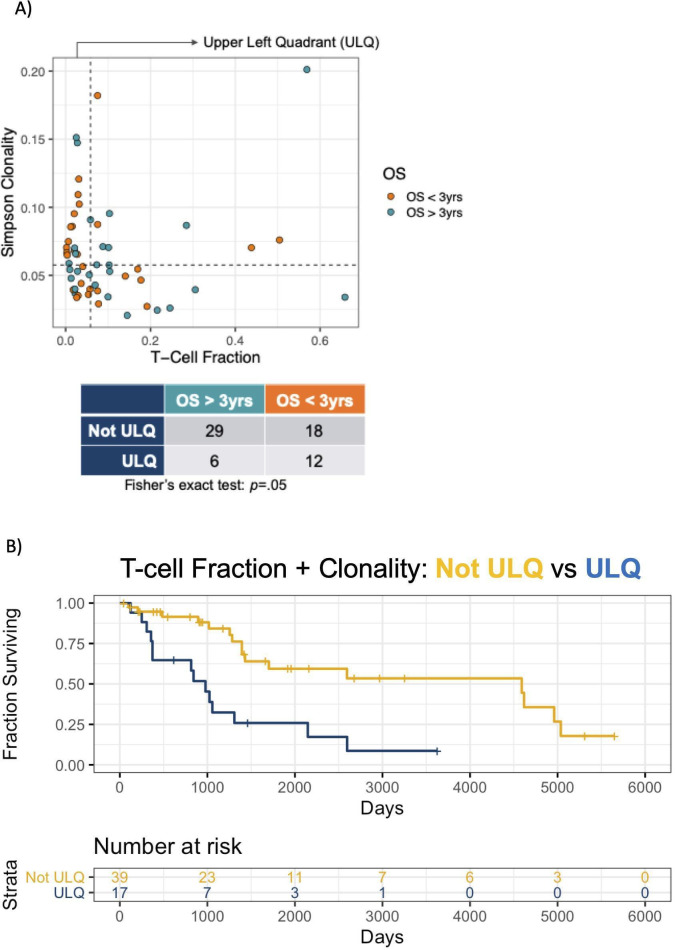
Although many DDLPS samples had low TCR clonality, high TCR clonality combined with low T-cell fraction predicted lower 3-year overall survival (p=0.05). Higher levels of CD14+ monocytes (p=0.02) inversely correlated with 3-year recurrence-free survival (RFS), while CD4+ T-cell infiltration (p=0.05) was associated with a higher RFS. Genes associated with longer RFS included (p=0.003), (p=0.006), (p=0.033), and (p=0.02). In a composite immune score, CD4+ T cells had the strongest positive predictive value, while CD14+ monocytes and M2 macrophages had the strongest negative predictive values.
Immune cell infiltration predicts clinical outcome in DDLPS, with CD4+ cells associated with better outcomes; CD14+ cells and M2 macrophages are associated with worse outcomes. Future checkpoint inhibitor studies in DDLPS should incorporate immunosequencing and gene expression profiling techniques that can generate immune landscape profiles.
去分化脂肪肉瘤(DDLPS)是最常见的软组织肉瘤亚型之一,在晚期/转移性阶段具有破坏性。尽管观察到抑制剂的临床反应,但对于与患者预后相关的免疫微环境知之甚少。
我们对 61 例 DDLPS 患者进行了回顾性研究。我们对 T 细胞受体(TCR)β链进行了深度测序,并进行了 RNA 测序以进行预测建模,评估了免疫标志物和肿瘤逃逸基因。采用层次聚类和递归分区来阐明肿瘤微环境中细胞浸润的关系,同时创建了用于预测的单个标志物的免疫评分。
尽管许多 DDLPS 样本的 TCR 克隆性较低,但高 TCR 克隆性结合低 T 细胞分数预示着 3 年总生存率较低(p=0.05)。CD14+单核细胞水平较高(p=0.02)与 3 年无复发生存率(RFS)呈负相关,而 CD4+T 细胞浸润(p=0.05)与 RFS 较高相关。与 RFS 较长相关的基因包括(p=0.003)、(p=0.006)、(p=0.033)和(p=0.02)。在复合免疫评分中,CD4+T 细胞具有最强的阳性预测值,而 CD14+单核细胞和 M2 巨噬细胞具有最强的阴性预测值。
免疫细胞浸润预测 DDLPS 的临床结局,CD4+细胞与更好的结局相关;CD14+细胞和 M2 巨噬细胞与更差的结局相关。未来在 DDLPS 中进行的检查点抑制剂研究应纳入免疫测序和基因表达谱分析技术,以生成免疫景观图谱。