Department of Medicine, University of Maryland School of Medicine, Baltimore, Maryland, United States of America.
PLoS One. 2021 Sep 1;16(9):e0247287. doi: 10.1371/journal.pone.0247287. eCollection 2021.
Thoracic aortic aneurysm (TAA) and abdominal aortic aneurysm (AAA) are known to have a strong genetic component.
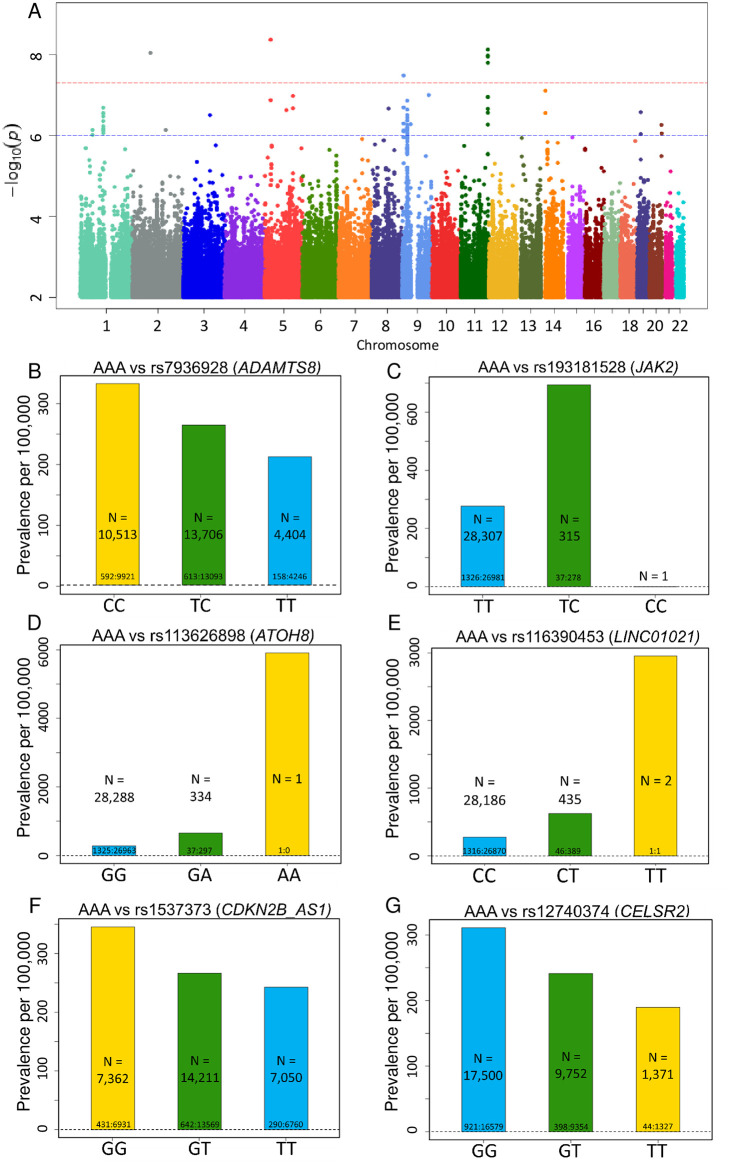
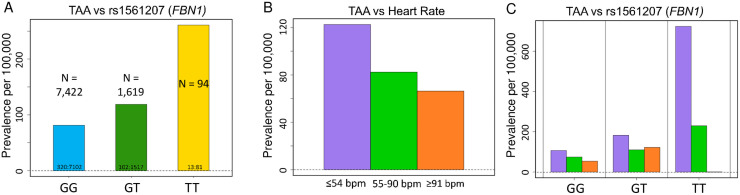
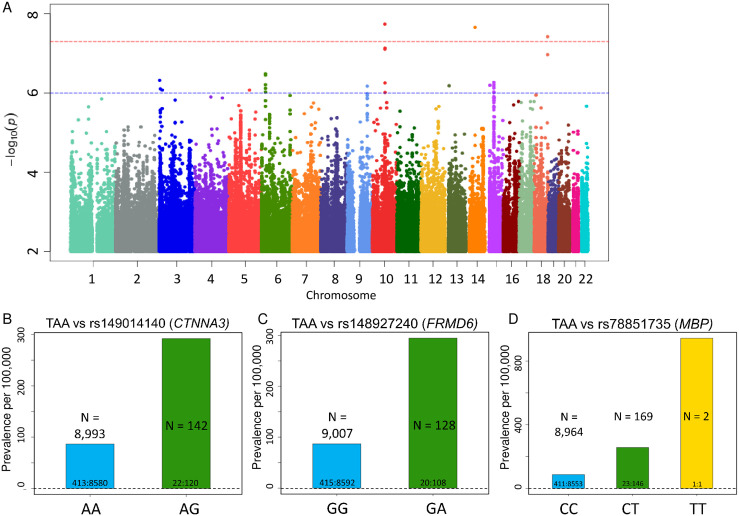
In a genome-wide association study (GWAS) using the UK Biobank, we analyzed the genomes of 1,363 individuals with AAA compared to 27,260 age, ancestry, and sex-matched controls (1:20 case:control study design). A similar analysis was repeated for 435 individuals with TAA compared to 8,700 controls. Polymorphism with minor allele frequency (MAF) >0.5% were evaluated. We identified novel loci near LINC01021, ATOH8 and JAK2 genes that achieved genome-wide significance for AAA (p-value <5x10⁻⁸), in addition to three known loci. For TAA, three novel loci in CTNNA3, FRMD6 and MBP achieved genome-wide significance. There was no overlap in the genes associated with AAAs and TAAs. Additionally, we identified a linkage group of high-frequency variants (MAFs ~10%) encompassing FBN1, the causal gene for Marfan syndrome, which was associated with TAA. In FinnGen PheWeb, this FBN1 haplotype was associated with aortic dissection. Finally, we found that baseline bradycardia was associated with TAA, but not AAA.
Our GWAS found that AAA and TAA were associated with distinct sets of genes, suggesting distinct underlying genetic architecture. We also found association between baseline bradycardia and TAA. These findings, including JAK2 association, offer plausible mechanistic and therapeutic insights. We also found a common FBN1 linkage group that is associated with TAA and aortic dissection in patients who do not have Marfan syndrome. These FBN1 variants suggest shared pathophysiology between Marfan disease and sporadic TAA.
胸主动脉瘤(TAA)和腹主动脉瘤(AAA)已知具有很强的遗传成分。
在一项使用英国生物库的全基因组关联研究(GWAS)中,我们分析了 1363 例 AAA 患者与 27260 例年龄、祖源和性别匹配的对照者(1:20 病例对照研究设计)的基因组。对 435 例 TAA 患者和 8700 例对照者进行了类似的分析。评估了次要等位基因频率(MAF)>0.5%的多态性。我们在 LINC01021、ATOH8 和 JAK2 基因附近发现了新的与 AAA 相关的位点,达到了全基因组显著水平(p 值<5x10⁻⁸),此外还有三个已知的位点。对于 TAA,CTNNA3、FRMD6 和 MBP 三个新的基因达到了全基因组显著水平。与 AAA 和 TAA 相关的基因没有重叠。此外,我们还鉴定了一个包含 Marfan 综合征致病基因 FBN1 的高频变异(MAF~10%)的连锁群,该基因与 TAA 相关。在 FinnGen PheWeb 中,这种 FBN1 单倍型与主动脉夹层相关。最后,我们发现基线心动过缓与 TAA 相关,但与 AAA 无关。
我们的 GWAS 发现,AAA 和 TAA 与不同的基因集相关,表明不同的潜在遗传结构。我们还发现基线心动过缓与 TAA 相关。这些发现,包括 JAK2 相关,提供了合理的机制和治疗见解。我们还发现了一个常见的 FBN1 连锁群,该连锁群与没有马凡综合征的 TAA 和主动脉夹层患者相关。这些 FBN1 变体表明马凡综合征和散发性 TAA 之间存在共同的病理生理学。