Department of Neuropediatrics, Medizinische Fakultät, Technische Universität Dresden, Dresden, Germany.
Department of Neurology, Center of Clinical Neuroscience, Universitätsklinikum Carl Gustav Carus, Technische Universität Dresden, Dresden, Germany.
Ann Clin Transl Neurol. 2021 Oct;8(10):2013-2024. doi: 10.1002/acn3.51449. Epub 2021 Sep 4.
The aim of this study was to evaluate neurofilament light chain as blood biomarker for disease activity in children and adolescents with different types of spinal muscular atrophy (SMA) and establish pediatric reference values.
We measured neurofilament light chain levels in serum (sNfL) and cerebral spinal fluid (cNfL) of 18 children with SMA and varying numbers of SMN2 copies receiving nusinersen by single-molecule array (SiMoA) assay and analyzed correlations with baseline characteristics and motor development. Additionally, we examined sNfL in 97 neurologically healthy children.
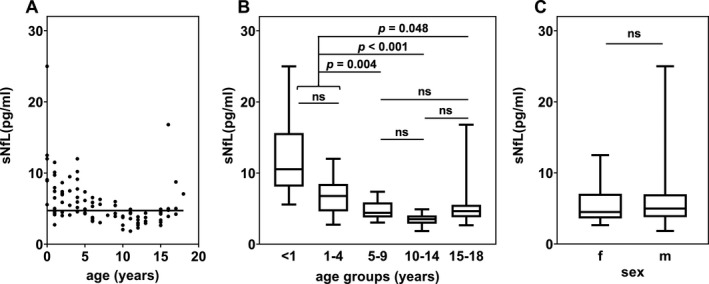
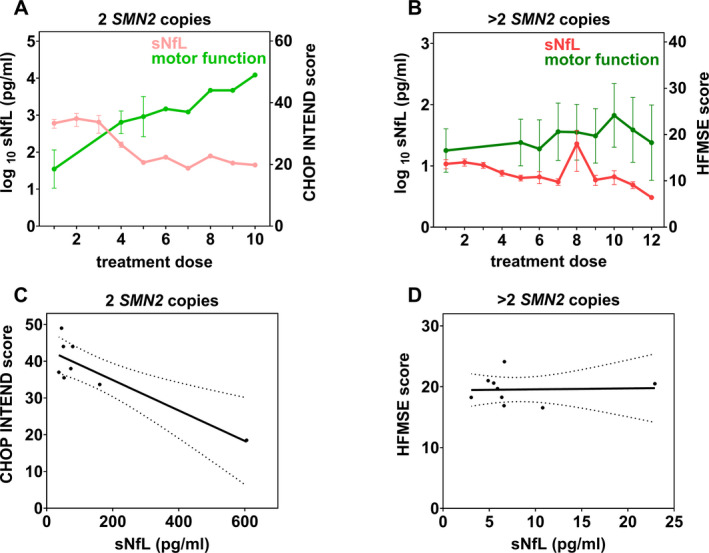
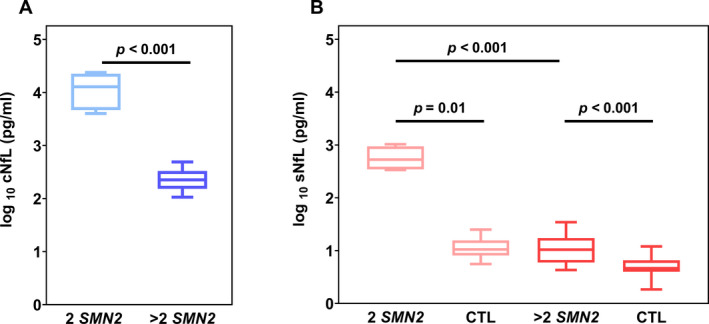
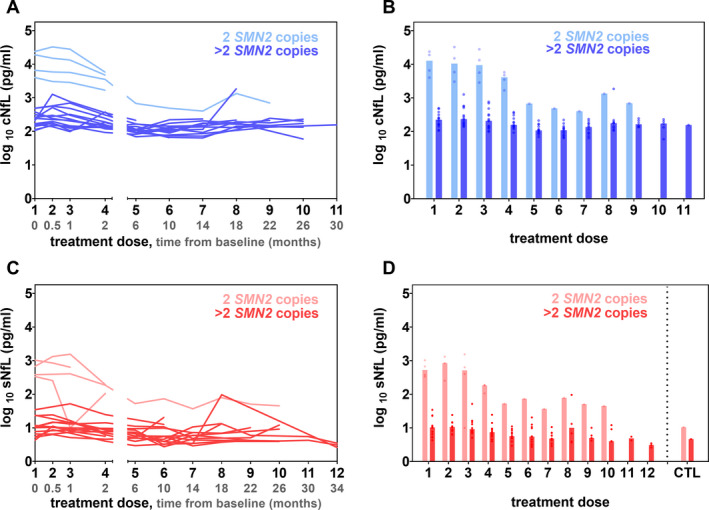
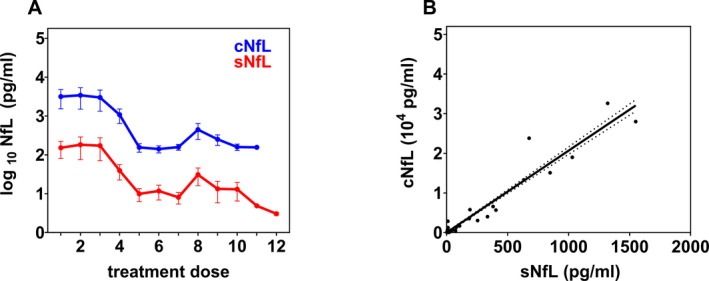
Median sNfL levels in treatment-naïve SMA patients with 2 SMN2 copies are higher than in those with >2 SMN2 copies (P < 0.001) as well as age-matched controls (P = 0.010) and decline during treatment. The median sNfL concentration of healthy controls is 4.73 pg/mL with no differences in sex (P = 0.486) but age (P < 0.001). In all children with SMA, sNfL levels correlate strongly with cNfL levels (r = 0.7, P < 0.001). In children with SMA and 2 SMN2 copies, sNfL values correlate with motor function (r = -0.6, P = 0.134), in contrast to older SMA children with >2 SMN2 copies (r = -0.1, P = 0.744).
Reference sNfL values of our large pediatric control cohort may be applied for future studies. Strong correlations between sNfL and cNfL together with motor function suggest that sNfL may be a suitable biomarker for disease activity in children with 2 SMN2 copies and those with >2 SMN2 copies within their initial stages during early childhood.
本研究旨在评估神经丝轻链(NfL)作为不同类型脊髓性肌萎缩症(SMA)患儿的血液生物标志物,用于评估疾病活动,并建立儿科参考值。
我们采用单分子阵列(SiMoA)检测了 18 名接受 nusinersen 治疗的 SMA 患儿的血清(sNfL)和脑脊液(cNfL)中的 NfL 水平,并对其与基线特征和运动发育的相关性进行了分析。此外,我们还检测了 97 名神经系统正常的儿童的 sNfL。
在基线时,2 个 SMN2 拷贝的 SMA 患儿的 sNfL 中位数高于>2 个 SMN2 拷贝的患儿(P<0.001),也高于年龄匹配的对照组(P=0.010),且在治疗期间下降。健康对照组的 sNfL 浓度中位数为 4.73pg/mL,性别之间无差异(P=0.486),但年龄之间有差异(P<0.001)。所有 SMA 患儿的 sNfL 水平与 cNfL 水平高度相关(r=0.7,P<0.001)。在 2 个 SMN2 拷贝的 SMA 患儿中,sNfL 值与运动功能呈负相关(r=-0.6,P=0.134),而在>2 个 SMN2 拷贝的大龄 SMA 患儿中,sNfL 值与运动功能呈正相关(r=-0.1,P=0.744)。
我们的大型儿科对照组的 sNfL 参考值可用于未来的研究。sNfL 与 cNfL 以及运动功能之间的强相关性表明,sNfL 可能是 2 个 SMN2 拷贝的 SMA 患儿及其在幼儿期早期的>2 个 SMN2 拷贝的 SMA 患儿疾病活动的合适生物标志物。