Roviello Valentina, Roviello Giovanni N
Department of Chemical, Materials and Industrial Production Engineering (DICMaPI), University of Naples Federico II, Piazzale V. Tecchio 80, 80125 Naples, Italy.
Istituto Di Biostrutture E Bioimmagini, IBB-CNR, Via Mezzocannone 16, 80134 Naples, Italy.
Environ Chem Lett. 2022;20(1):7-17. doi: 10.1007/s10311-021-01309-5. Epub 2021 Sep 1.
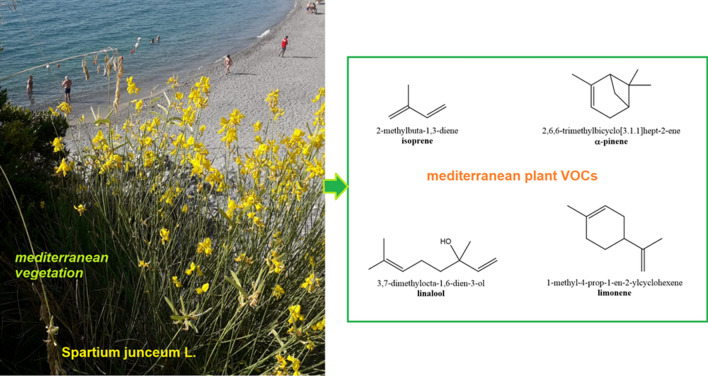
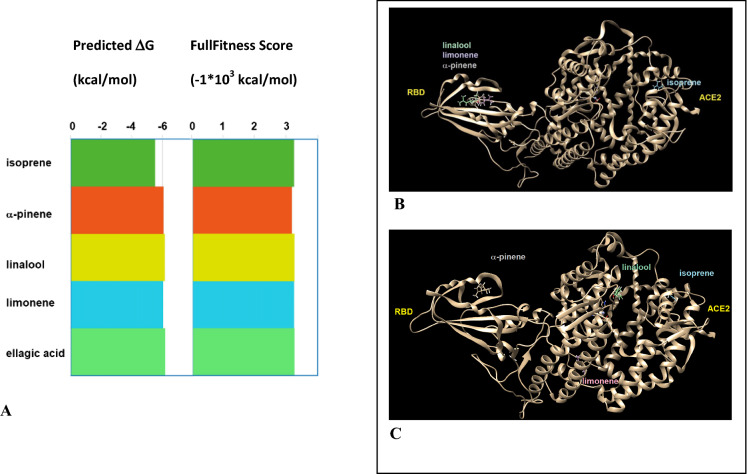
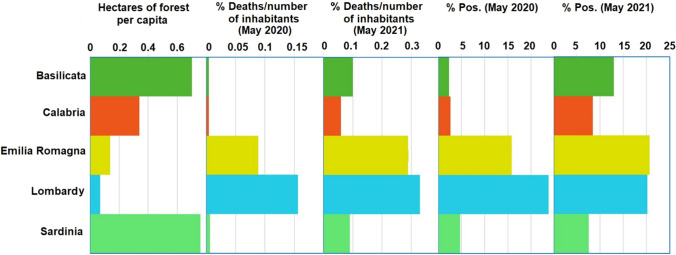
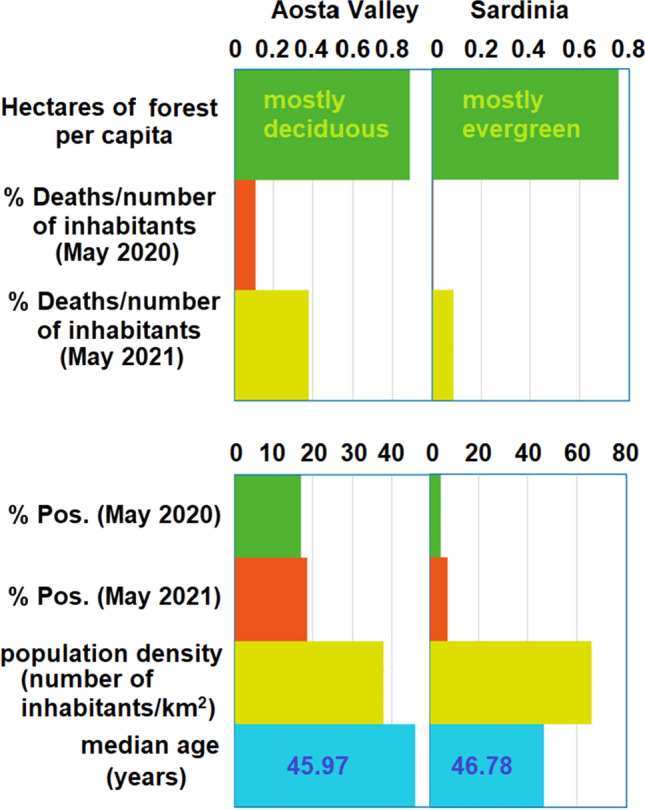
The coronavirus disease 2019 (COVID-19) is causing major sanitary and socioeconomic issues, yet some locations are less impacted than others. While densely populated areas are likely to favor viral transmission, we hypothesize that other environmental factors could explain lower cases in some areas. We studied COVID-19 impact and population statistics in highly forested Mediterranean Italian regions versus some northern regions where the amount of trees per capita is much lower. We also evaluated the affinity of Mediterranean plant-emitted volatile organic compounds (VOCs) isoprene, α-pinene, linalool and limonene for COVID-19 protein targets by molecular docking modeling. Results show that while mean death number increased about 4 times from 2020 to 2021, the percentage of deaths per population (0.06-0.10%) was lower in the greener Mediterranean regions such as Sardinia, Calabria and Basilica versus northern regions with low forest coverage, such as Lombardy (0.33%) and Emilia Romagna (0.29%). Data also show that the pandemic severity cannot be explained solely by population density. Modeling reveals that plant organic compounds could bind and interfere with the complex formed by the receptor binding domain of the coronavirus spike protein with the human cell receptor. Overall, our findings are likely explained by sea proximity and mild climate, Mediterranean diet and the abundance of non-deciduous Mediterranean plants which emit immunomodulatory and antiviral compounds. Potential implications include 'forest bathing' as a therapeutic practice, designing nasal sprays containing plant volatile organic compounds, and preserving and increasing forest coverage.
The online version contains supplementary material available at 10.1007/s10311-021-01309-5.
2019年冠状病毒病(COVID-19)正在引发重大的卫生和社会经济问题,但一些地区受到的影响小于其他地区。虽然人口密集地区可能有利于病毒传播,但我们推测其他环境因素可以解释某些地区病例较少的原因。我们研究了意大利森林茂密的地中海地区与一些人均树木数量低得多的北部地区的COVID-19影响和人口统计数据。我们还通过分子对接模型评估了地中海植物释放的挥发性有机化合物(VOCs)异戊二烯、α-蒎烯、芳樟醇和柠檬烯与COVID-19蛋白质靶点的亲和力。结果表明,虽然从2020年到2021年平均死亡人数增加了约4倍,但在撒丁岛、卡拉布里亚和巴西利卡等更绿色的地中海地区,每人口死亡百分比(0.06 - 0.10%)低于森林覆盖率低的北部地区,如伦巴第(0.33%)和艾米利亚 - 罗马涅(0.29%)。数据还表明,大流行的严重程度不能仅由人口密度来解释。模型显示,植物有机化合物可以结合并干扰冠状病毒刺突蛋白的受体结合域与人类细胞受体形成的复合物。总体而言,我们的发现可能由靠近海洋和温和的气候、地中海饮食以及大量释放免疫调节和抗病毒化合物的非落叶地中海植物来解释。潜在影响包括将“森林浴”作为一种治疗方法、设计含有植物挥发性有机化合物的鼻喷雾剂以及保护和增加森林覆盖率。
在线版本包含可在10.1007/s10311-021-01309-5获取的补充材料。