Wang Yong, Chen Shuo, Yang Dandan, Li Yang
Business School, Beijing Technology and Business University, Beijing, China.
Front Psychol. 2021 Aug 13;12:619303. doi: 10.3389/fpsyg.2021.619303. eCollection 2021.
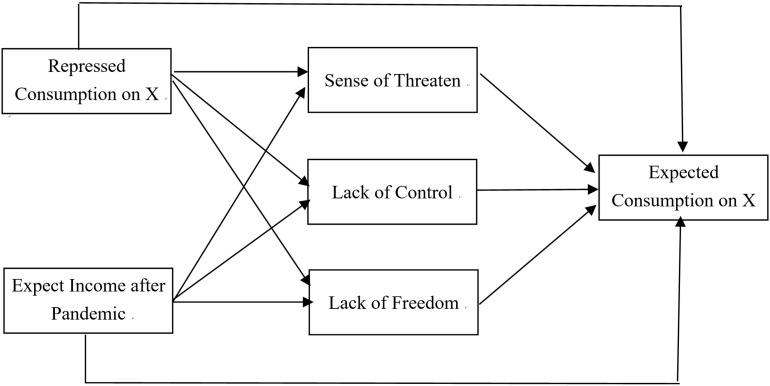
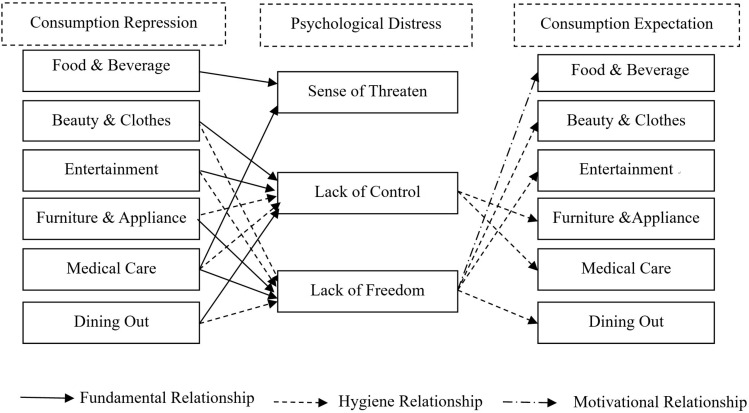
Even though the coronavirus disease (COVID-19) has limited consumption, individuals continue to plan post-pandemic consumption activities to get rid of the stress caused by consumption repression. Building on Maslow's theory of needs and Herzberg's two-factor theory, our research categorizes consumption into fundamental ("must-have" products that fulfill the physical needs of individuals), hygiene (maintaining the security needs of consumers), and motivational consumption (enhancing well-being of individuals). Based on empirical data of purchase behavior and consumption expectation before, during, and after the pandemic in China, we identify how consumption repression induces psychological distress, a sense of feeling threatened, lacking control, or lacking freedom, and how the expectation of future consumption alleviates that stress. Results show that fundamental consumption leads to psychological distress; hygiene consumption can both result in and reduce stress; and motivational consumption can reduce stress. Our findings provide new insights into the relationship between consumption and psychological distress through new theoretical formulations. The results can be applied by marketers attempting to understand purchase decision-making and by policymakers supporting both citizens and commerce during social emergencies.
尽管冠状病毒病(COVID-19)限制了消费,但个人仍在规划疫情后的消费活动,以摆脱消费压抑带来的压力。基于马斯洛的需求理论和赫兹伯格的双因素理论,我们的研究将消费分为基本消费(满足个人生理需求的“必需品”)、卫生消费(维持消费者的安全需求)和激励性消费(提升个人幸福感)。基于中国疫情前、疫情期间和疫情后的购买行为及消费预期的实证数据,我们确定了消费压抑如何引发心理困扰、受威胁感、缺乏控制感或缺乏自由感,以及对未来消费的预期如何缓解这种压力。结果表明,基本消费会导致心理困扰;卫生消费既能导致压力,也能减轻压力;而激励性消费可以减轻压力。我们的研究结果通过新的理论阐述,为消费与心理困扰之间的关系提供了新的见解。这些结果可供试图理解购买决策的营销人员以及在社会紧急情况期间支持公民和商业的政策制定者参考。