Fandler-Höfler Simon, Stauber Rudolf E, Kneihsl Markus, Wünsch Gerit, Haidegger Melanie, Poltrum Birgit, Pichler Alexander, Deutschmann Hannes, Enzinger Christian, Fickert Peter, Gattringer Thomas
Department of Neurology, Medical University of Graz, Graz, Austria.
Division of Gastroenterology and Hepatology, Department of Internal Medicine, Medical University of Graz, Graz, Austria.
Ther Adv Neurol Disord. 2021 Aug 31;14:17562864211037239. doi: 10.1177/17562864211037239. eCollection 2021.
Liver fibrosis has been identified as an outcome predictor in cardiovascular disease and has been associated with hematoma expansion and mortality in patients with primary intracerebral hemorrhage. We aimed to explore whether clinically inapparent liver fibrosis is related to neurological outcome, mortality, and intracranial hemorrhage risk in ischemic stroke patients after mechanical thrombectomy.
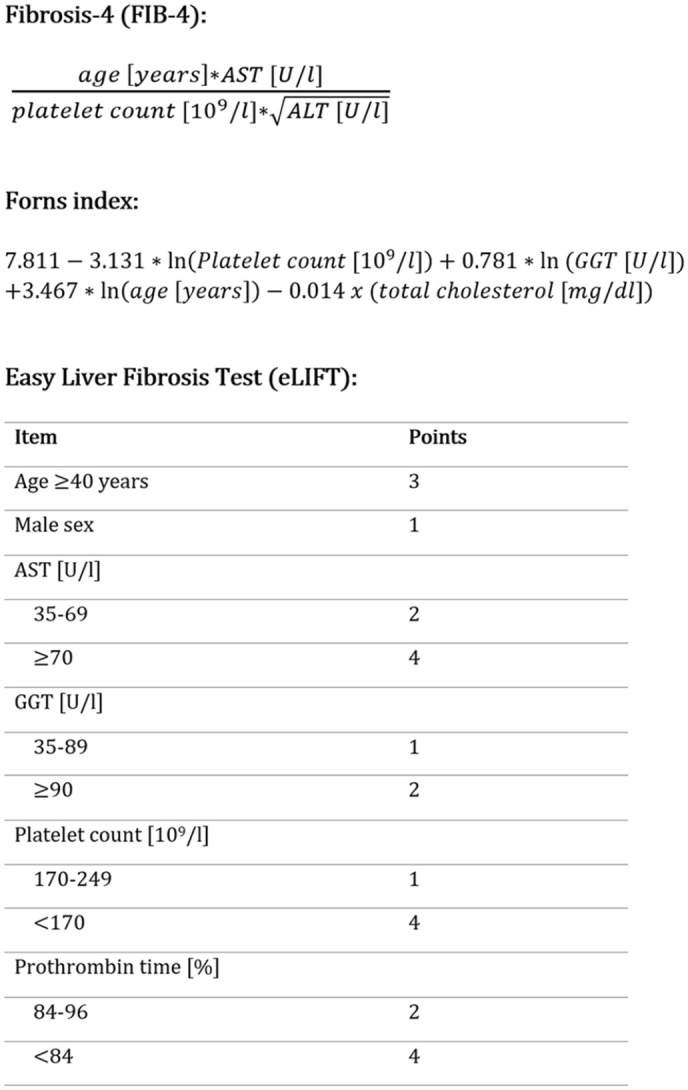
We included consecutive patients with anterior circulation large vessel occlusion stroke treated at our center with mechanical thrombectomy between January 2011 and April 2019. Clinical data had been collected prospectively; laboratory data were extracted from our electronic hospital information system. We calculated the Fibrosis-4 index (FIB-4), an established non-invasive liver fibrosis test. The main outcomes were postinterventional intracranial hemorrhage, unfavorable functional status (modified Rankin scale scores of 3-6), and mortality three months post-stroke.
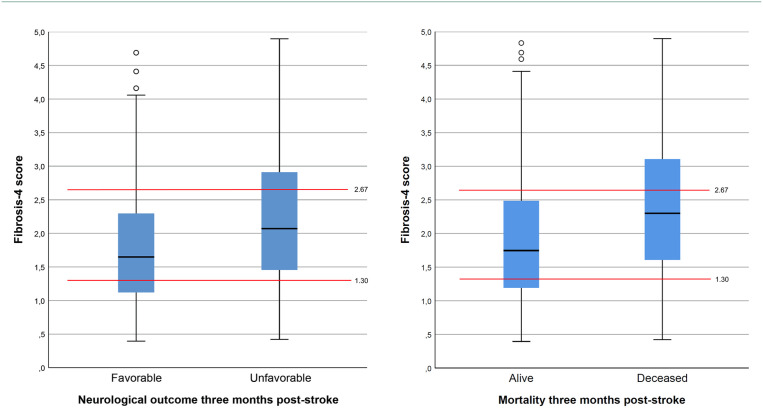
In the 460 patients (mean age 69 years, 49.3% female) analyzed, FIB-4 indicated advanced liver fibrosis in 22.6%. Positive FIB-4 was associated with unfavorable neurological outcomes and mortality three months post-stroke, even after correction for co-factors [Odds Ratio (OR) 2.15 for unfavorable outcome in patients with positive FIB-4, 95% confidence interval (CI) 1.21-3.83, = 0.009, and 2.16 for mortality, 95% CI 1.16-4.03, = 0.01]. However, FIB-4 was neither related to hemorrhagic transformation nor symptomatic intracranial hemorrhage. Moreover, atrial fibrillation was more frequent in patients with liver fibrosis ( < 0.001). Two further commonly-used liver fibrosis indices (Forns index and the Easy Liver Fibrosis Test) yielded comparable results regarding outcome and atrial fibrillation.
Clinically inapparent liver fibrosis (based on simple clinical and laboratory parameters) represents an independent risk factor for unfavorable outcomes, including mortality, at three months after stroke thrombectomy. Elevated liver fibrosis indices warrant further hepatological work-up and thorough screening for atrial fibrillation in stroke patients.
肝纤维化已被确定为心血管疾病的预后预测指标,并与原发性脑出血患者的血肿扩大和死亡率相关。我们旨在探讨临床上隐匿的肝纤维化是否与机械取栓术后缺血性卒中患者的神经功能结局、死亡率及颅内出血风险有关。
我们纳入了2011年1月至2019年4月期间在本中心接受机械取栓治疗的连续性前循环大血管闭塞性卒中患者。临床数据为前瞻性收集;实验室数据从我们的电子医院信息系统中提取。我们计算了Fibrosis-4指数(FIB-4),这是一种已确立的非侵入性肝纤维化检测方法。主要结局为介入治疗后颅内出血、功能状态不佳(改良Rankin量表评分3-6分)以及卒中后三个月的死亡率。
在分析的460例患者(平均年龄69岁,49.3%为女性)中,FIB-4显示22.6%存在晚期肝纤维化。即使在校正了协变量后,FIB-4阳性仍与卒中后三个月的不良神经功能结局和死亡率相关[FIB-4阳性患者不良结局的比值比(OR)为2.15,95%置信区间(CI)为1.21-3.83, =0.009;死亡率的OR为2.16,95%CI为1.16-4.03, =0.01]。然而,FIB-4与出血转化及症状性颅内出血均无关。此外,肝纤维化患者中房颤更为常见(<0.001)。另外两个常用的肝纤维化指标(Forns指数和简易肝纤维化检测)在结局和房颤方面产生了类似结果。
临床上隐匿的肝纤维化(基于简单的临床和实验室参数)是卒中取栓术后三个月不良结局(包括死亡率)独立的危险因素。肝纤维化指标升高值得对卒中患者进一步进行肝脏检查并全面筛查房颤。