Othman Fatmah, Alsagami Noura, Alharbi Reem, Almuammer Yara, Alshahrani Shatha, Ismaeil Taha
Department of Research, College of Applied Medical Sciences, King Saud Bin Abdulaziz University for Health Sciences, Riyadh, Saudi Arabia.
King Abdullah International Medical Research Center, Riyadh, Saudi Arabia.
Ann Thorac Med. 2021 Jul-Sep;16(3):245-252. doi: 10.4103/atm.ATM_475_20. Epub 2021 Jul 20.
To recruit poorly ventilated lung areas by providing active and adequate oxygenation is a core aspect of treating patients with acute respiratory distress syndrome (ARDS). The airway pressure release ventilation (APRV) mode is increasingly accepted as a means of supporting patients with ARDS. This study aimed to determine whether the APRV mode is effective in improving oxygenation, compared to conventional ventilation, in adult ARDS patients.
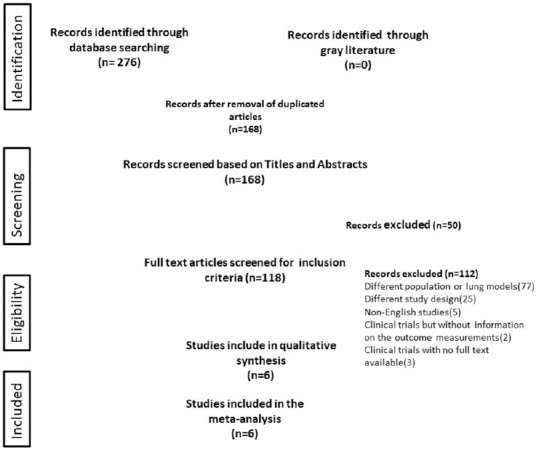
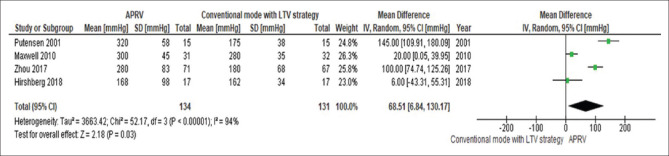
We conducted the study according to the Preferred Reporting Items for Systematic Reviews and Meta-Analyses guidelines. We searched for clinical trials in PubMed, Embase, Web of Science, and the Cochrane Library until April 2019. We included all studies comparing APRV and other conventional mechanical ventilation modes for adult ARDS patients. Our primary outcome was oxygenation status (defined as the day 3 PaO/FiO ratio). The secondary outcomes were the length of stay (LOS) in the intensive care unit (ICU) and mortality. Sensitivity analyses were performed including studies with conventional low-tidal volume ventilation as a comparator ventilation strategy.
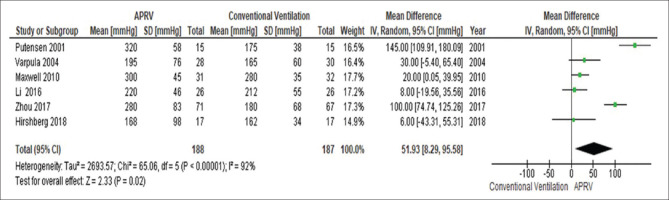
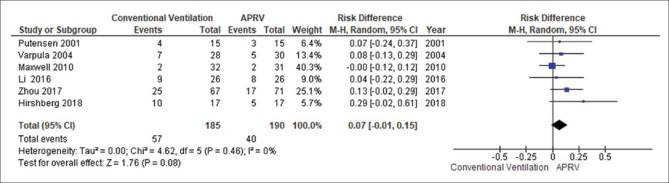
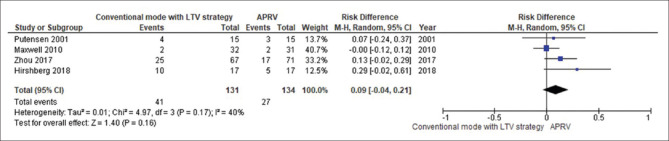
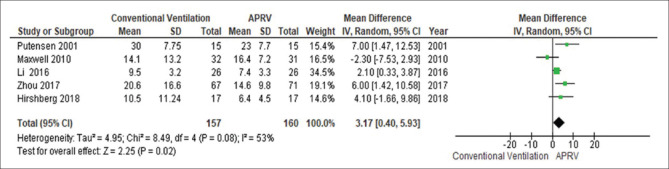
We included six clinical trials enrolling a total of 375 patients. The day 3 PaO/FiO was reported in all the studies, and it was significantly higher in patients receiving APRV (mean difference [MD] 51.9 mmHg, 95% confidence intervals (CI) 8.2-95.5, = 0.02, = 92%). There was no significant difference in mortality between APRV and the other conventional ventilator modes (risk difference 0.07, 95% CI: -0.01-0.15, = 0.08, 0%). The point estimate for the effect of APRV on the LOS in ICU indicated a significant reduction in the ICU LOS for the APRV group compared to the counter group (MD 3.1 days, 95% CI 0.4-5.9, = 0.02, = 53%).
In this study, using the APRV mode may improve oxygenation on day 3 and contribute to reducing the LOS in ICU. However, it is difficult to draw a clinical message about APRV, and well-designed clinical trials are required to investigate this issue.
通过提供有效的充分氧合来募集通气不良的肺区域是治疗急性呼吸窘迫综合征(ARDS)患者的核心环节。气道压力释放通气(APRV)模式越来越被认可为支持ARDS患者治疗的一种手段。本研究旨在确定与传统通气相比,APRV模式对成年ARDS患者改善氧合是否有效。
我们按照系统评价和Meta分析的首选报告项目指南开展本研究。截至2019年4月,我们在PubMed、Embase、科学网和Cochrane图书馆中检索临床试验。我们纳入了所有比较APRV与其他传统机械通气模式用于成年ARDS患者的研究。我们的主要结局是氧合状态(定义为第3天的PaO₂/FiO₂比值)。次要结局是重症监护病房(ICU)的住院时间(LOS)和死亡率。进行敏感性分析,包括将传统低潮气量通气作为对照通气策略的研究。
我们纳入了6项临床试验,共375例患者。所有研究均报告了第3天的PaO₂/FiO₂,接受APRV治疗的患者该指标显著更高(平均差值[MD]51.9 mmHg,95%置信区间[CI]8.2 - 95.5,P = 0.02,I² = 92%)。APRV与其他传统通气模式之间的死亡率无显著差异(风险差值0.07,95%CI:-0.01 - 0.15,P = 0.08,I² = 0%)。APRV对ICU住院时间影响的点估计表明,与对照组相比,APRV组的ICU住院时间显著缩短(MD 3.1天,95%CI 0.4 - 5.9,P = 0.02,I² = 53%)。
在本研究中,使用APRV模式可能在第3天改善氧合,并有助于缩短ICU住院时间。然而,关于APRV很难得出临床结论性信息,需要设计良好的临床试验来研究这一问题。