Zhong Xi, Wu Qin, Yang Hao, Dong Wei, Wang Bo, Zhang Zhongwei, Liang Guopeng
Department of Critical Care Medicine, West China Hospital of Sichuan University, Chengdu, China.
Ann Transl Med. 2020 Dec;8(24):1641. doi: 10.21037/atm-20-6917.
It is uncertain whether airway pressure release ventilation (APRV) is better than low tidal volume ventilation (LTVV) for patients with acute respiratory distress syndrome (ARDS). The purpose of this meta-analysis was to compare APRV and LTVV on patients with ARDS.
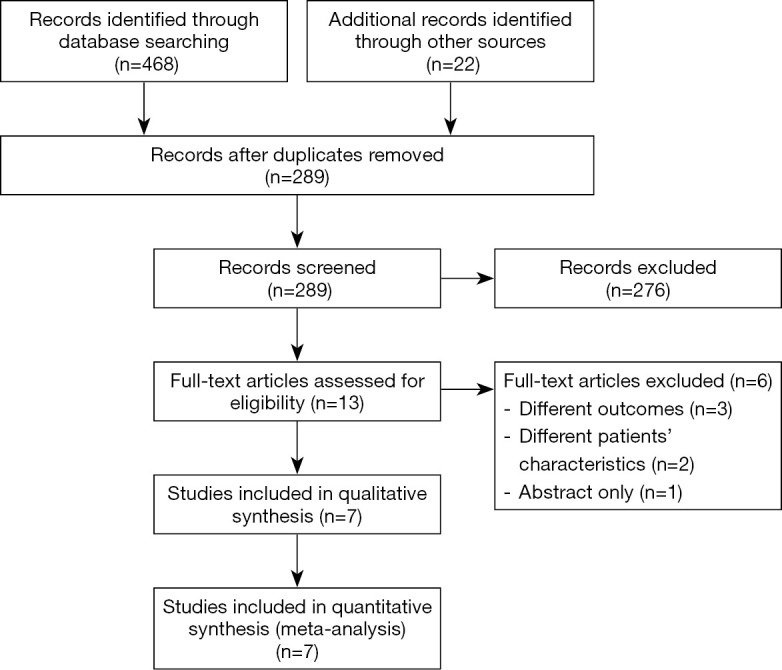
Randomized controlled trials (RCTs) comparing outcomes in ARDS ventilator therapy with APRV or LTVV were identified using Medical Literature Analysis and Retrieval System Online (MEDLINE), Excerpta Medica Database (EMBASE), Cumulative Index to Nursing and Allied Health Literature (CINAHL), Web of Science, the Cochrane Library, and The Chinese Biomedicine Literature Database (SinoMed) from inception to March 2019.
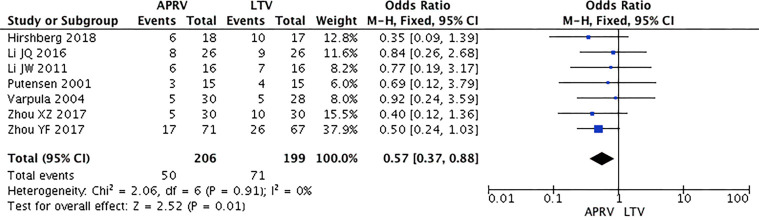
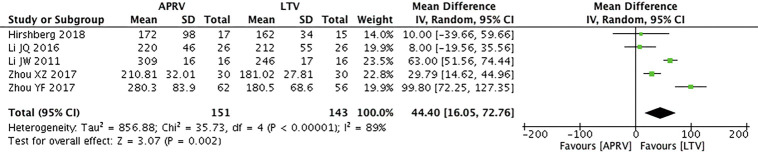
A total of 7 RCTs with a 405 patients were eligible for our meta-analysis. The results revealed that APRV was associated with lower hospital mortality [405 patients; odds ratio (OR), 0.57; 95% confidence interval (CI), 0.37-0.88; P=0.01], a shorter time of ventilator therapy [373 patients; mean difference (MD), 5.36; 95% CI, 1.99-8.73; P=0.002], and intensive care unit (ICU) stay (315 patients; MD, -4.50; 95% CI, -6.56 to -2.44; P<0.0001), better respiratory system compliance on day 3 (202 patients; MD, 8.19; 95% CI, 0.84-15.54; P=0.03), arterial partial pressure of oxygen/fraction of inspired oxygen (PaO2/FiO2) on day 3 (294 patients; MD, 44.40; 95% CI, 16.05-72.76; P=0.002), and higher mean arterial pressure (MAP) on day 3 (285 patients; MD, 4.18; 95% CI, 3.10-5.25; P<0.00001). There was no statistical difference in the incidence of pneumothorax (170 patients; OR, 0.40; 95% CI, 0.12-1.34; P=0.14).
The meta-analysis showed that APRV could reduce hospital mortality, duration of ventilation and ICU stay, improve lung compliance, oxygenation index, and MAP compared with LTVV for patients with ARDS. We found APRV to be a safe and effective ventilation mode for patients with ARDS.
对于急性呼吸窘迫综合征(ARDS)患者,气道压力释放通气(APRV)是否优于低潮气量通气(LTVV)尚不确定。本荟萃分析的目的是比较APRV和LTVV用于ARDS患者的效果。
使用医学文献分析与联机检索系统(MEDLINE)、医学文摘数据库(EMBASE)、护理学与健康相关文献累积索引(CINAHL)、科学引文索引数据库、考克兰图书馆以及中国生物医学文献数据库(SinoMed),检索从建库至2019年3月比较APRV或LTVV用于ARDS机械通气治疗效果的随机对照试验(RCT)。
共有7项RCT、405例患者符合我们的荟萃分析标准。结果显示,APRV与较低的医院死亡率相关[405例患者;比值比(OR)为0.57;95%置信区间(CI)为0.37 - 0.88;P = 0.01],机械通气治疗时间较短[373例患者;平均差(MD)为5.36;95% CI为1.99 - 8.73;P = 0.002],重症监护病房(ICU)住院时间较短(315例患者;MD为 - 4.50;95% CI为 - 6.56至 - 2.44;P < 0.0001),第3天呼吸系统顺应性更好(202例患者;MD为8.19;95% CI为0.84 - 15.54;P = 0.03),第3天动脉血氧分压/吸入氧分数(PaO2/FiO2)更高(294例患者;MD为44.40;95% CI为16.05 - 72.76;P = 0.002),第3天平均动脉压(MAP)更高(285例患者;MD为4.18;95% CI为3.10 - 5.25;P < 0.00001)。气胸发生率无统计学差异(170例患者;OR为0.40;95% CI为0.12 - 1.34;P = 0.14)。
荟萃分析表明,对于ARDS患者,与LTVV相比,APRV可降低医院死亡率、缩短通气时间和ICU住院时间,改善肺顺应性、氧合指数和MAP。我们发现APRV是ARDS患者一种安全有效的通气模式。