United Nations Children's Fund (UNICEF), West and Central Africa Regional Office, Dakar, Senegal.
Department of Economics and Centre for Modern Indian Studies, University of Göttingen, Göttingen, Germany.
J Glob Health. 2021 Aug 10;11:13008. doi: 10.7189/jogh.11.13008. eCollection 2021.
The global community recognizes the urgent need to end preventable child deaths, making it an essential part of the third Sustainable Development Goal. Pneumonia, diarrhoea, and malaria still remain the leading causes of deaths among children under five years, especially in one of the poorest geographic regions of the world - West and Central Africa. This region carries a disproportionately high share of the global burden, both in terms of morbidity and mortality. The study aims to assess levels and trends of the prevalence of these three childhood diseases in West and Central Africa to better inform ongoing and future programmes to improve child survival.
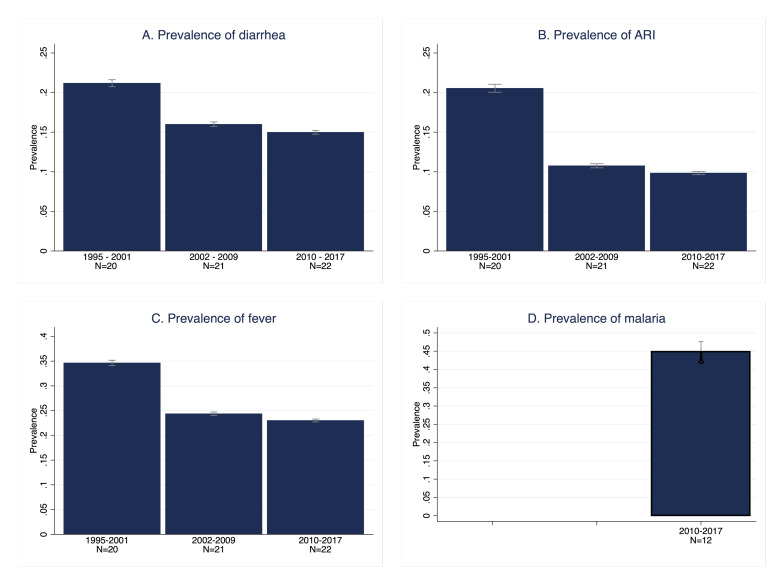
Demographic and Health Surveys and Multiple Indicator Cluster Surveys available from 1995 to 2017 for 23 countries in West and Central Africa were analysed. We estimated the prevalence of diarrhoea, acute respiratory infections (ARI), malaria, and fever as a proxy for malaria, and split the data into three time periods to assess these trends in disease prevalence over time. Further analyses were done to assess the variations by geographic location (urban and rural) and gender (boys and girls).
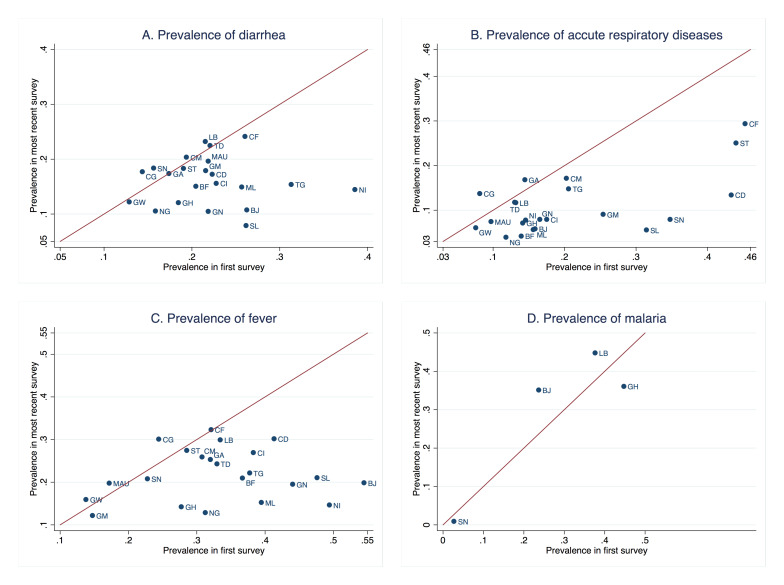
In West and Central Africa, the reduction of the prevalence rates of diarrhoea, acute respiratory infections, malaria, and fever has decelerated over time (1995-2009), and little improvements occurred between 2010 and 2017. The reduction within the region has been uneven and the prevalence rates either increased or stagnated for diarrhoea (nine countries), ARI (four countries), and fever (six countries). The proportion of affected children was high in emergency or fragile settings. Disaggregated analyses of population-based data show persistent gaps between the prevalence of diseases by geographic location and gender, albeit not significant for the latter.
Without intensified commitment to reducing the prevalence of pneumonia, malaria, and diarrhoea, many countries will not be able to meet the SDG goal to end preventable child deaths. Evidence-driven programmes that focus on improving equitable access to preventive health care information and services must be fostered, especially in complex emergency settings. This will be an opportunity to strengthen primary health care, including community health programmes, to achieve universal health coverage.
全球社会认识到迫切需要杜绝可预防的儿童死亡,因此将其作为可持续发展目标 3 的一个重要组成部分。肺炎、腹泻和疟疾仍然是五岁以下儿童死亡的主要原因,特别是在世界上最贫穷的地理区域之一——西非和中非。该区域在发病率和死亡率方面都承担着不成比例的高负担。本研究旨在评估西非和中非地区这三种儿童疾病的流行水平和趋势,以便更好地为正在进行和未来的改善儿童生存的方案提供信息。
分析了 1995 年至 2017 年来自西非和中非 23 个国家的人口和健康调查及多指标类集调查数据。我们估计了腹泻、急性呼吸道感染(ARI)、疟疾和发热(发热作为疟疾的替代指标)的流行率,并将数据分为三个时间段,以评估这些疾病流行率随时间的变化趋势。进一步的分析评估了地理位置(城市和农村)和性别(男孩和女孩)的差异。
在西非和中非,腹泻、急性呼吸道感染、疟疾和发热的流行率下降速度自 1995 年至 2009 年以来有所减缓,而 2010 年至 2017 年期间几乎没有改善。该地区的下降趋势不均衡,腹泻(9 个国家)、ARI(4 个国家)和发热(6 个国家)的流行率要么增加,要么停滞不前。在紧急或脆弱环境中,受影响儿童的比例较高。基于人群的数据分析表明,疾病的流行率在地理位置和性别方面存在持续差距,尽管后者没有显著差异。
如果不加强努力降低肺炎、疟疾和腹泻的流行率,许多国家将无法实现可持续发展目标中关于杜绝可预防儿童死亡的目标。必须推动以证据为基础的方案,重点是改善公平获得预防保健信息和服务的机会,特别是在复杂的紧急环境中。这将是加强初级卫生保健的机会,包括社区卫生方案,以实现全民健康覆盖。