Karami Salaheddin Kola Maryam, Jafari Hedayat, Charati Jamshid Yazdani, Shafipour Vida
Student Research Committee, Mazandaran University of Medical Science, Sari, Iran.
Traditional and Complementary Medicine Research Center, Addiction Institute Mazandaran University of Medical Science, Sari, Iran.
J Educ Health Promot. 2021 Jul 30;10:248. doi: 10.4103/jehp.jehp_1481_20. eCollection 2021.
The knowledge level of caregivers and their support for patients can affect the self-care of patients with heart failure (HF). The present study was conducted to compare the effects of teach-back, multimedia, and blended training methods on self-care and social support in patients with HF and on knowledge in their caregivers.
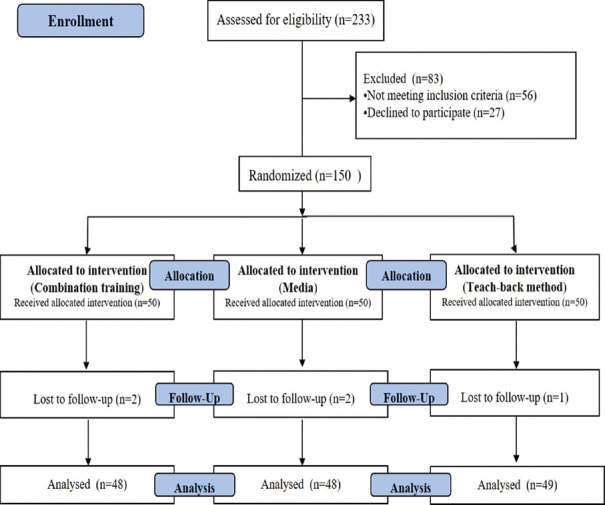
In a randomized clinical trial, a total of 150 HF patient-caregiver dyads were randomly allocated into three equally sized training groups, using a simple number table ( = 50). The study was conducted between May to October 2018 in Sari, northern Iran. In the teach-back, multimedia and blended training groups, patient-caregiver dyads participated in 20-30-min training sessions held face-to-face, using digital video disc (DVD) and combination of teach-back and DVD on 4 consecutive days at the bedside of hospitalized patients in coronary care unit, respectively. Data were collected using the European Heart Failure Self-Care Behaviour Scale and the multidimensional scale of perceived social support for patients. Caregivers' level of knowledge was measured using the HF Knowledge Scale. Data were measured on the first day of hospitalization, 1 day before discharge and 4 and 8 weeks after patients' discharge. Data were analyzed using SPSS version 18 (SPSS Inc., Chicago, IL, USA).
All three educational methods improved self-care behaviors in patients. The comparison of self-care behavior scores in patients with HF among the three groups at different time points showed no statistically significant differences ( > 0.05), except 1 day before discharge ( = 0.04). There were no statistically-significant differences between the teach-back, multimedia and the blended training group in terms of perceived social support at any of the four-time points ( > 0.05). All three training methods improved the level of knowledge of caregivers. However, the score in the blended training groups was higher than the other groups ( < 0.001).
According to the results of the present study, it seems that all three educational interventions can improve self-care behaviors in HF patients and increase knowledge in their caregivers. However, using the blended training method was associated with better outcomes.
护理人员的知识水平及其对患者的支持会影响心力衰竭(HF)患者的自我护理。本研究旨在比较反馈教学法、多媒体教学法和混合教学法对HF患者自我护理和社会支持以及对其护理人员知识水平的影响。
在一项随机临床试验中,使用简单数字表将总共150对HF患者-护理人员二元组随机分为三个规模相等的训练组(每组 = 50)。该研究于2018年5月至10月在伊朗北部的萨里进行。在反馈教学组、多媒体教学组和混合教学组中,患者-护理人员二元组分别在冠心病监护病房住院患者床边连续4天参加面对面的20 - 30分钟训练课程,反馈教学组使用数字视频光盘(DVD),多媒体教学组使用DVD,混合教学组使用反馈教学和DVD相结合的方式。使用欧洲心力衰竭自我护理行为量表和患者感知社会支持多维量表收集数据。使用心力衰竭知识量表测量护理人员的知识水平。在患者住院第一天、出院前1天以及出院后4周和8周测量数据。使用SPSS 18版软件(SPSS公司,美国伊利诺伊州芝加哥)进行数据分析。
所有三种教育方法均改善了患者的自我护理行为。在不同时间点对三组HF患者的自我护理行为得分进行比较,除出院前1天( = 0.04)外,差异无统计学意义( > 0.05)。在四个时间点中的任何一个时间点,反馈教学组、多媒体教学组和混合教学组在感知社会支持方面差异均无统计学意义( > 0.05)。所有三种训练方法均提高了护理人员的知识水平。然而,混合教学组的得分高于其他组( < 0.001)。
根据本研究结果,似乎所有三种教育干预措施均可改善HF患者的自我护理行为并增加其护理人员的知识。然而,使用混合教学法的效果更佳。