Vogel Mandy, Meigen Christof, Sobek Carolin, Ober Peggy, Igel Ulrike, Körner Antje, Kiess Wieland, Poulain Tanja
LIFE Child Leipzig University Hospital for Children and Adolescents Leipzig University Leipzig Germany.
Department of Women and Child Health Center for Pediatric Research Leipzig University Leipzig Germany.
JCPP Adv. 2021 Apr;1(1):e12004. doi: 10.1111/jcv2.12004. Epub 2021 Mar 17.
There is concern that pandemic measures put a strain on the health and well-being of children. We investigated the effects of the COVID-19 pandemic, the lockdown, and social distancing on the well-being, media use, and emotions of children and adolescents between 9 and 18 years.
We used linear and proportional odds logistic regression correcting for age, sex, and socioeconomic status (SES) and to compare media use, peers/social support, physical, and psychological well-being between 2019 (pre-COVID baseline) and two time points shortly after the start of the lockdown (last week of March and April 2020, respectively) in 391 9-19-year-old healthy children and adolescents of the LIFE Child cohort. COVID-19-related feelings and their relationship to age, sex, and SES were assessed at two time points during lockdown.
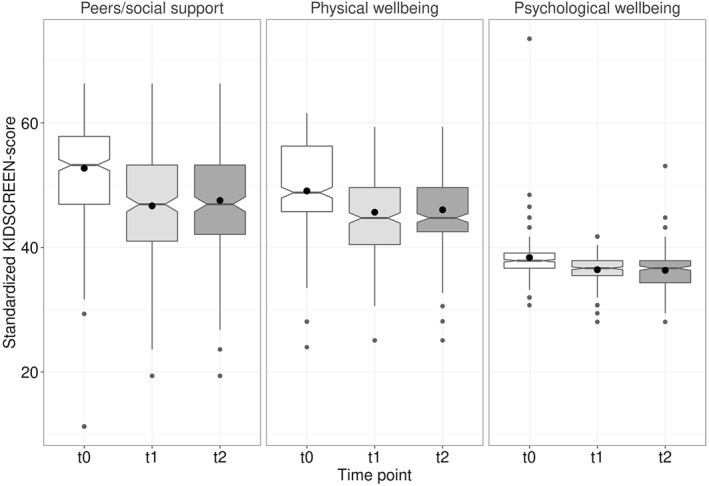
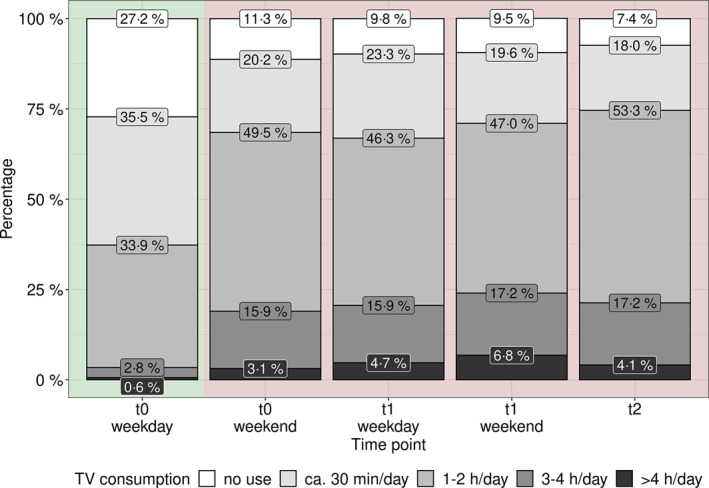
We found significantly lower scores in physical and psychological well-being during lockdown compared to baseline. The effect was significantly stronger in children with medium/low SES. Perceived social support scores were also significantly lower during the lockdown. The percentage of children who had no contact with their peers (in-person or online) increased from 3% pre-COVID to 14% and 13% in April and March 2020, respectively. About 80% of the children missed in-person contacts with friends. Most of the children worried more about the health of their families than their own. Sixty percent worried about the international situation at least moderately, whereas only 20% were afraid of COVID-19 itself. The percentage of children who believed it would never be as before COVID-19 rose from 7.4% at the beginning lockdown end of March to 16.2% a month later. In contrast, all other COVID-19-related worries, showed a (nonsignificant) decline during the same period.
Our study supports the notion that pandemic measures have to be balanced against adverse public health effects. Especially vulnerable groups have to be protected.
人们担心大流行措施会给儿童的健康和幸福带来压力。我们调查了新冠疫情、封锁措施和社交距离对9至18岁儿童和青少年的幸福、媒体使用及情绪的影响。
我们采用线性和比例优势逻辑回归,对年龄、性别和社会经济地位(SES)进行校正,以比较2019年(新冠疫情前基线)与封锁开始后不久的两个时间点(分别为2020年3月最后一周和4月)391名9至19岁健康儿童和青少年的LIFE儿童队列中的媒体使用、同伴/社会支持、身体和心理健康状况。在封锁期间的两个时间点评估与新冠疫情相关的感受及其与年龄、性别和SES的关系。
我们发现,与基线相比,封锁期间身体和心理健康得分显著降低。在中/低SES儿童中,这种影响明显更强。封锁期间感知到的社会支持得分也显著降低。与同伴没有联系(面对面或在线)的儿童比例从新冠疫情前的3%分别增至2020年4月的14%和3月的13%。约80%的儿童想念与朋友的面对面接触。大多数儿童更担心家人的健康而非自己的健康。60%的儿童至少适度担心国际形势,而只有20%的儿童害怕新冠疫情本身。认为情况再也不会像新冠疫情前那样的儿童比例从3月底封锁开始时的7.4%升至一个月后的16.2%。相比之下,同期所有其他与新冠疫情相关的担忧均呈(不显著的)下降趋势。
我们的研究支持这样一种观点,即大流行措施必须与不利的公共卫生影响相平衡。尤其必须保护弱势群体。