Center for Pediatric Diabetology, Endocrinology, and Metabolism, Children's Hospital AUF DER BULT, 30173 Hannover, Germany.
Department for Sports Science, University of Hildesheim, 31141 Hildesheim, Germany.
Nutrients. 2023 Jun 28;15(13):2936. doi: 10.3390/nu15132936.
This study aimed to evaluate the impact of the COVID-19 pandemic on the nutritional patterns, eating behavior, dietary content, and health-related quality of life (HrQoL) of adolescents with preexisting obesity.
Anthropometric and metabolic parameters were measured, and validated questionnaires on eating habits, nutritional content, and HrQoL were administered to 264 adolescents with obesity during the COVID-19 pandemic (June 2020-June 2022) and 265 adolescents with obesity before the pandemic (from June 2017 to June 2019).
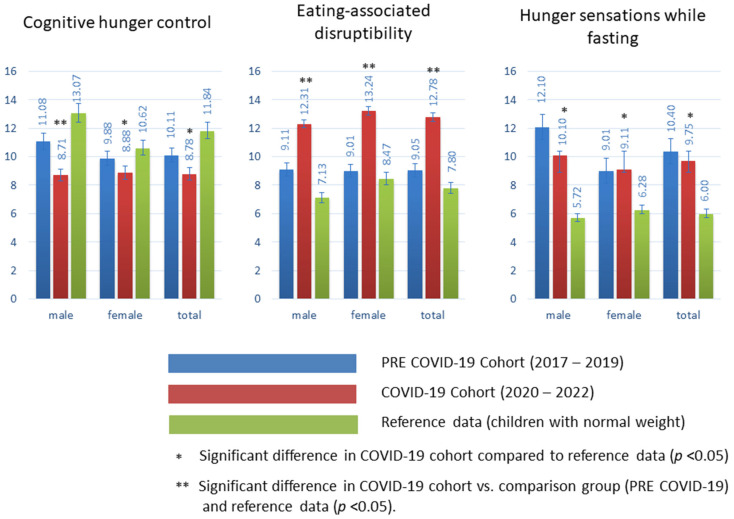
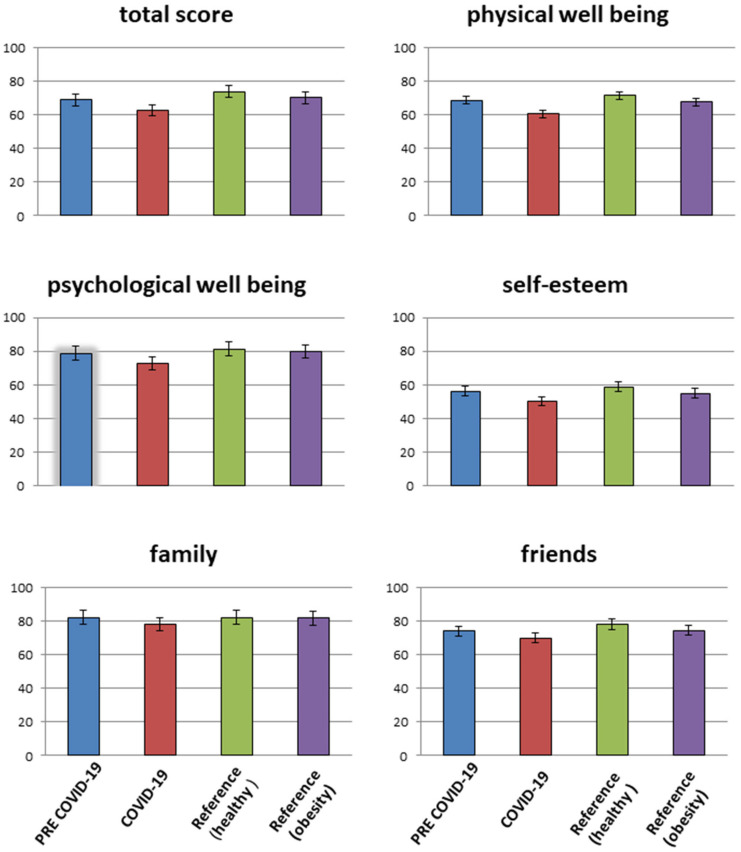
Both study cohorts were comparable in age and sex distribution. Significant differences were found between the COVID-19 and pre-COVID-19 cohorts in HOMA-index (3.8 (interquartile range [IQR])): 3.3; 4.1) vs. 3.2 (IQR: 2.8; 3.5, < 0.001), total cholesterol (208.8 mg/dL (IQR: 189.9; 214.5) vs. 198.5 mg/dL (IQR: 189.5; 207.4), < 0.001), and GPT (93.4 (IQR 88.7; 96.5) vs. 72.8 U/L (IQR 68.9; 75.7), < 0.001). The COVID-19 cohort reported significantly higher consumption of obesity-promoting food components, such as soft drinks, meat, sausages, fast food and delivery food, chocolate, and sweets. There was also a significant decrease in cognitive hunger control ( = 0.002) and an increase in distractibility potential ( = 0.001) while eating. HrQoL was significantly lower in the COVID-19 cohort ( = 0.001).
This study reveals the adverse associations of exposure to the public health measures during the COVID-19 pandemic with nutrition, dietary content, and HrQoL in adolescents with preexisting obesity. These findings underscore the importance of tailored preventive and treatment strategies for addressing the specific challenges of disruptive events such as pandemics, especially in population-based context.
本研究旨在评估 COVID-19 大流行对患有肥胖症的青少年的营养模式、饮食习惯、饮食内容和健康相关生活质量(HrQoL)的影响。
对 264 名患有肥胖症的青少年(2020 年 6 月至 2022 年 6 月)和 265 名患有肥胖症的青少年(2017 年 6 月至 2019 年 6 月)在 COVID-19 大流行期间和之前进行了人体测量和代谢参数测量,并使用经过验证的饮食习惯、营养含量和 HrQoL 问卷进行了调查。
两个研究队列在年龄和性别分布上具有可比性。COVID-19 队列和大流行前队列之间在 HOMA 指数(3.8(四分位距 [IQR]):3.3;4.1)与 3.2(IQR:2.8;3.5,<0.001)、总胆固醇(208.8mg/dL(IQR:189.9;214.5)与 198.5mg/dL(IQR:189.5;207.4),<0.001)和 GPT(93.4(IQR 88.7;96.5)与 72.8U/L(IQR 68.9;75.7),<0.001)方面存在显著差异。COVID-19 队列报告说,他们摄入了更多促进肥胖的食物成分,如软饮料、肉、香肠、快餐和外卖食品、巧克力和糖果。在进食时,他们的认知饥饿控制能力显著下降(=0.002),分心潜力显著增加(=0.001)。COVID-19 队列的 HrQoL 显著降低(=0.001)。
本研究揭示了青少年接触 COVID-19 大流行期间的公共卫生措施与营养、饮食内容和 HrQoL 之间的不良关联。这些发现强调了针对特定挑战的量身定制的预防和治疗策略的重要性,特别是在基于人群的背景下。