Human Biology Division, Fred Hutchinson Cancer Research Center, Seattle, WA, USA.
Vaccine and Infectious Disease Division, Fred Hutchinson Cancer Research Center, Seattle, WA, USA.
Mol Syst Biol. 2021 Sep;17(9):e10426. doi: 10.15252/msb.202110426.
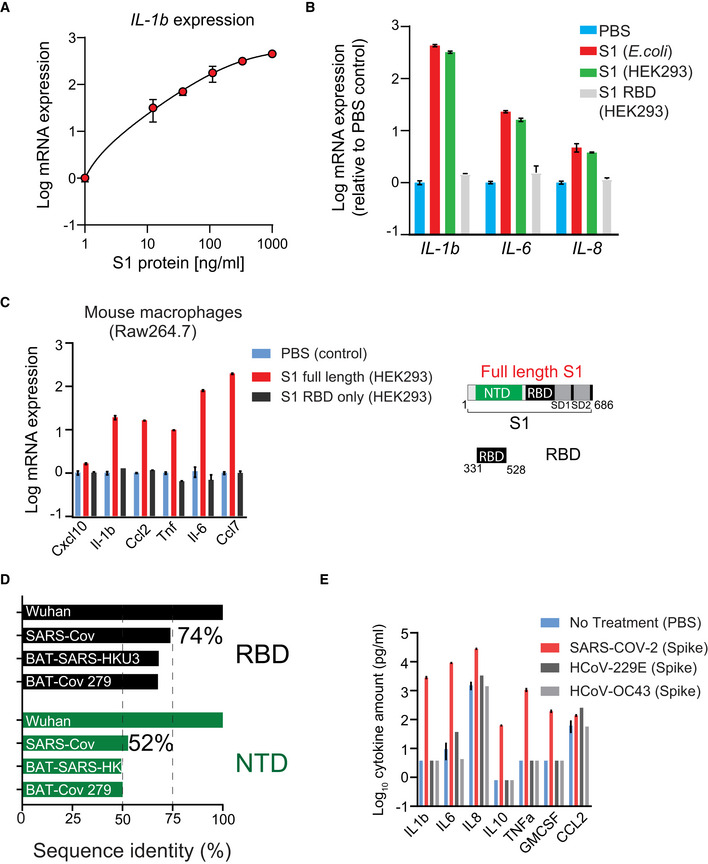
Although 15-20% of COVID-19 patients experience hyper-inflammation induced by massive cytokine production, cellular triggers of this process and strategies to target them remain poorly understood. Here, we show that the N-terminal domain (NTD) of the SARS-CoV-2 spike protein substantially induces multiple inflammatory molecules in myeloid cells and human PBMCs. Using a combination of phenotypic screening with machine learning-based modeling, we identified and experimentally validated several protein kinases, including JAK1, EPHA7, IRAK1, MAPK12, and MAP3K8, as essential downstream mediators of NTD-induced cytokine production, implicating the role of multiple signaling pathways in cytokine release. Further, we found several FDA-approved drugs, including ponatinib, and cobimetinib as potent inhibitors of the NTD-mediated cytokine release. Treatment with ponatinib outperforms other drugs, including dexamethasone and baricitinib, inhibiting all cytokines in response to the NTD from SARS-CoV-2 and emerging variants. Finally, ponatinib treatment inhibits lipopolysaccharide-mediated cytokine release in myeloid cells in vitro and lung inflammation mouse model. Together, we propose that agents targeting multiple kinases required for SARS-CoV-2-mediated cytokine release, such as ponatinib, may represent an attractive therapeutic option for treating moderate to severe COVID-19.
虽然有 15%-20%的 COVID-19 患者会出现由大量细胞因子产生引起的过度炎症反应,但目前仍不清楚该过程的细胞触发因素和靶向这些因素的策略。在这里,我们表明,SARS-CoV-2 刺突蛋白的 N 端结构域(NTD)会在髓样细胞和人 PBMC 中大量诱导多种炎症分子。我们采用表型筛选与基于机器学习的建模相结合的方法,鉴定并实验验证了几种蛋白激酶,包括 JAK1、EPHA7、IRAK1、MAPK12 和 MAP3K8,它们是 NTD 诱导细胞因子产生的必需下游介质,表明多种信号通路在细胞因子释放中发挥作用。此外,我们发现了几种已获 FDA 批准的药物,包括 ponatinib 和 cobimetinib,它们是 NTD 介导的细胞因子释放的有效抑制剂。ponatinib 治疗在抑制 SARS-CoV-2 和新兴变异株的 NTD 介导的细胞因子释放方面优于其他药物,包括地塞米松和 baricitinib。最后,ponatinib 治疗可抑制髓样细胞中 LPS 介导的细胞因子释放和小鼠肺部炎症模型。总之,我们提出,针对 SARS-CoV-2 介导的细胞因子释放所需的多种激酶的药物,如 ponatinib,可能是治疗中重度 COVID-19 的一种有吸引力的治疗选择。