Vijay Siddharth, Gujral Taranjit S
Division of Human Biology, Fred Hutchinson Cancer Research Center, Seattle, WA, USA.
Division of Human Biology, Fred Hutchinson Cancer Research Center, Seattle, WA, USA; Department of Pharmacology, University of Washington, Seattle, WA, USA.
iScience. 2020 May 22;23(5):101129. doi: 10.1016/j.isci.2020.101129. Epub 2020 May 1.
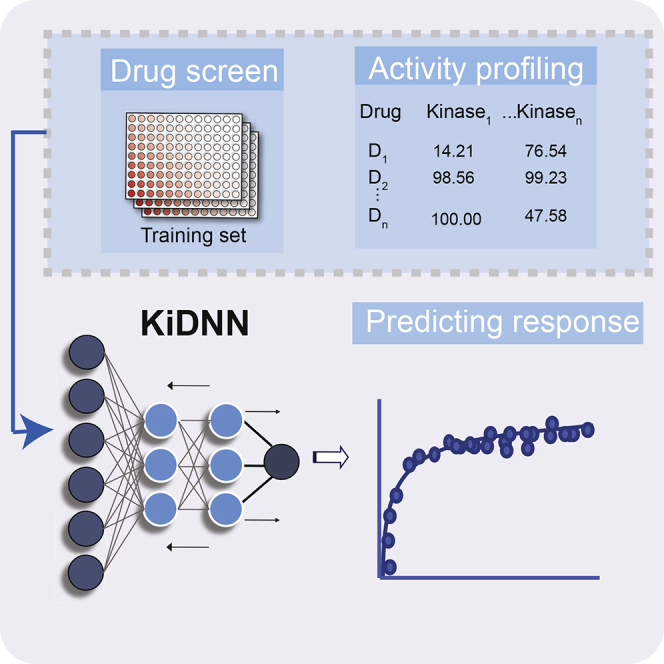
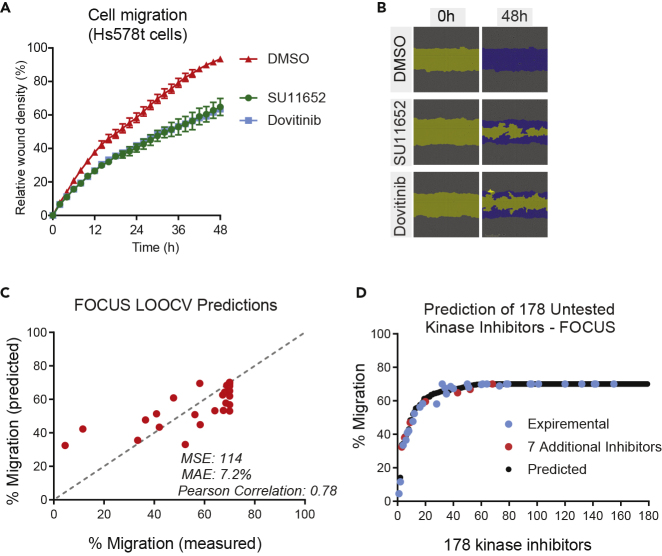
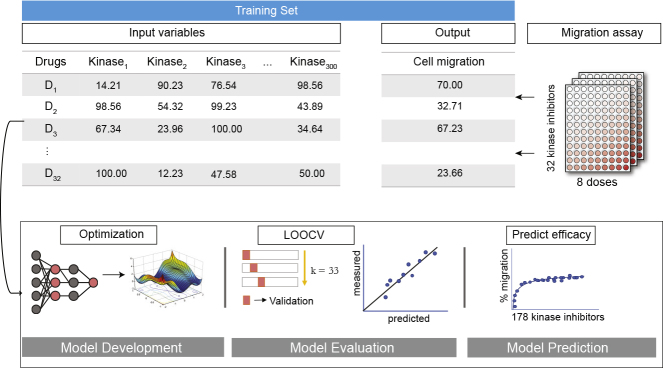
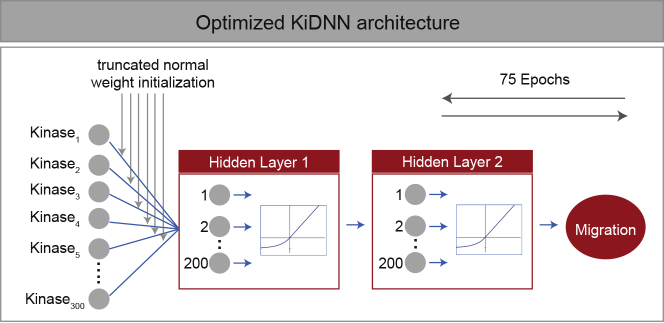
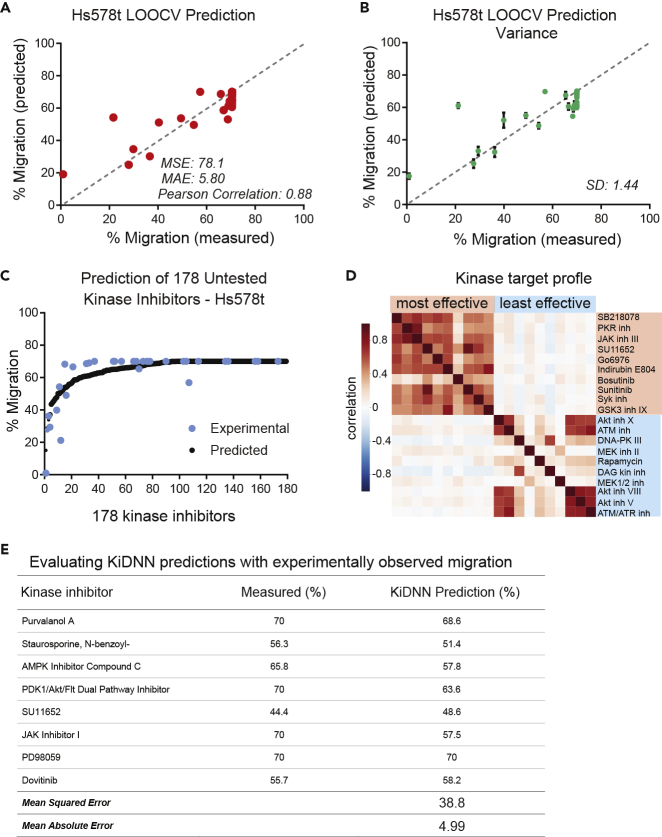
Protein kinase inhibitors are one of the most successful targeted therapies to date. Despite this progress, additional kinase inhibitors are needed to expand the target space as well as overcome drug resistance that has emerged in clinical setting. Here, we developed KiDNN (Kinase inhibitor prediction using Deep Neural Networks). KiDNN utilizes non-linear, multilayer feedforward network that mimics complex and dynamic kinase-driven signaling pathways. We used KiDNN to predict the effect of ∼200 kinase inhibitors on migration of breast and liver cancer cells. We show that the prediction accuracy of KiDNN outperformed other prediction tools based on linear models. We validated that an inhibitor of tyrosine kinase receptors, and an inhibitor of Src family kinases, decreased migration of triple-negative breast cancer cells, consistent with the role of these kinases in driving motility. Overall, we show that non-linear, DNN-based models provide a powerful approach to in silico screen hundreds of kinase inhibitors.
蛋白激酶抑制剂是迄今为止最成功的靶向治疗方法之一。尽管取得了这一进展,但仍需要更多的激酶抑制剂来扩大靶点范围,并克服临床中出现的耐药性。在此,我们开发了KiDNN(使用深度神经网络预测激酶抑制剂)。KiDNN利用非线性多层前馈网络,该网络模仿复杂且动态的激酶驱动信号通路。我们使用KiDNN预测了约200种激酶抑制剂对乳腺癌和肝癌细胞迁移的影响。我们表明,KiDNN的预测准确性优于基于线性模型的其他预测工具。我们验证了酪氨酸激酶受体抑制剂和Src家族激酶抑制剂可降低三阴性乳腺癌细胞的迁移,这与这些激酶在驱动细胞运动中的作用一致。总体而言,我们表明基于深度神经网络的非线性模型为在计算机上筛选数百种激酶抑制剂提供了一种强大的方法。